
Charles Whittlesey
From Socialist to Military Leader
James G. Fausone
Long before Charles White Whittlesey became synonymous with the ordeal of the Lost Battalion, his life followed a trajectory that, on its surface, seemed to point toward a genteel quiet, civilian life. Born on January 20, 1884, in the logging town of Florence, Wisconsin, Whittlesey entered the world at an intersectional time of industrial America’s growth. His father, Frank R. Whittlesey, worked in the lumber trade and later in manufacturing management. The family’s eventual relocation eastward would shape Charles’s temperament as much as his opportunities.
The Early Years
When Whittlesey was about ten years old, the family moved to Pittsfield, Massachusetts, where his father took a position with the General Electric Company. Charles was serious, observant, and intellectually inclined, traits that distinguished him early from his peers. He attended Pittsfield High School, graduating in 1901, already marked as a young man of uncommon discipline and promise. Today he would be called a nerd. He was slim, wore glasses, a socialist intellectual, and was not athletic.
From Pittsfield, Whittlesey advanced to Williams College, a small but demanding institution in the Berkshires. He graduated in 1905, but the significance of his Williams years lies less in the degree itself than in the habits of mind and conscience he developed there. Whittlesey was not a flamboyant student. He did not seek easy popularity. Instead, he earned a reputation for intelligence, restraint, and moral seriousness. Classmates voted him among the brightest in his class, and while such distinctions were informal, they reflected a widely held view that Whittlesey was a man to be taken seriously.
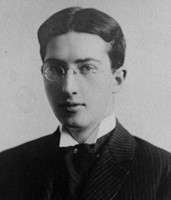
At Williams College, he joined St. Anthony Hall and participated actively in campus life, including student publications. He also encountered ideas that would shape his worldview in complex and sometimes contradictory ways. One of his closest friendships was with someone who would become a prominent socialist writer and editor of The Masses. Whittlesey was exposed to progressive and socialist critiques of American capitalism, militarism, and social inequality. These ideas appealed to his sense of justice and ethical responsibility, even as they sat uneasily with his innate respect for order and duty.
After college, Whittlesey moved on to Harvard Law School, graduating in 1908. Harvard reinforced his analytical rigor and deepened his sense of professional responsibility. Law, for Whittlesey, was not merely a career but a calling—an arena in which intelligence and moral judgment could be brought to bear on the practical problems of society. Upon graduation, he settled in New York City, where he joined an established law firm before eventually forming a partnership with a former Williams classmate.
In New York, Whittlesey lived the life of a young professional on the rise. He was financially comfortable, socially connected, and intellectually engaged. Yet he remained personally reserved, even austere. Friends noted his formality, his careful speech, and his reluctance to indulge in excess. He dressed neatly, spoke precisely, and held himself to standards that others sometimes found severe. He never married. Beneath this exterior, however, lay a deep sensitivity—one that would later exact a heavy toll.
During the years before the First World War, Whittlesey’s political and social commitments continued to evolve. For a time, he joined the Socialist Party, attracted by its emphasis on social justice and its critique of unrestrained power. But he was never a doctrinaire radical. As the international situation darkened and the rhetoric within the socialist movement grew more absolutist, Whittlesey became increasingly uneasy. By around 1915, he withdrew from the party, disillusioned with what he perceived as ideological rigidity and a failure to grapple honestly with the realities of global conflict.
This period marked a turning point. Whittlesey, who had once leaned toward pacifism, began to reconsider the role of force in defending democratic institutions. The outbreak of war in Europe, and particularly the conduct of Imperial Germany, convinced him that moral responsibility could not always be reconciled with nonviolence. Like many educated Americans of his generation, he struggled to reconcile intellectual skepticism with a growing sense of civic obligation.
That struggle found expression in his participation in the Plattsburgh training camps, voluntary military preparedness programs established before the United States formally entered the war. These camps attracted lawyers, businessmen, and professionals who believed that if war came, the nation would need trained officers rather than raw enthusiasm. For Whittlesey, Plattsburgh was not an adventure but a duty. He approached military training with the same seriousness he brought to law and scholarship, absorbing discipline and command not as abstractions but as moral responsibilities.
World War I
By the time the United States entered World War I in 1917, Charles Whittlesey was already prepared—intellectually, physically, and ethically—for service. The man who would later command under impossible circumstances in the Argonne was already fully formed: thoughtful, exacting, deeply principled, and quietly burdened by the belief that leadership meant responsibility without escape. What the war would demand of him, however, was more than preparation could foresee.
Whittlesey was commissioned a captain in May 1917 and assigned to the 308th Infantry Regiment of the newly formed 77th Division. The division, drawn largely from New York City, was a study in contrast: immigrants, laborers, clerks, and professionals thrown together in uniform. Many spoke little English; few had prior military experience. At Camp Upton on Long Island, where the division trained, Whittlesey’s early task was not combat but transformation—turning civilians into soldiers capable of surviving modern warfare.
Training at Camp Upton was compressed and imperfect. Officers were required to master drill, weapons, and field tactics while simultaneously teaching men who had never fired a rifle or marched in formation. Whittlesey distinguished himself by his seriousness and methodical leadership. He demanded discipline but avoided theatrics. His men came to see him as distant yet dependable, a commander who neither cajoled nor bullied, but expected orders to be carried out precisely.
In late 1917, the 77th Division sailed for France as part of the American Expeditionary Forces. There, Whittlesey and his regiment entered a far harsher phase of preparation. The Western Front required adaptation to trench warfare, constant artillery fire, and coordination with Allied forces whose experience dwarfed that of the Americans. The division rotated through quiet sectors to acclimate, learning the routines of patrols, wire cutting, and holding ground under fire. For Whittlesey, this period reinforced his belief that leadership was less about inspiration than steadiness.
By early 1918, Whittlesey had earned promotion to major and was given command of the 1st Battalion, 308th Infantry. Battalion command marked a decisive shift in responsibility. A full-strength battalion would have roughly 1000 soldiers. He now directed several companies, managed logistics under combat conditions, and bore responsibility for hundreds of men. His orders were clear, his demeanor reserved, and his concern for his soldiers evident, though rarely expressed in words. Subordinates later recalled that Whittlesey neither raised his voice nor courted popularity; he led by example and expectation.
The Division’s early combat experience was limited but sobering. The men learned quickly that confusion was constant, communication unreliable, and casualties inevitable. Whittlesey proved adept at navigating uncertainty. He followed orders precisely, resisted improvisation unless absolutely necessary, and impressed superiors with his composure. These traits would soon define his reputation, though at the time they passed largely unnoticed beyond regimental headquarters.
Argonne Forest
In the weeks leading up to the Meuse-Argonne Offensive in the fall of 1918, Whittlesey focused relentlessly on readiness. He studied maps, rehearsed movements, and emphasized adherence to objectives. The Argonne Forest promised difficult terrain, poor visibility, and fragmented command—conditions under which discipline and restraint would matter more than brilliance. Whittlesey was, in many ways, ideally suited to such an environment, though neither he nor his superiors could have anticipated how completely those qualities would be tested.
By the eve of the offensive, Major Charles Whittlesey was no longer a lawyer in uniform, nor merely a trained officer. He had become a professional soldier, shaped by preparation rather than battle, carrying a profound sense of responsibility that would soon place him at the center of one of the war’s most enduring episodes.
The World War I fighting in the Argonne Forest was strategically significant because it sat at the geographic, logistical, and operational heart of the German defensive system on the Western Front. Control of the Argonne was not an isolated objective; it was a prerequisite for breaking the German Army’s ability to sustain the war in France.
Geographically, the Argonne Forest formed a natural barrier between the Meuse River to the east and the Aire River to the west. Dense woods, ravines, and uneven terrain made it ideal for defense and extremely difficult for attackers. For the Germans, the forest anchored a critical sector of the Hindenburg Line’s western extensions, protecting interior lines of communication and limiting Allied maneuver. As long as Germany held the Argonne, Allied forces could not easily advance northward without exposing their flanks.
Logistically, the Argonne protected vital German rail and road networks running through Sedan and Mézières. These routes were essential for moving troops, artillery, and supplies between the German front lines and their industrial base. A successful Allied advance through the Argonne would threaten to sever these supply arteries, forcing German withdrawals across a broad front. In practical terms, the Argonne was the gateway to the German rear.
Operationally, the Argonne was central to the Allies’ endgame strategy in 1918. The Meuse-Argonne Offensive was designed as a sustained, attritional push that would deny Germany the ability to regroup or redeploy forces. For the United States Army, it was also the largest and most consequential operation it undertook during the war. American divisions were tasked with advancing through terrain the Germans believed nearly impassable, thereby demonstrating both resolve and mass.
Finally, the battle’s strategic importance lay in its cumulative effect. Though progress was slow and casualties heavy, Allied pressure in the Argonne fixed German forces in place while parallel offensives elsewhere collapsed the broader German position. The loss of the Argonne undermined German defensive coherence and accelerated the conditions that led to the Armistice in November 1918.
The Lost Battalion
The episode that became known as the battle of the Lost Battalion stands as one of the most severe and emblematic trials faced by American forces in World War I. Fought over five days in early October 1918 during the Meuse–Argonne Offensive, the engagement combined strategic overreach, brutal terrain, and relentless German resistance into a crucible that tested endurance more than tactics. Its outcome was not a conventional victory, but a demonstration of survival under conditions approaching annihilation.
On October 2, 1918, elements of the U.S. 77th Division were ordered to advance through the dense Argonne Forest. The division’s objective was to push forward aggressively, assuming that French and American units on either flank would keep pace. Major Charles Whittlesey, commanding the 1st Battalion of the 308th Infantry, along with attached elements of the 307th Infantry, moved ahead as ordered. In total, approximately 550 men under Whittlesey’s command advanced into a ravine surrounded by high ground—terrain ideally suited for German defensive fire.
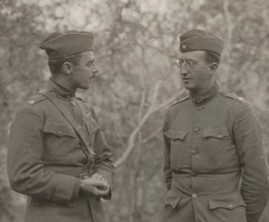
Almost immediately, the assumptions underlying the attack collapsed. Units on both flanks were halted by heavy resistance and failed to advance, leaving Whittlesey’s force dangerously exposed. German troops quickly recognized the opportunity and encircled the Americans with machine-gun nests, artillery, and snipers positioned on the surrounding ridges. Within hours, the battalion was cut off from resupply, reinforcement, and reliable communication.
Five days of sustained brutality followed. German forces launched repeated infantry assaults, probing for weaknesses and attempting to force surrender. Artillery fire rained down on the ravine, compounding casualties and destroying what little cover existed. The Americans, short on ammunition, food, and medical supplies, dug in where they stood. Wounded men lay untreated, water ran out, and rations dwindled to nothing. Some soldiers survived on leaves and muddy water scooped from shell holes.
Casualties mounted rapidly. Of the roughly 550 men who entered the ravine, more than half were killed or wounded during the encirclement. By the end of the ordeal, approximately 107 were dead and nearly 200 wounded, leaving fewer than 200 men capable of bearing arms. Losses among officers were especially severe, further straining command and control. Despite this, discipline largely held. Whittlesey and his remaining officers imposed fire control, forbidding wasteful shooting and reserving ammunition for direct assaults.
Communication and Coordination
One of the most tragic elements of the battle was the failure of American artillery coordination. Unable to communicate effectively with higher headquarters, the Lost Battalion was subjected to friendly fire from U.S. artillery batteries attempting to dislodge German positions. (The battalion was not lost, but a newspaper article gave it that name, which stuck.) Whittlesey sent multiple runners and carrier pigeons with pleas to lift the artillery barrage. All were killed or captured en route. By the end, the damage had already been done.
An essential and often overlooked dimension of the Lost Battalion’s ordeal was the desperate reliance on carrier pigeons for communication, most famously embodied by the bird known as Cher Ami. By the second day of the encirclement, all conventional means of communication had failed. Telephone wires were severed by shellfire, runners were killed attempting to pass through German lines, and visual signaling was impossible in the dense forest and constant smoke. Pigeons became the battalion’s last tenuous link to higher command.
Several pigeons were released with messages describing the battalion’s position and condition. Most never returned. Some were shot down; others were likely disoriented or killed by artillery blasts. The loss of these birds deepened the battalion’s isolation and contributed directly to one of the engagement’s most tragic episodes: sustained friendly artillery fire. American gunners, unaware of Whittlesey’s exact location or given faulty coordinates, shelled the ravine in an attempt to dislodge German forces, inflicting further casualties on the trapped Americans.
On October 4, 1918, with the situation critical, Whittlesey authorized the release of the final pigeon. Despite being shot through the breast, blinded in one eye, and having a leg nearly severed, Cher Ami flew approximately 25 miles back to division headquarters with a message identifying the battalion’s coordinates and pleading for the artillery barrage to stop. The artillery fire was redirected, saving what remained of the force.
Cher Ami’s flight did not end the battle, but it prevented further catastrophic losses. The pigeon’s survival became emblematic of the fragile thread by which the Lost Battalion endured, and of how, amid industrial slaughter, the fate of hundreds could hinge on a single, wounded bird. Cheri Ami today is on display at the Smithsonian Museum.
German psychological warfare added to the pressure. Enemy officers sent messages offering honorable surrender, citing the hopelessness of the Americans’ position. Whittlesey refused. His now-famous response—never formally written but widely paraphrased—reflected a simple reality: surrender was not an option he would entertain. For the men under his command, the choice was endurance or death.
Survival
The fifth day marked the breaking point. By October 7, survivors were exhausted, starving, and barely able to repel further attacks. At that moment, elements of the 77th Division finally succeeded in fighting through German lines and reached the encircled force. Relief came not as triumph but as grim reckoning. The survivors emerged emaciated, shell-shocked, and deeply altered. Many were unable to speak; others collapsed upon rescue.
The conclusion of the Lost Battalion battle carried consequences beyond the immediate tactical situation. Strategically, the Americans had held ground that the Germans considered critical, contributing to the broader Allied pressure in the Argonne. Tactically, the episode exposed flaws in coordination, communication, and assumptions about enemy withdrawal. It left scars that would never fully heal.
In the aftermath, the Lost Battalion became a symbol of American resolve. Whittlesey was promoted and awarded the Medal of Honor, as were several of his men. Newspapers celebrated the episode as an unambiguous triumph. Yet for those who survived, the legacy was more complex. The battle was not remembered as a victory in the conventional sense, but as an ordeal survived at immense cost.
The five-day encirclement in the Argonne Forest demonstrated both the brutality of modern industrial warfare and the limits of human endurance. The Lost Battalion did not break through enemy lines or destroy German formations. Instead, it endured—isolated, battered, and bleeding—until relief arrived. In that endurance lay its significance, and in its casualties lay the true measure of the price paid.
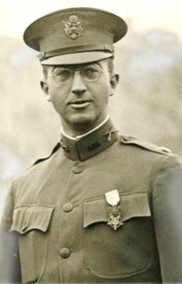
The ordeal of the Lost Battalion in the Argonne Forest produced not only staggering casualties but some of the most extraordinary acts of valor in American military history. The Medal of Honor awards that emerged from those five days of isolation reflected both the ground combat endured in the ravine and the desperate efforts from the air to sustain men who were otherwise condemned to destruction.
At the center stood Major Charles White Whittlesey, whose leadership defined the battalion’s survival. From October 2 to October 7, 1918, Whittlesey commanded a surrounded force cut off from food, water, ammunition, and medical aid. Under constant artillery and machine-gun fire, he maintained discipline, controlled ammunition expenditure, and refused repeated German demands to surrender. His courage was not expressed through dramatic gestures but through endurance and command presence. Whittlesey’s Medal of Honor recognized the moral weight of leadership under conditions where collapse would have been understandable, if not expected.
Whittlesey received the Medal of Honor on December 24, 1918, from Major General Clarence Edwards. It was presented to Whittlesey on the Boston Commons. The brief citation, even by Army standards, simply reads:
Although cut off for five days from the remainder of his division, Maj. Whittlesey maintained his position, which he had reached under orders received for an advance, and held his command, consisting originally of 46 officers and men of the 308th Infantry and of Company K, of the 307th Infantry, together in the face of superior numbers of the enemy during the five days. Maj. Whittlesey and his command were cut off, and no rations or other supplies reached him, in spite of determined efforts which were made by his division. On the fourth day Maj. Whittlesey received from the enemy a written proposition to surrender, which he treated with contempt, although he was at the time out of rations and had suffered a loss of about 50 percent in killed and wounded of his command and was surrounded by the enemy.
Whittlesey was not alone in bearing that burden of survival. Captain George G. McMurtry, serving as second-in-command, played a critical role in sustaining the defense. Wounded during the encirclement, McMurtry continued to direct operations, coordinate firing sectors, and assist in maintaining order among exhausted troops. His calm persistence under fire and willingness to share responsibility for impossible decisions earned him the Medal of Honor alongside his commander.
On the battalion’s flank, Captain Nelson M. Holderman of the 307th Infantry exemplified personal bravery. Exposed repeatedly to enemy fire, Holderman moved among his men to steady positions, encourage resistance, and aid the wounded despite being wounded himself. His actions demonstrated the essential link between leadership and proximity in close combat, where authority was measured in presence rather than rank. He also received the Medal of Honor.
Valor also took quieter forms. Private Archie A. Peck distinguished himself by repeatedly leaving cover to rescue wounded comrades under heavy machine-gun fire. In a battle defined by attrition, Peck’s actions reflected a refusal to abandon fellow soldiers even when survival demanded self-preservation. His Medal of Honor honored individual sacrifice within collective suffering.
Above the forest, courage assumed a different form. First Lieutenant Harold Ernest Goettler and Second Lieutenant Erwin R. Bleckley undertook repeated low-altitude flights to locate and resupply the Lost Battalion. Flying directly into intense German ground fire, they attempted to drop food and ammunition to the encircled troops. On their final mission, their aircraft was fatally struck, killing both men. Their posthumous Medals of Honor recognized that the battle extended beyond the ravine into the skies above it.
Together, these awards illustrate the full scope of the Lost Battalion’s ordeal—leadership, endurance, selflessness, and sacrifice on the ground and in the air- each contributing to a legacy defined not by victory, but by honor sustained under siege.
Last Chapter
For Charles White Whittlesey, the war did not end with the Armistice. When the guns fell silent on November 11, 1918, he returned to a country eager for heroes and reassurance, but ill-equipped to understand what prolonged survival under modern warfare had done to those it celebrated. Whittlesey, elevated almost overnight from obscure major to national figure, bore his fame as another burden rather than a reward.
In the months following the war, Whittlesey was promoted to lieutenant colonel and formally awarded the Medal of Honor. Public ceremonies followed. He marched in parades, stood on reviewing platforms, and was repeatedly called upon to recount the story of the Lost Battalion. Newspapers framed the episode as a triumph of American grit and unbreakable morale. Whittlesey complied outwardly, but those close to him noted his growing discomfort. He resisted embellishment, corrected inaccuracies, and refused to glorify suffering. The narrative demanded by the public bore little resemblance to his own memories.
He returned briefly to civilian life, resuming legal practice in New York. Yet the transition proved difficult. The discipline and moral clarity that had sustained him in combat offered little guidance in peacetime routine. He struggled with insomnia, emotional withdrawal, and what would now be recognized as severe post-traumatic stress. Loud noises unsettled him. Crowds exhausted him. The gap between public adulation and private anguish widened with each retelling of the battle he wished to forget.
Whittlesey never married. He maintained friendships, particularly with former comrades, but even among them he was reserved. The Lost Battalion survivors shared a bond forged in extremity, yet many sensed that Whittlesey carried a heavier weight. As commander, he had made decisions that lived on in his memory—choices that meant survival for some and death for others. Praise offered no relief from that accounting.
In the early 1920s, Whittlesey accepted a position with the American Legion and later worked with veterans’ organizations, advocating for those struggling to reintegrate into civilian life. The work aligned with his sense of duty, but it also kept him tethered to the war. He found himself repeatedly confronted by reminders of what he could not escape. His health deteriorated. Friends described him as increasingly withdrawn, prone to long silences and bouts of melancholy.
The public, however, continued to demand his presence. He was asked to speak at memorials, dedications, and anniversaries. Each appearance reopened wounds. Whittlesey declined as many invitations as he could, but the Medal of Honor carried obligations he felt unable to refuse. The symbol had eclipsed the man.
By 1927, signs of profound distress were unmistakable. Whittlesey confided to a few close friends that he felt worn down, unable to reconcile his inner life with the role imposed upon him. He spoke of exhaustion rather than despair, of being “tired” in a way that suggested finality. Yet in an era that lacked language for psychological injury, such signals went largely unaddressed.
That January, Whittlesey boarded the passenger ship SS Toloa in New York, bound for Havana. Officially, the voyage was described as a respite- a change of climate, a chance to recover his health. On January 26, 1927, during the night, Whittlesey left his cabin, placed his Medal of Honor and personal effects neatly behind, and went overboard into the Atlantic. His body was never recovered.
The circumstances of his death were quietly acknowledged but rarely discussed in detail. The Navy ruled it a suicide, though the word itself was often avoided. Newspapers reported the loss with restraint, framing it as a tragic end to a heroic life. For many veterans, the meaning was clearer. Whittlesey had survived what few could endure, only to be undone by the years of guilt that followed.
Today, Whittlesey is remembered as the commander of the Lost Battalion, a symbol of courage under fire. Yet his life after the war reminds us that survival is not always synonymous with victory. For some, the most enduring struggle begins only after the fighting ends.
For those who survived the Argonne and lived to wear the Medal of Honor, the decoration was both recognition and burden. Unlike Charles Whittlesey, whose life ended in quiet tragedy, several of his fellow recipients carried the memory of the Lost Battalion across long civilian lives, each in markedly different ways. Yet for George McMurtry, Archie Peck, and Nelson Holderman, the medal remained an inseparable companion—visible, symbolic, and inescapable.
Captain George G. McMurtry emerged from the Argonne physically wounded but psychologically resilient. As Whittlesey’s deputy during the encirclement, McMurtry shared command responsibility under the most punishing conditions imaginable. After the war, he returned to civilian life and pursued a career in business and public service. Unlike Whittlesey, McMurtry was more willing to speak publicly about the Lost Battalion, though he did so with restraint. He attended reunions, commemorations, and veterans’ events, viewing the Medal of Honor not as a personal distinction but as a tribute to collective endurance. McMurtry lived a long life, dying in 1968, and remained until the end a measured, disciplined figure who carried the memory of the Argonne without allowing it to define his entire identity.
Captain Nelson M. Holderman followed yet another path. Wounded repeatedly during the Argonne, Holderman pursued a military and educational career after the war. He remained active in veterans’ affairs and public service, embracing the responsibilities that accompanied his Medal of Honor. Holderman became a respected speaker and advocate, particularly for remembrance and military history. He died in 1944, still closely associated with the values of duty and service that had defined his conduct in combat.
Private Archie A. Peck represented a different trajectory. A working-class soldier before the war, Peck returned to civilian life with limited financial security and few opportunities. His Medal of Honor elevated him briefly into the national spotlight, but the attention faded quickly. Peck struggled with the transition back to ordinary labor and suffered lasting physical effects from the war. Unlike officers who could leverage status and connections, Peck lived quietly and, at times, precariously. He died in 1943, largely outside public notice, his heroism remembered primarily by veterans’ organizations and local commemorations. His life illustrated how honor did not guarantee comfort, nor recognition ensure stability.
Together, McMurtry, Holderman, and Peck demonstrated that surviving valor and guilt carried no single outcome. Each wore the Medal of Honor differently—quietly, uneasily, or publicly—but all bore its weight. Their lives remind us that heroism does not conclude with survival, and that the true cost of honor is often paid long after the battlefield has fallen silent.
There are many books and movies that explore the stories of the Lost Battalion, Whittelsey, and Cher Ami. The men of the Lost Battalion, a group of men with many languages, cultures, and life experiences, weathered the worst that the German Army could mount.
About James G. Fausone, Esq.
James G. Fausone, Esq. is a partner with Legal Help For Veterans, PLLC, with over twenty years of experience helping veterans apply for service-connected disability benefits and starting their claims, appealing VA decisions, and filing claims for an increased disability rating so veterans can receive a higher level of benefits.
If you were denied service connection or benefits for any service-connected disease, our firm can help. We can also put you and your family in touch with other critical resources to ensure you receive the treatment you deserve.
Give us a call at (800) 693-4800 or visit us online at www.LegalHelpForVeterans.com.
This electronic book is available for free download and printing from www.homeofheroes.com. You may print and distribute in quantity for all non-profit, and educational purposes.
Copyright © 2018 by Legal Help for Veterans, PLLC
ALL RIGHTS RESERVED