
Dewayne Thomas Williams
A Short Life of Courage & Sacrifice
James G. Fausone
Among the thousands of young Americans who answered their nation’s call during the Vietnam War, few would leave behind a legacy as profound as that of Marine Private First Class Dewayne Thomas Williams. Though his life lasted only nineteen years, his final act of selfless courage on a battlefield in Vietnam secured his place among the most honored heroes in American military history. By sacrificing himself to save his fellow Marines, Williams embodied the highest traditions of the United States Marine Corps and the ideals represented by the Medal of Honor.
His story is not one of a long military career or decades of public service after the war. Instead, it is the story of a small-town Michigan boy who came of age during one of the most turbulent periods in American history and who, when confronted with a moment of life-and-death decision, chose the welfare of others over his own survival.
Born on September 18, 1949, in Brown City, Michigan, Dewayne Thomas Williams grew up in the communities of St. Clair County during the post-World War II era. The nation was experiencing unprecedented prosperity, but the communities along Michigan’s eastern shoreline retained the values that had long characterized Midwestern America: hard work, patriotism, family, and service.
Williams spent his childhood moving between St. Clair and Capac, attending Bell Elementary School and later St. Clair schools before eventually attending Capac High School. Those who knew him remembered a quiet young man who did not seek attention or acclaim. He was not known as a loud or boastful individual. Rather, he possessed the steady demeanor and dependable character that often defines people who later perform extraordinary deeds.
As Williams entered his teenage years, the United States found itself increasingly embroiled in the conflict in Southeast Asia. What had begun as an advisory effort in Vietnam expanded dramatically during the 1960s. By the time Williams was nearing adulthood, hundreds of thousands of American service members were deployed overseas. Nightly television broadcasts brought images of combat into American living rooms. Young men throughout the nation faced decisions about military service amid a climate of political debate and social unrest.
Joining Up
Unlike many who sought deferments or attempted to avoid military service, Williams chose to serve. On December 18, 1967, at only eighteen years of age, he enlisted in the United States Marine Corps Reserve. Less than three weeks later, on January 2, 1968, he was discharged from the reserve component so that he could enlist in the Regular Marine Corps and enter active duty. It was a significant commitment. The Marine Corps was widely regarded as the most demanding branch of military service, and combat deployments to Vietnam were almost certain for newly trained infantry Marines.
Williams reported to Marine Corps Recruit Depot San Diego, California, where he underwent the rigorous transformation from civilian to Marine. In 1968, Marine boot camp was designed to build physical endurance, mental toughness, discipline, and unit cohesion. Drill instructors demanded perfection and relentlessly pushed recruits beyond what they believed they could accomplish. Upon graduation in March 1968, Williams had earned the title Marine, joining a brotherhood whose traditions stretched back to the founding of the Corps in 1775.
His training continued at Camp Pendleton, California. There, he completed individual combat training and advanced infantry instruction. These courses focused on weapons proficiency, patrolling, field tactics, and survival skills. Every Marine is fundamentally a rifleman, and the training emphasized aggressive infantry combat. On June 1, 1968, he was promoted to Private First Class, reflecting satisfactory performance and growing responsibility within the Corps.
The timing of his deployment could not have been more consequential. The year 1968 was one of the bloodiest and most difficult years of the Vietnam War. Earlier that year, communist forces had launched the massive Tet Offensive, attacking cities and military installations across South Vietnam. Although American and South Vietnamese forces eventually repelled the offensive, the fighting demonstrated the enemy’s resilience and determination. U.S. Marines in particular bore a heavy burden during the campaign, fighting some of the war’s fiercest battles.
Williams arrived in Vietnam later in June 1968 and was assigned as an automatic rifleman with Company I, 3rd Battalion, 27th Marines, part of the 1st Marine Division. The division operated extensively in the I Corps Tactical Zone, the northernmost region of South Vietnam, and one of the most contested areas of the conflict. Marines there faced a determined enemy that utilized ambushes, mines, booby traps, snipers, and conventional infantry attacks.
Life for a Marine infantryman in Vietnam was physically exhausting and psychologically demanding. Patrols through dense jungle and rice paddies often lasted days. Temperatures soared, humidity was relentless, and every movement carried the risk of enemy contact. Unlike traditional battlefields with clearly defined front lines, Vietnam’s combat environment was fluid and unpredictable. An apparently quiet area could suddenly erupt in violence.
In August 1968, Williams received a new assignment as an anti-tank assaultman with Company H, 2nd Battalion, 1st Marines, also part of the 1st Marine Division. The reassignment placed him in another combat unit engaged in aggressive operations against the North Vietnamese Army and Viet Cong forces in Quang Nam Province. This region, located south of Da Nang, witnessed continuous fighting throughout the war due to its strategic importance and proximity to enemy infiltration routes. By September 1968, Williams had spent only a few months in Vietnam, yet those months exposed him to the realities of combat that many Americans would never experience. The young Marine who had left Michigan earlier that year had matured quickly under the pressures of war.
Birthday and Day of Death
On September 18, 1968, Williams celebrated his nineteenth birthday. It would also be the final day of his life.
That day, he was a member of a five-man combat patrol often referred to as a “killer team.” Such small patrols operated independently, seeking enemy snipers and reconnaissance elements that threatened larger Marine formations. Their mission required stealth, initiative, and courage. Working far from immediate support, these patrols frequently found themselves vulnerable if discovered by enemy forces.
As daylight faded in Quang Nam Province, Williams and the other Marines prepared to move from their concealed daytime position to a planned nighttime location. Darkness in Vietnam often heightened danger. Visibility decreased, communications became more difficult, and enemy forces frequently used the cover of night to conduct attacks.
Suddenly, the patrol was ambushed by a North Vietnamese force armed with small arms and grenades. The attack was intense and close. Enemy fire erupted into the patrol’s position, creating confusion and immediate casualties. Williams was struck in the back and seriously wounded during the opening moments of the engagement. For many soldiers, such a wound would have ended participation in the fight. Survival instinct alone might have compelled a wounded man to seek shelter and await assistance.
Williams reacted differently.
Recognizing the peril facing his fellow Marines, he began crawling toward a position from which he could effectively return fire. Despite severe wounds and continuing enemy fire, he sought to contribute to the defense of the patrol. His concern was not for his own safety but for the success of the mission and the survival of his comrades. Then came the moment that would define his legacy.
Amid the chaos of the firefight, a Marine shouted a warning. An enemy grenade had landed within their position. In the confined space occupied by the patrol, the explosion threatened to kill or seriously wound multiple Marines. There was little time to react. The interval between the warning and detonation was measured in seconds.
During the Vietnam War, and particularly around the intense fighting of 1968 (the year of the Tet Offensive), the People’s Army of Vietnam (PAVN/NVA) and their Viet Cong (VC) allies utilized a diverse mix of hand grenades. Because North Vietnam relied heavily on foreign military aid, its inventory was dominated by Soviet-designed and Chinese-manufactured ordnance, supplemented by locally improvised explosives. By far the most common grenades encountered by U.S. and allied forces were Chinese-supplied “stick” style grenades, heavily influenced by older German designs. For conventional, egg-shaped fragmentation grenades, the NVA utilized long-serving Soviet designs and their direct Chinese copies. NVA infantry routinely encountered American armored personnel carriers (like the M113) and tanks, requiring specialized, hand-thrown armor-piercing ordnance.
The type of grenade mattered as to its kill radius. In the Vietnam War, the American slang term “chicken stick” referred to Chinese Communist stick grenades (commonly the Type 67 hand grenade). These defensive stick grenades had an extremely localized lethal blast radius of just 1.5 to 2 meters (about 5 to 6 feet), though fragmentation could occasionally cause casualties up to 15 meters away. The “chicken stick” or Chicom grenade was heavily used by Viet Cong and NVA forces. It would detonate 3-4 seconds after triggering. Compared to U.S. fragmentation grenades of the era (like the M26 or M67), which had a standard 5-meter kill radius, the Chicom stick grenade featured a smaller explosive charge and a reputation for inconsistent manufacturing, resulting in a notably smaller lethality zone or a high dud rate.
Williams saw the grenade lying near him. What Williams did next was an act of conscious, deliberate heroism. Without hesitation, he rolled his wounded body onto the grenade. The explosion occurred beneath him. By absorbing the full force of the blast, Williams shielded the other members of the patrol from deadly fragmentation and overpressure. He knowingly sacrificed his life so that others might live.
His action accomplished exactly what he intended. The surviving Marines were able to continue fighting, repel the attackers, and maintain their position until reinforcement arrived. Had Williams not acted, the grenade likely would have inflicted devastating casualties upon the patrol. Instead, one Marine gave everything so that several others could return home.
Military history contains many examples of soldiers, sailors, airmen, and Marines sacrificing themselves to save others. Yet each instance remains extraordinary because it requires an individual to make an almost unimaginable choice. Human beings naturally seek survival. To consciously place oneself between a deadly explosive and fellow service members represents a level of courage that transcends ordinary understanding. Such actions explain why the Medal of Honor remains the nation’s highest award for valor.
Williams’ Medal of Honor citation recognized his “conspicuous gallantry and intrepidity at the risk of his life above and beyond the call of duty.” Those words have become familiar through generations of military awards, but in Williams’ case, they accurately describe the magnitude of his sacrifice. His actions were not merely brave; they were entirely selfless. He knowingly accepted certain death to protect others.
News of his death traveled from the battlefields of Vietnam back to Michigan, where family, friends, and community members mourned the loss of a young man whose life had barely begun. Williams was not married and had no children. His parents and siblings became the guardians of his memory, carrying the burden shared by countless American families whose loved ones never returned from war.
Medal of Honor
The Marine Corps and the nation soon recognized the extraordinary nature of his heroism. Following a thorough review of the circumstances surrounding the action, Williams was approved for the Medal of Honor. On April 20, 1970, his family traveled to the White House, where Vice President Spiro T. Agnew presented the nation’s highest military decoration on behalf of President Richard Nixon. The ceremony symbolized not only national gratitude but also national sorrow, for the medal could only be awarded because Williams was no longer alive to receive it himself.
Vice President Agnew understood the sacrifice that Williams made that day. Agnew served in WWII and in Korea. Agnew was drafted into the Army after Pearl Harbor and was deployed in Europe, fighting in France and Germany, including the Battle of the Bulge. He earned a Bronze Star, and in Korea, he served stateside, ultimately honorably discharged as a Captain.
Dewayne Thomas Williams’ Medal of Honor citation reads:
For conspicuous gallantry and intrepidity at the risk of his life above and beyond the call of duty while serving as a rifleman with the 1st Platoon, Company H, in action against communist insurgent forces. Pfc. Williams was a member of a combat patrol sent out from the platoon with the mission of establishing positions in the company’s area of operations from which it could intercept and destroy enemy sniper teams operating in the area. In the night as the patrol was preparing to move from its daylight position to a preselected night position, it was attacked from ambush by a squad of enemy using small arms and hand grenades. Although severely wounded in the back by the close intense fire, Pfc. Williams, recognizing the danger to the patrol, immediately began to crawl forward toward a good firing position. While he was moving under the continuing intense fire, he heard one of the members of the patrol sound the alert that an enemy grenade had landed in their position. Reacting instantly to the alert, he saw that the grenade had landed close to where he was lying and without hesitation, in a valiant act of heroism, rolled on top of the grenade as it exploded, absorbing the full and tremendous impact of the explosion with his body. Through his extraordinary initiative and inspiring valor in the face of certain death, he saved the other members of his patrol from serious injury and possible loss of life, and enabled them to successfully defeat the attackers and hold their position until assistance arrived. His personal heroism and devotion to duty upheld the highest traditions of the Marine Corps and the U.S. Naval Service. He gallantly gave his life for his country.
In addition to the Medal of Honor, Williams received the Purple Heart, National Defense Service Medal, Vietnam Service Medal with two bronze service stars, and the Republic of Vietnam Campaign Medal. These decorations reflected both his service and the sacrifice he made in combat.
Posthumous Recognitions
Over the decades following the Vietnam War, Williams’ legacy continued to grow. Communities in Michigan worked diligently to ensure that future generations would know his story. A section of Interstate 69 stretching across eastern Michigan was designated the DeWayne T. Williams Memorial Highway, permanently linking his name to the region where he was raised. Travelers who pass along that roadway encounter a reminder that one of Michigan’s sons gave his life in service to the nation.
The U.S. Navy further honored him by naming a maritime prepositioning vessel, the USNS PFC Dewayne T. Williams (T-AK-3009), in his memory. For decades, the ship supported military operations and humanitarian missions around the world, carrying forward the name of the young Marine whose courage represented the finest traditions of naval service.
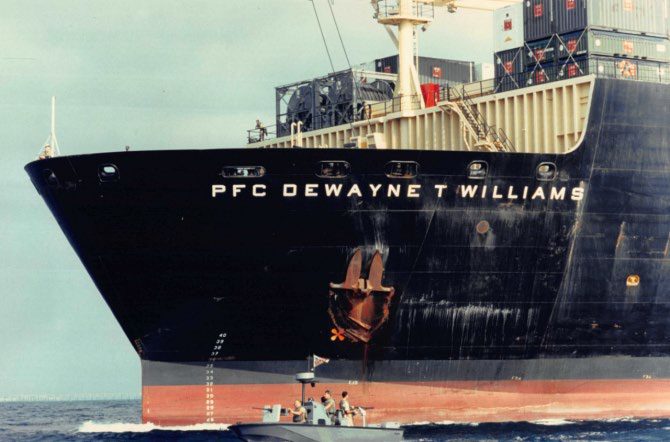
(U.S. Coast Guard Photograph, USCG Historian’s Office).
His memory is also preserved at the Michigan Heroes Museum in Frankenmuth, where his Medal of Honor is displayed. Visitors who view the decoration encounter not merely a medal but a story of sacrifice and duty.
The Vietnam Veterans Memorial in Washington, D.C., likewise, bears his name on Panel 43W, Line 25, ensuring that he remains forever among the more than 58,000 Americans who lost their lives during the conflict.
Perhaps most significant is the way Williams’ story continues to resonate within the Marine Corps. Marines study examples of battlefield leadership and heroism not simply to remember history but to understand the values expected of them. Williams demonstrated devotion to comrades, courage under fire, and selfless service in their purest forms. His example teaches that heroism is not necessarily the product of rank, experience, or age. At nineteen years old, having served only months in combat, he displayed a level of character that continues to inspire generations.
Today, more than half a century after his death, Dewayne Thomas Williams remains one of Michigan’s most revered military heroes. His life was brief, but its impact has endured. In a remote corner of Quang Nam Province, amid the violence and uncertainty of war, a wounded young Marine made a choice that saved the lives of others. That decision transformed an ordinary combat patrol into a story of extraordinary valor.
The measure of a life is not always found in its length. Sometimes it is found in a single moment when character, courage, and duty converge. For Dewayne Thomas Williams, that moment came on his nineteenth birthday. In those final seconds, he demonstrated the highest ideals of the United States Marine Corps and the nation he served.
His story remains a testament to sacrifice, a reminder of the costs of war, and an enduring example of what it means to place the lives of others before one’s own. For that reason, the name Dewayne Thomas Williams will forever occupy a place of honor in the history of the Marine Corps, the State of Michigan, and the United States of America.
About James G. Fausone, Esq.
James G. Fausone, Esq. is a partner with Legal Help For Veterans, PLLC, with over twenty years of experience helping veterans apply for service-connected disability benefits and starting their claims, appealing VA decisions, and filing claims for an increased disability rating so veterans can receive a higher level of benefits.
If you were denied service connection or benefits for any service-connected disease, our firm can help. We can also put you and your family in touch with other critical resources to ensure you receive the treatment you deserve.
Give us a call at (800) 693-4800 or visit us online at www.LegalHelpForVeterans.com.
This electronic book is available for free download and printing from www.homeofheroes.com. You may print and distribute in quantity for all non-profit, and educational purposes.
Copyright © 2018 by Legal Help for Veterans, PLLC
ALL RIGHTS RESERVED