
George Ham Cannon
Michigan's First WWII Marine MOH Recipient
James G. Fausone
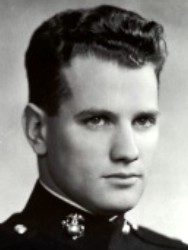
(Public Domain, via Wikipedia.org)
George Ham Cannon, a young Marine officer educated in Michigan and trained for leadership from an early age, sacrificed his own life on December 7, 1941, during the Japanese attack on Midway Island. Refusing evacuation despite mortal wounds, he remained at his post directing the defense of his command and ensuring the safety of his men. His actions made him the first United States Marine of World War II to receive the Medal of Honor.
Although his life was tragically brief, Cannon’s story reflects the ideals of duty, courage, education, and selfless service. His journey from a Midwestern childhood to the battlefields of the Pacific reveals the development of a remarkable young leader whose legacy continues to inspire Marines and Americans alike.
Early Life and Family Background
George Ham Cannon was born on November 5, 1915, in Webster Groves, a suburban community near St. Louis. He was the son of Benjamin Cannon and Charlotte Estelle Ham Cannon. He was one of three children in the family. His father died of appendicitis in 1931 when George was 15. During his childhood, the Cannon family relocated to Detroit, Michigan, a city experiencing tremendous growth due to the expanding automobile industry.
Growing up in Detroit during the 1920s exposed George to a city defined by industry, innovation, and opportunity. The city was becoming one of America’s economic powerhouses, attracting ambitious families from across the nation. These surroundings undoubtedly influenced the young Cannon, who developed an interest in engineering and technical subjects that would later shape his educational path.
Friends and educators remembered him as intelligent, disciplined, and mature beyond his years. Even as a teenager, he demonstrated qualities of leadership and responsibility that would later characterize his military service.
Southeastern High School
Cannon attended Southeastern High School, one of Detroit’s prominent public high schools. He graduated in 1932 during the depths of the Great Depression. While many American families struggled economically during those years, Cannon remained focused on education and personal development.
Graduating with honors in 1932 placed Cannon among a generation of young Americans who came of age during difficult economic times. The Depression fostered resilience, self-reliance, and a strong work ethic in many young people. These values became deeply embedded in Cannon’s personality and would later be evident in his military career.
Culver Military Academy
After high school, Cannon attended the prestigious Culver Military Academy in Culver, Indiana, for a year in 1935. The academy had earned a national reputation for producing disciplined young men prepared for leadership in civilian and military life.
Culver Military Academy was founded in 1894 and has been a long, prestigious college-prep boarding school on Lake Maxinkuckee in Culver, Indiana. In the 1930s, Culver was an all-male boarding school. It became co-ed in 1971. It has prestigious alumni including George Steinbrenner (legendary owner of the New York Yankees), Lamar Hunt (owner of the Kansas City Chiefs), Roger Penske (founder of Penske Corporation and IndyCar racing icon), and William J. Perry (former US Secretary of Defense),
Cadets at Culver were expected to uphold high standards of conduct, academic achievement, and physical fitness. The academy’s emphasis on honor, responsibility, and service aligned naturally with Cannon’s character. There he refined leadership skills that would later serve him as a Marine officer. The institution would eventually honor his memory by displaying his Medal of Honor as part of its exhibit recognizing distinguished alumni.
Culver represented an important bridge between Cannon’s high school years and his future military career. The academy strengthened his interest in service and helped prepare him for the challenges of college and military life.
University of Michigan Education
Following his one year of studies at Culver, Cannon enrolled in 1935 at the University of Michigan, one of the nation’s leading public universities. His years in Ann Arbor proved formative and laid the foundation for both his professional and military futures.
At Michigan, Cannon pursued a Bachelor of Science degree in Mechanical Engineering. Engineering education during the 1930s was rigorous, requiring advanced study in mathematics, physics, mechanics, and industrial design. Cannon excelled in this demanding curriculum and graduated in June 1938.
Beyond academics, Cannon actively participated in the university’s Reserve Officers’ Training Corps (ROTC). ROTC training allowed students to develop military leadership skills while completing their college education. Through drills, classroom instruction, and leadership exercises, Cannon gained valuable military experience.
He was also a member of the Sigma Chi fraternity, which provided opportunities for friendship, leadership, and community involvement. He participated in the band, choral union, orchestra, and Varsity glee club. His university years produced a balanced combination of technical education, leadership development, and social engagement.
As graduation approached, Cannon had already demonstrated exceptional promise. His engineering training sharpened his analytical abilities, while ROTC strengthened his leadership capabilities. Together, these experiences prepared him for a future military career.
Transition from Army Reserve to the Marine Corps
During his senior year at Michigan, Cannon received a commission as a second lieutenant in the U.S. Army Engineer Reserve. Such a commission represented a significant achievement and reflected confidence in his leadership abilities.
Yet, Cannon had his sights set elsewhere. Following graduation in June 1938, he resigned his Army commission in order to accept a commission in the United States Marine Corps. On June 25, 1938, he became a second lieutenant in the Marines.
This decision revealed much about his character. The Marine Corps of the late 1930s was a relatively small, elite service known for demanding standards and professional excellence. Cannon sought the challenge and prestige associated with Marine service.
After receiving his commission, he reported to the Philadelphia Navy Yard before beginning instruction at The Basic School, where newly commissioned Marine officers learned the fundamentals of leadership, tactics, weapons, and military operations.
The training was rigorous and designed to prepare officers for service anywhere in the world. Cannon excelled, establishing a reputation as a capable and dependable young officer.
Early Marine Corps Service
Upon completing his training in May 1939, Cannon received his first assignment aboard the light cruiser USS Boise. Service aboard a warship provided valuable experience in naval operations and exposed him to the close partnership between the Navy and Marine Corps.
The late 1930s were a period of growing international tension. War had already erupted in Europe, and Japanese expansion in Asia threatened American interests in the Pacific. The U.S. military was expanding and modernizing in anticipation of possible conflict.
In July 1940, Cannon was assigned to the Post Service Battalion at Marine Barracks Quantico, Virginia. Shortly afterward, he entered the Base Defense Weapons Course, receiving specialized training in coastal defense and anti-aircraft operations.
This training would prove crucial. The Marine Corps was developing defense battalions specifically designed to protect advanced naval bases throughout the Pacific. Cannon’s engineering background and technical aptitude made him particularly well suited for such assignments.
Assignment to the Pacific
In December 1940, Cannon received orders to the Marine Corps base at San Diego, California. There he joined Battery H of the 2nd Defense Battalion, a unit responsible for coastal and anti-aircraft defense. Shortly thereafter, the battery became part of the 6th Defense Battalion.
As tensions with Japan intensified, the battalion was deployed to the Pacific. In July 1941, the unit sailed to Pearl Harbor. The following month, Cannon was promoted to first lieutenant, reflecting his growing responsibilities and demonstrated competence.
On September 7, 1941, he arrived on Midway Island as a platoon leader and member of the battalion coding board. Midway occupied a strategically vital position in the central Pacific. American planners recognized that the atoll would be essential to defending Hawaii and projecting power across the ocean.
The Marines stationed there worked tirelessly to strengthen defenses, construct gun positions, and prepare for potential attacks. Cannon’s responsibilities included overseeing defensive operations and maintaining combat readiness among his men.
The Attack on Midway Island
The morning of December 7, 1941, changed history. As part of the Japanese planned attack on the United States, while Japanese aircraft attacked Pearl Harbor, Japanese naval forces also shelled Midway Island. The bombardment represented one of the opening actions of America’s entry into World War II. Other concurrent December 7, 1941, Japanese attacks occurred at Wake Island and Guam.
At the time of the attack, First Lieutenant Cannon served as commander of Battery H of the 6th Defense Battalion. He was located at his command post directing defensive operations when an enemy shell exploded nearby. The naval attack damaged the seaplane hangar and a power plant. Four men died, and ten men were wounded in action.
The blast inflicted devastating wounds. Cannon was mortally injured and losing blood rapidly. Most officers in such circumstances would have accepted evacuation and medical treatment immediately.
Cannon did not. Instead, he refused evacuation until the Marines wounded by the same shell had been removed and cared for. Despite his severe injuries, he continued directing the reorganization of his command post and supervising efforts to restore communications disrupted by the bombardment.
Witnesses later recalled his determination and composure. Though suffering immensely, Cannon remained focused entirely on the mission and the welfare of his men. Only after ensuring that wounded Marines had been evacuated and that communications were functioning again was he finally removed from the position. By then, however, he had lost too much blood. He died later that day. He was only twenty-six years old.
A newspaper clipping dated January 9, 1942, revealed a prophetic conversation between George and his mother when he left for the war. The clipping reads:
“Midway Prophecy Made 3 Months Ago – Ann Arbor, Mich. – Before leaving for Midway Island three months ago, Lieut. George H. Cannon, 26, of the United States Marine Corps, told his mother, Mrs. B. B. Cannon 3d: ‘We’re going to fight the Japs [sic] and I won’t be back.’ Today Mrs. Cannon was notified that her son was killed during a Japanese naval assault on Midway Island on the night of December 7.”
Medal of Honor
For his extraordinary heroism, Cannon received the Medal of Honor posthumously.
His citation praised his “distinguished conduct,” “extraordinary courage,” and “disregard of his own condition.” It emphasized his refusal to abandon his post despite mortal wounds and his determination to place the welfare of his men above his own survival.
George Ham Cannon’s Medal of Honor citation reads:
For distinguished conduct in the line of his profession, extraordinary courage, and disregard for his own condition during the bombardment of Sand Island, Midway Islands, by Japanese forces on 7 December 1941. 1st Lt. Cannon, Battery Commander of Battery H, 6th Defense Battalion, Fleet Marine Force, U.S. Marine Corps, was at his command post when he was mortally wounded by enemy shellfire. He refused to be evacuated from his post until after his men who had been wounded by the same shell were evacuated and directed the reorganization of his command post until forcibly removed. As a result of his utter disregard of his own condition, he died from loss of blood.
His actions embodied the highest traditions of the Marine Corps and military leadership. Unlike acts of heroism involving dramatic assaults or offensive action, Cannon’s courage was demonstrated through steadfast devotion to duty under extreme circumstances.
Military historians often note that effective leadership requires putting subordinates first. Cannon’s final actions provide one of the clearest examples of that principle in American military history.
His award was especially significant because he became the first Marine of World War II to receive the Medal of Honor. His Medal of Honor is displayed at Culver Military Academy.
Family and Personal Life
Because Cannon died so young, he never had the opportunity to establish a family of his own. Historical records indicate that he was unmarried and left no children. His life was devoted primarily to education, military service, and preparation for a promising future that was cut short by war.
His closest surviving family members were his parents, particularly his mother, Charlotte Estelle Ham Cannon. Following his death, she became an important guardian of his legacy. In 1943, she sponsored the launching of the destroyer escort named in his honor.
George’s older brother, Ben, who clearly idolized his younger brother, wrote a letter to the commandant of the U.S. Marine Corps less than two months after George’s death:
“He joined the Marines in 1938 because of a genuine fear for the safety of his and our country, and never once did he falter. In selecting the Pacific area last year, he went where he thought the danger was greatest . . . .
When I saw him in San Diego last summer my heart turned as heavy as lead because I knew I would never see him again. Even if it hadn’t happened at Midway, it would have been somewhere else, because he was bound to mix it up with them until he fell, dragging a dozen with him. I was worried until the Washington dispatch disclosed that two Jap [sic] warships were damaged, but now I know that a point blank blast from their guns couldn’t drive him from his post or keep him from getting his dozen.
I’m sorry for carrying on to this length, but to me George Washington has just lost first place.”
The grief experienced by his family was profound. Yet they also witnessed their son’s elevation to national hero status. His sacrifice became a source of pride for Michigan, the Marine Corps, and the nation.
Post-Service Legacy and Honors
Because Cannon died in combat in 1941, he had no post-military civilian career. Nevertheless, his legacy after death became substantial.
His remains were ultimately interred at the National Memorial Cemetery of the Pacific, commonly known as Punchbowl Cemetery, where many of America’s military heroes are buried. The Punchbowl is a sacred burial site and memorial nestled within an extinct volcanic crater in Honolulu. It serves as the final resting place for over 50,000 U.S. military personnel and their dependents who served in the Pacific . He is interred along with other highly distinguished figures, including Pulitzer Prize-winning journalist Ernie Pyle, Hawaiian astronaut Ellison Onizuka, and World War II hero and U.S. Senator Daniel Inouye.
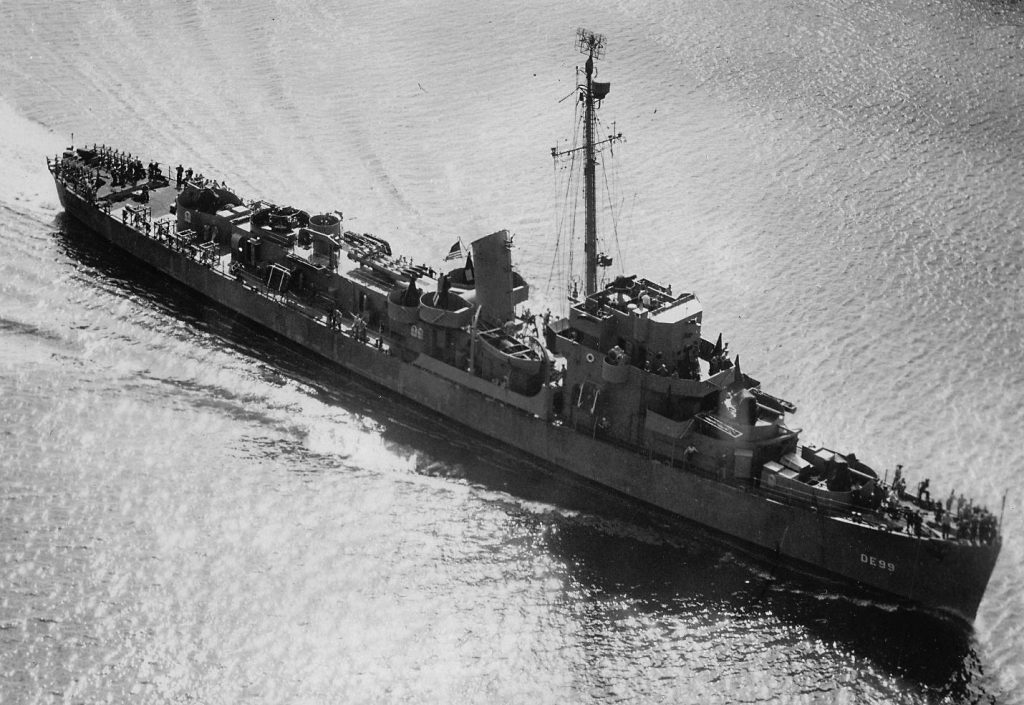
In 1943, the U.S. Navy named the destroyer escort USS Cannon in his honor. The vessel served during World War II and helped perpetuate his memory throughout the fleet. Operating primarily in the Atlantic and Caribbean, the USS Cannon was tasked with hunting submarines and escorting vital supply and fuel convoys. For much of 1944, she escorted shipping lines between Trinidad, Recife, and Rio de Janeiro, Brazil. She also completed a trans-Atlantic escort run to Gibraltar to supply fuel for Mediterranean operations. She was sold to Brazil and decommissioned in 1975.
Conclusion
The life of George Ham Cannon demonstrates how character is developed long before heroism is required. His upbringing in Missouri and Detroit, education at Southeastern High School, training at Culver Military Academy, engineering studies at the University of Michigan, and early Marine Corps service all contributed to the qualities he displayed on December 7, 1941.
When faced with mortal danger, Cannon did not think first of himself. He thought of his Marines, his mission, and his duty. In doing so, he exemplified the highest ideals of military leadership and being a Michigan man.
About James G. Fausone, Esq.
James G. Fausone, Esq. is a partner with Legal Help For Veterans, PLLC, with over twenty years of experience helping veterans apply for service-connected disability benefits and starting their claims, appealing VA decisions, and filing claims for an increased disability rating so veterans can receive a higher level of benefits.
If you were denied service connection or benefits for any service-connected disease, our firm can help. We can also put you and your family in touch with other critical resources to ensure you receive the treatment you deserve.
Give us a call at (800) 693-4800 or visit us online at www.LegalHelpForVeterans.com.
This electronic book is available for free download and printing from www.homeofheroes.com. You may print and distribute in quantity for all non-profit, and educational purposes.
Copyright © 2018 by Legal Help for Veterans, PLLC
ALL RIGHTS RESERVED