
Donald P. Sloat
Oklahoma Soldier Gave His Life For His Men
James G. Fausone
Donald Paul Sloat was only 20 years old when he arrived in Vietnam, and he had been a soldier for less than a year when he died. Yet in those few months he established a reputation as a dependable infantryman, a skilled machine gunner and a man willing to expose himself to extraordinary danger to protect the soldiers around him.
Early Life
His story begins in Coweta, Oklahoma, a small community in Wagoner County where Sloat was born on February 6, 1949. Sloat graduated from Coweta High School in 1967. He was a big man—more than six feet four inches tall—and football was an important part of his high school life. He played offensive and defensive line for the Coweta Tigers. After high school, Sloat briefly attended Northeastern Oklahoma A&M College in Miami, Oklahoma, a community college.
In The Army Now
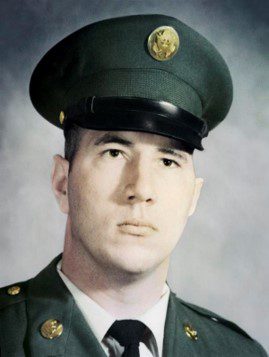
At a time when many young Americans were looking for ways to avoid military service, Sloat was doing the opposite. He was determined to become a soldier. Sloat initially failed his military physical because of high blood pressure. Rather than accepting the decision, he kept trying. Sloat returned for another examination, and another, eventually undergoing the physical approximately seven times before finally being accepted.
He finally enlisted in the U.S. Army on March 19, 1969, at the age of 20. After completing his initial training at Fort Polk, Louisiana, he prepared for the assignment that would take him halfway around the world. In September 1969 he arrived in Vietnam.
Sloat was assigned to the 3rd Platoon, Company D, 2nd Battalion, 1st Infantry Regiment, 196th Light Infantry Brigade, Americal Division. His military occupational specialty was 11B, infantryman, and he served as an M60 machine gunner.
The assignment placed him in one of the most dangerous environments of the Vietnam War. His unit operated from Fire Support Base Hawk Hill in the I Corps region south and southwest of Da Nang. The soldiers provided security for local villages and conducted patrols in terrain that stretched from coastal lowlands into mountains and jungle. Patrols could involve long movements through difficult terrain, exposure to enemy fire, and the constant possibility of mines, booby traps, or ambushes.
The M60 machine gunner occupied a particularly important position in an infantry patrol and carried 50 lbs. of equipment and ammunition. The weapon provided the squad with substantial firepower, but carrying and operating it also made the gunner an obvious target. When an enemy ambush occurred, the machine gunner was expected to react immediately and provide suppressive fire while other soldiers maneuvered.
Sloat was known as a skilled machine gunner. During his first months in Vietnam, his patrol was ambushed twice. On both occasions, he responded with machine-gun fire despite exposing himself to enemy fire. His actions were recognized with awards for valor. Sloat himself apparently did not view his growing list of decorations with the gravity that others might have attached to them. In a December 1969 letter home, he wrote that he had been recommended for another medal. “I guess they think I’m really gung-ho or something,” he wrote.
The Army later described him as an excellent and dependable soldier. His decorations included the Bronze Star Medal with “V” Device, the Army Commendation Medal with “V” Device, the Purple Heart, the Army Good Conduct Medal, the National Defense Service Medal, the Vietnam Service Medal, the Republic of Vietnam Campaign Medal, the Republic of Vietnam Gallantry Cross with Palm and the Combat Infantryman Badge, among others.
Battle at Que Son Valley
But war does not care about being gung-ho. Fate often intervenes. On January 17, 1970, Sloat’s squad was conducting a patrol in the Que Son Valley area of Quang Nam Province. The squad was operating as a blocking element in support of tanks and armored personnel carriers.
The patrol moved up a small hill in file formation. Then disaster struck. A soldier toward the front of the formation tripped a wire connected to an enemy hand-grenade booby trap. The grenade was triggered and rolled down the slope toward Sloat.
In a combat situation, a soldier has virtually no time to analyze such a threat. There was no safe way for Sloat simply to get away. He did something remarkable. Sloat picked up the grenade.
His first instinct was apparently to throw it away from the patrol. But he would have recognized a terrible problem: soldiers were positioned both ahead of him and behind him. Throwing the grenade in either direction could kill other members of the squad. Sloat realized the grenade was about to explode. Rather than attempting to save himself, he pulled the grenade against his body and bent over it, deliberately using his own body to shield his fellow soldiers from the blast.
The explosion killed him. But his decision saved the men around him. One of those soldiers, former Private First Class DeWayne C. Lewis Jr., later recalled that he was only five to eight feet behind Sloat when the grenade exploded. “His act saved my life,” Lewis said.
Sloat’s 21st birthday was less than three weeks away. The tragedy was compounded by the fact that Sloat’s family did not initially know what had really happened. When military officials arrived at the Sloat home in Coweta, his mother, Evelyn, initially thought they were to tell her about another Coweta young man who had recently been killed.
Instead, the uniformed officers had come to tell her that Don had been killed. The official information provided to the family was incomplete. According to accounts later published by the Army, his family was initially told that he had been killed when a booby trap detonated. His mother did not know that he had deliberately sacrificed himself to save his fellow soldiers. That incomplete account would remain part of the family’s understanding of Don’s death for decades. Sloat was buried in Vernon Cemetery in Coweta, the Oklahoma community where he had grown up.
A Mother’s Battle for Her Son
The years passed. The Vietnam War receded into history, and Sloat’s family carried the loss of a young son and brother without knowing the full story of his final moments. Then, decades later, the truth began to emerge.
A cousin searching for information about Sloat encountered a tribute to him online. Former members of Sloat’s unit were eventually located, including Michael W. Muhlheim, who had been with him on that fateful patrol. Muhlheim had carried the memory of the incident for decades.
When he finally contacted Sloat’s family, the story changed their understanding of Don’s death. He had not simply been the victim of a booby trap. He had knowingly placed himself between the grenade and his fellow soldiers. The revelation also led to a renewed effort to obtain the recognition that Sloat’s family believed he deserved.
His mother, Evelyn, became a driving force behind the effort. She did not live to see the final ceremony—she died in December 2012—but she had spent the last years of her life working to establish the truth about her son’s sacrifice. Army officials later specifically recognized her persistence in ensuring that his valor received appropriate recognition.
In 2002, the Army undertook a review of wartime awards, and Sloat’s Distinguished Service Cross was eventually upgraded to the Medal of Honor. On September 15, 2014—44 years after Sloat’s death—President Barack Obama presented the Medal of Honor posthumously in a White House ceremony. His brother, Dr. Bill Sloat, accepted the medal on his behalf.
His citation reads:
Specialist Four Donald P. Sloat distinguished himself by acts of gallantry and intrepidity at the risk of his life above and beyond the call of duty while serving as a Machinegunner with Company D, 2nd Battalion, 1st Infantry Regiment, 196th Light Infantry Brigade, Americal Division, during combat operations against an armed enemy in the Republic of Vietnam on January 17, 1970. On that morning, Specialist Four Sloat’s squad was conducting a patrol, serving as a blocking element in support of tanks and armored personnel carriers in the area. As the squad moved up a small hill in file formation, the lead soldier tripped a wire attached to a hand grenade booby trap set up by enemy forces. As the grenade rolled down the hill, Specialist Four Sloat knelt and picked up the grenade. After initially attempting to throw the grenade, Specialist Four Sloat realized that detonation was imminent. He then drew the grenade to his body and shielded his squad members from the blast, saving their lives. Specialist Four Sloat’s actions define the ultimate sacrifice of laying down his own life in order to save the lives of his comrades. Specialist Four Donald P. Sloat’s extraordinary heroism and selflessness above and beyond the call of duty are in keeping with the highest traditions of military service and reflect great credit upon himself, Company D, 2nd Battalion, 1st Infantry Regiment, 196th Light Infantry Brigade, Americal Division and the United States Army.
The ceremony represented more than the correction of an old military record. It was a moment in which the nation finally learned what the men who served beside Sloat had known: that the young Oklahoman had willingly given his life for his fellow soldiers.
President Obama used the ceremony to place Sloat’s story in the broader context of the Vietnam generation. He noted that recognition for extraordinary acts could sometimes become lost in the confusion of war and the passage of time.
In describing Sloat, Obama emphasized the qualities that had distinguished him before and during his military service: his determination to join the Army despite repeated medical disqualifications, his physical stature, his love of football and his reputation among his fellow soldiers.
Sloat was not a career soldier. He was a young man from Oklahoma who had attended college, played football and was just beginning adulthood. He entered the Army at 20 and reached Vietnam only months later. His military career lasted less than a year. Yet within that short period, he demonstrated qualities that military organizations value across generations: persistence, courage, competence, loyalty and selflessness.
He was also one of many young men from Coweta who paid the ultimate price during the Vietnam War. According to the Army, eight young men from the community died in Vietnam, a devastating loss for a town of its size. Sloat and two of his Coweta classmates died within weeks of one another. That community connection makes Sloat’s story particularly poignant.
He had grown up among people who knew him before he became a soldier. They knew the tall teenager who played football for the Tigers. His family knew him as a son and brother. His Army comrades knew him as the machine gunner they could depend upon. History eventually came to know him as a Medal of Honor recipient.
But the medal does not define the whole man. The ultimate choice he made defines him.
About James G. Fausone, Esq.
James G. Fausone, Esq. is a partner with Legal Help For Veterans, PLLC, with over twenty years of experience helping veterans apply for service-connected disability benefits and starting their claims, appealing VA decisions, and filing claims for an increased disability rating so veterans can receive a higher level of benefits.
If you were denied service connection or benefits for any service-connected disease, our firm can help. We can also put you and your family in touch with other critical resources to ensure you receive the treatment you deserve.
Give us a call at (800) 693-4800 or visit us online at www.LegalHelpForVeterans.com.
This electronic book is available for free download and printing from www.homeofheroes.com. You may print and distribute in quantity for all non-profit, and educational purposes.
Copyright © 2018 by Legal Help for Veterans, PLLC
ALL RIGHTS RESERVED