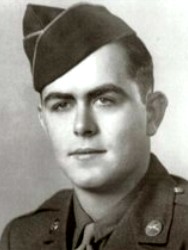
John C. Squires
Born: May 19, 1925 at Louisville, Kentucky
Home Town: Louisville, Kentucky
Status: KIA
Medal of Honor
U.S. Army
World War II
War Department, General Orders No. 78, October 2, 1944
The President of the United States of America, in the name of Congress, takes pride in presenting the Medal of Honor (Posthumously) to Sergeant John C. Squires, United States Army, for conspicuous gallantry and intrepidity at risk of life above and beyond the call of duty while serving with Company A, 30th Infantry Regiment, 3d Infantry Division. At the start of his company’s attack on strongly held enemy positions in and around Spaccasassi Creek, near Padiglione, Italy, on the night of 23 & 24 April 1944, Private First Class Squires, platoon messenger, participating in his first offensive action, braved intense artillery, mortar, and antitank gun fire in order to investigate the effects of an antitank mine explosion on the leading platoon. Despite shells which burst close to him, Private First Class Squires made his way 50 yards forward to the advance element, noted the situation, reconnoitered a new route of advance and informed his platoon leader of the casualties sustained and the alternate route. Acting without orders, he rounded up stragglers, organized a group of lost men into a squad and led them forward. When the platoon reached Spaccasassi Creek and established an outpost, Private First Class Squires, knowing that almost all of the noncommissioned officers were casualties, placed eight men in position of his own volition, disregarding enemy machinegun, machine-pistol, and grenade fire which covered the creek draw. When his platoon had been reduced to 14 men, he brought up reinforcements twice. On each trip he went through barbed wire and across an enemy minefield, under intense artillery and mortar fire. Three times in the early morning the outpost was counterattacked. Each time Private First Class Squires ignored withering enemy automatic fire and grenades which struck all around him, and fired hundreds of rounds of rifle, Browning automatic rifle, and captured German Spandau machinegun ammunition at the enemy, inflicting numerous casualties and materially aiding in repulsing the attacks. Following these fights, he moved 50 yards to the south end of the outpost and engaged 21 German soldiers in individual machinegun duels at point-blank range, forcing all 21 enemy to surrender and capturing 13 more Spandau guns. Learning the function of this weapon by questioning a German officer prisoner, he placed the captured guns in position and instructed other members of his platoon in their operation. The next night when the Germans attacked the outpost again he killed three and wounded more Germans with captured potato-masher grenades and fire from his Spandau gun. Private First Class Squires was killed in a subsequent action.
Silver Star
U.S. Air Force
Vietnam War
Major John C. Squires, United States Air Force, was awarded the Silver Star for gallantry in connection with military operations against an armed enemy of the United States as a member of an all-volunteer joint U.S. Army and Air Force raiding force in the Joint Chiefs of Staff-directed heliborne assault mission to rescue United States military personnel held as prisoners of war at Son Tay prison in North Vietnam, on 21 November 1970. The personal skill and extreme courage displayed by Major Squires in his gallant actions during the heroic rescue attempt contributed immeasurably to the ultimate effectiveness and tactical success of the mission. By his gallantry and devotion to duty, Major Squires has reflected great credit upon himself and the United States Air Force.
