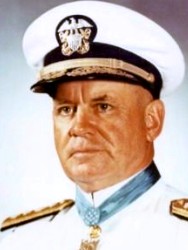
John Duncan Bulkeley
Born: August 19, 1911 at New York, New York
Home Town: Hackettstown, New Jersey
Medal of Honor
U.S. Navy
World War II
The President of the United States of America, in the name of Congress, takes pleasure in presenting the Medal of Honor to Lieutenant Commander John Duncan Bulkeley (NSN: 0-72460), United States Navy, for extraordinary heroism, distinguished service, and conspicuous gallantry above and beyond the call of duty as extraordinary heroism as Commanding Officer, Motor Torpedo Boat THIRTY-FOUR (PT-34), Motor Torpedo Boat Squadron THREE (MTB-3), in Philippine waters during the period 7 December 1941 to 10 April 1942. The remarkable achievement of Lieutenant Commander Bulkeley’s command in damaging or destroying a notable number of Japanese enemy planes, surface combatant and merchant ships, and in dispersing landing parties and land-based enemy forces during the four months and eight days of operation without benefit of repairs, overhaul, or maintenance facilities for his squadron, is believed to be without precedent in this type of warfare. His dynamic forcefulness and daring in offensive action, his brilliantly planned and skillfully executed attacks, supplemented by a unique resourcefulness and ingenuity, characterize him as an outstanding leader of men and a gallant and intrepid seaman. These qualities coupled with a complete disregard for his own personal safety reflect great credit upon him and the Naval Service.
Distinguished Service Cross
U.S. Navy
World War II
South West Pacific Area, General Orders No. 3 (1942)
The President of the United States takes pleasure in presenting a Bronze Oak Leaf Cluster in lieu of a Second Award of the Distinguished Service Cross to John Duncan Bulkeley, Lieutenant, U.S. Navy, for extraordinary heroism in connection with military operations against an armed enemy while serving as Commanding Officer, Motor Torpedo Boat THIRTY-FOUR (PT-34), Motor Torpedo Boat Squadron THREE (MTB-3), in action in the Mindanao Sea, Philippine Islands, on the night of 8 – 9 April 1942. When Lieutenant Bulkeley, in command of Motor Torpedo Boat Squadron THREE encountered a hostile cruiser accompanied by destroyers, he unhesitatingly ordered an attack by the two boats in his squadron in spite of the tremendous odds. After the vessel on which he was embarked had fired all its torpedoes in an attack against the enemy cruiser, Lieutenant Bulkeley, at great personal risk, directed the aggressive maneuver of this vessel so as to draw to it the bulk of the hostile fire, enabling the other boat to deliver a torpedo attack at close range. As a result of this daring, combined maneuver, the enemy cruiser was destroyed. After this action, Lieutenant Bulkeley skillfully withdrew his command, evading the pursuing hostile destroyers. The conduct of Lieutenant Bulkeley throughout this action reflects great credit upon himself, and was in keeping with the highest traditions of the Military Forces of the United States.
Distinguished Service Cross
U.S. Navy
World War II
U.S. Army Forces in the Far East, General Orders No. 29 (1942)
The President of the United States takes pleasure in presenting the Distinguished Service Cross to John Duncan Bulkeley, Lieutenant, U.S. Navy, for extraordinary heroism in connection with military operations against an armed enemy while serving as Commanding Officer, Motor Torpedo Squadron THREE (MTB-3), in the vicinity of Subic Bay, Luzon, Philippine Islands, on 18 January 1942 and 25 January 1942. When a hostile vessel was reported in Binanga Bay, Luzon, on 18 January, Lieutenant Bulkeley proceeded with a squadron of two motor torpedo boats to search it out and attack it. When one of the two patrol boats became disabled, Lieutenant Bulkeley continued on his mission without the other. In spite of challenges by several enemy shore observation posts and by a hostile patrolling vessel and fire from an enemy shore battery, Lieutenant Bulkeley entered Port Binanga, located the hostile vessel and attacked it with two torpedoes, one of which struck it and set it afire. Again, on the night of 24 January, he successfully attacked an enemy merchant vessel off Sampaloc Point, Luzon. After firing the first torpedo which struck the target amidships and exploded, the torpedo boat came under heavy fire from the hostile ship and from shore batteries. In spite of this fire, Lieutenant Bulkeley continued his attack to within five hundred yards, firing another torpedo and attacking with machine gun fire, seriously hampered hostile operations on the west coast of Bataan. The conduct of Lieutenant Bulkeley throughout this action reflects great credit upon himself, and was in keeping with the highest traditions of the Military Forces of the United States.
Navy Cross
U.S. Navy
World War II
The President of the United States takes pleasure in presenting the Navy Cross to John Duncan Bulkeley, Lieutenant, U.S. Navy, for extraordinary heroism and distinguished service in the line of his profession while serving as Commanding Officer of Motor Torpedo Boat THIRTY-FOUR (PT-34), Motor Torpedo Boat Squadron THREE (MTB-3), in connection with military operations against the Japanese enemy forces in the Philippine Area on 18 and 19 January 1942. Despite enemy machine gun fire, Lieutenant Bulkeley searched Binanga Bay, Luzon, Philippine Islands, for an enemy ship reported therein, located and sank the unidentified 5,000-ton enemy ship with torpedoes without serious damage to his ship or casualty to his crew. The exceptional bravery, aggressive leadership, and outstanding devotion to duty displayed by Lieutenant Bulkeley were in keeping with the highest traditions of the United States Naval Service.
Silver Star
U.S. Navy
World War II
The President of the United States takes pleasure in presenting the Silver Star Medal (Army Award) to John Duncan Bulkeley, Lieutenant, U.S. Navy, for extraordinary action and retrograde maneuver involving General Douglas MacArthur. Lieutenant Bulkeley made detailed plans involving exacting preparations for a movement of major strategic importance and of the most hazardous nature, then executed the mission with marked skill and coolness in the face of greatly superior enemy forces.
Bureau of Naval Personnel Information Bulletin No. 306 (September 1942)
