
Benjamin Lewis Salomon
Duty Beyond Designation
James G. Fausone
The action of Medal of Honor recipients, while specific to a particular battle, also can be placed in the context of the larger war. Benjamin Salomon fought on a tiny island he probably never heard of before – Saipan. It is one of the Marianna Islands in the Pacific Ocean and is located north of Guam.
A Hero Outside the Rules
Benjamin Lewis Salomon, DDS was not meant to be a combat hero—not according to the laws of war or the institutional expectations that governed his medical service in the United States Army. He was trained to heal rather than to fight, commissioned to preserve life rather than to take it. Yet it was precisely this tension, between prescribed role and lived reality, that produced one of the most extraordinary acts of individual courage of the Pacific War. Salomon did not earn the Medal of Honor through battlefield command or tactical maneuver, but through a solitary decision made amid catastrophe when the distinction between healer and defender dissolved and only obligation remained. Let’s place his actions into the wider context of the war.
Saipan: Breaking Japan’s Inner Defense
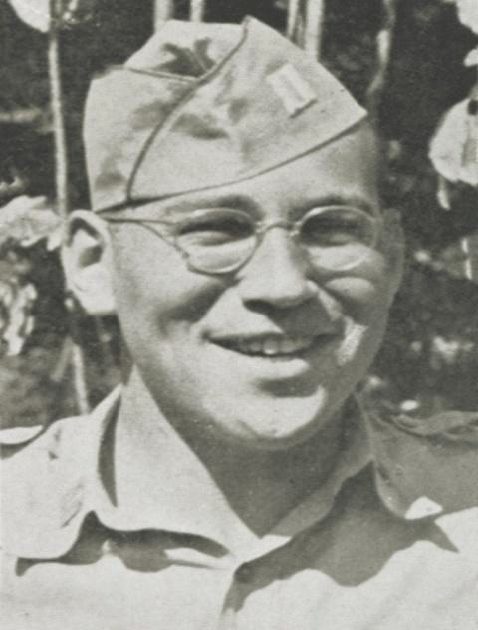
In the vast geography of the Pacific War, few places exerted an influence as decisive as the small island of Saipan. Barely fourteen miles long and five miles wide, Saipan lacked the scale, population,
or industrial base normally associated with strategic turning points in global wars. Yet its capture in the summer of 1944 fundamentally altered the course of World War II in the Pacific. From Saipan, the United States gained the ability to strike Japan directly and continuously, undermining the very premise upon which Japanese war strategy rested – that the homeland was safe. Militarily, politically, and psychologically, Saipan marked the moment when Japan’s defeat became structurally inevitable.
The convergence of geography, air power, logistics, and strategic misalignment within the Japanese war effort created Saipan’s importance. At the time Saipan was attacked, the Imperial Japanese Army was fully committed elsewhere—engaged in Operation Ichi-Go on the Chinese mainland—leaving the island chain under-resourced. The result was not merely a battlefield defeat, but a systemic collapse of Japan’s inner defense concept.
Saipan in Japanese Strategic Planning
Saipan lies in the Mariana Islands, a chain stretching north–south across the western Pacific Ocean. The Marianas are located approximately 1,300 miles south of Japan and roughly equidistant between the Philippines and the Japanese home islands. This positioning made the islands a natural crossroads of maritime and aerial movement across East Asia and the Pacific.
From a military perspective, the Mariana Islands possessed three critical geographic attributes. First, it was close enough to Japan to support sustained long-range air operations. Second, it was far enough from Japan’s core industrial centers to provide operational depth and protection for airfields and logistical infrastructure. Third, its surrounding seas could be dominated by naval power, allowing whichever side-controlled Saipan to secure supply lines and deny access to the enemy.
Japan acquired Saipan after World War I and administered it under a League of Nations mandate. Over the interwar period, Japan integrated the Marianas into its expanding imperial system, developing infrastructure, settlements, and military installations while restricting foreign access. By the 1930s, Saipan was no longer a colonial backwater; it was a fortified node in Japan’s Pacific defense network.
Japanese war planning revolved around the concept of layered defensive perimeters. The outer perimeter were islands —stretching through the Solomons, Gilberts, and Marshalls—was designed to delay and wear down an advancing enemy. Behind it lay the inner defense line, anchored on the Marianas, the Philippines, and key positions in Southeast Asia. Saipan was a cornerstone of this inner line protecting the homeland.
Japanese leaders believed that if the Marianas could be held, the United States would be unable to bring decisive force against the homeland without first fighting a climactic naval battle under unfavorable conditions. Saipan was thus both shield and tripwire: its defense was meant to buy time, force attrition, and ultimately enable a decisive engagement that would restore strategic balance.
Yet, this concept rested on flawed assumptions. It underestimated American industrial capacity, overestimated Japan’s ability to control the timing and location of decisive battles, and ignored the growing centrality of air power. Most critically, it failed to account for Japan’s internal strategic fragmentation, particularly the rivalry between the Imperial Japanese Army and Navy.
American Strategy and the Central Pacific Drive
By 1943, American strategy in the Pacific had matured into a coherent, multi-axis approach. While General Douglas MacArthur advanced through New Guinea toward the Philippines, Admiral Chester Nimitz led the Central Pacific drive, hopping across island chains toward Japan. The capture of the Gilbert and Marshall Islands demonstrated that heavily defended Japanese positions could be neutralized through superior firepower, logistics, and operational planning or bypassed.
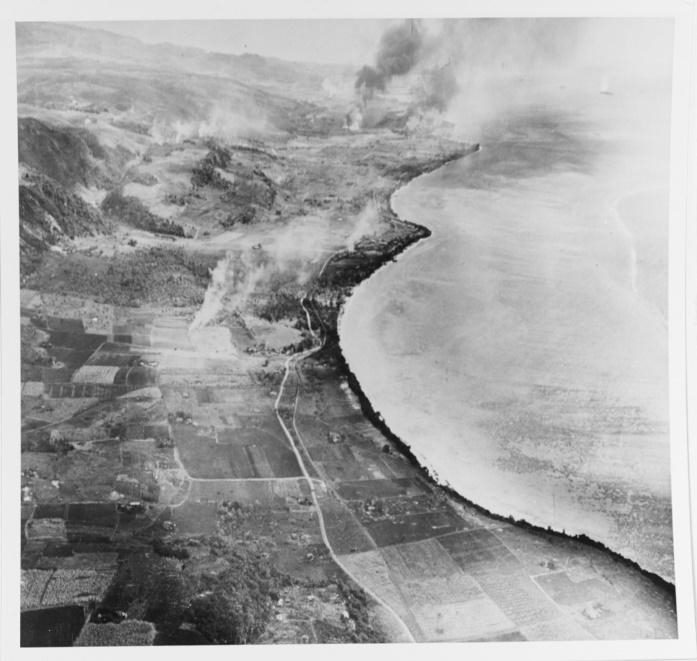
Within this framework, Saipan emerged as a priority target. Its capture promised a decisive strategic payoff: direct access to Japan via strategic bombing. American planners understood the risks. Saipan lay well beyond the range of existing fighter support, and its defense was expected to be fierce. Nevertheless, the potential reward—breaking the Japanese inner defense line—made the operation unavoidable.
The strategic importance was magnified by technological change. The emergence of the B-29 Superfortress, with its unprecedented range and payload, transformed islands like Saipan from peripheral outposts into strategic platforms. Once airfields were constructed, Saipan became a launching point for thousands of B-29 attacks on Japan. The B-29 strength in the Marianas increased to 1,000. Command personnel on Guam reached 37,500, on Tinian 26,500, on Saipan 12,700, and on newly captured Iwo Jima 13,000.
The Battle of Saipan
The Battle of Saipan began on 15 June 1944, when U.S. Marines landed on the island’s western beaches following one of the most intense naval bombardments of the Pacific War. Japanese defenders, commanded by Lieutenant General Yoshitsugu Saitō, had prepared extensive fortifications, including cave networks, bunkers, and concealed artillery positions.
The fighting quickly devolved into a brutal contest of attrition. The island’s rugged interior terrain favored the defenders, and Japanese troops exploited their familiarity with the landscape to conduct ambushes, night attacks, and infiltration operations. American forces responded with combined arms tactics, integrating infantry, armor, artillery, naval gunfire, and close air support.
As U.S. troops advanced northward, Japanese resistance became increasingly desperate. By early July, organized defense had collapsed. In a final act of defiance, thousands of Japanese soldiers launched a massive banzai charge. The attack failed, resulting in devastating casualties and effectively ending Japanese military resistance.
The battle officially concluded on 9 July 1944. U.S. casualties exceeded 14,000, while Japanese military losses were catastrophic. Civilian deaths were also tragically high, exacerbated by Japanese propaganda that portrayed capture as worse than death.
The Strategic Absence: Operation Ichi-Go
While the battle raged on Saipan, the Imperial Japanese Army was fully committed elsewhere. Beginning in April 1944, Japan launched Operation Ichi-Go, the largest ground offensive of the entire war, across central and southern China. Involving hundreds of thousands of troops, the operation aimed to destroy American air bases in China, secure key rail corridors, and stabilize Japan’s continental holdings.
From the Imperial Army’s perspective, Ichi-Go was strategically essential. Japanese leaders believed that U.S. bombers operating from China posed an immediate threat to the homeland and that control of Chinese territory was vital to sustaining Japan’s broader war effort. As a result, the Imperial Japanese Army committed its best remaining formations, logistics, and command attention to the Chinese theater.
This commitment had decisive consequences for Saipan. Although the island lay at the heart of Japan’s inner defense line, its defense fell largely under naval responsibility, with limited Army involvement. Reinforcement from China was neither planned nor feasible. Japan’s shrinking merchant fleet, ravaged by American submarines, could not support large-scale troop movements across the Pacific. More importantly, the Army showed no willingness to divert forces from Ichi-Go, even as the strategic importance of Saipan became clear.
The result was a fatal asymmetry: Japan was winning territory in China while losing control of the approaches to its own homeland. Operation Ichi-Go did not directly cause the loss of Saipan, but it consumed Japan’s remaining strategic flexibility according to Jenny Chan of Pacific Atrocities Education. When Saipan was attacked, Japan lacked both the forces and the institutional unity required to mount an effective response.
Political and Psychological Shock
The fall of Saipan sent shockwaves through Japan’s leadership. For the first time, Japanese leaders openly acknowledged that the homeland itself was under direct threat. Within weeks of Saipan’s loss, Prime Minister Hideki Tōjō’s government collapsed, a rare and telling admission of strategic failure.
For the Japanese public, Saipan marked the collapse of the belief that the war could be fought at a distance. The prospect of American bombers striking Japanese cities from secure Pacific bases shattered morale and exposed the limitations of imperial propaganda.
In the United States, Saipan reinforced confidence in the island-hopping strategy and validated the enormous investment in amphibious warfare, naval power, and strategic aviation. At the same time, the ferocity of Japanese resistance and the scale of civilian tragedy influenced American expectations for future battles, foreshadowing the grim struggles still to come.
Saipan and the Transformation of the Air War
From Saipan and the broader Marianas complex, the United States conducted a sustained strategic bombing campaign that targeted Japanese industry, infrastructure, and urban centers. The development of nearby Tinian and Guam expanded this capacity, creating an integrated air-industrial system unmatched in scale.
While the atomic bomb missions were launched from Tinian, Saipan was indispensable to that outcome. Its capture enabled the seizure of neighboring islands, validated the Marianas as bomber bases, and provided the operational foundation for the final phase of the war.
Early Life and Formative Values of Salomon
Benjamin L. Salomon was born on September 1, 1914, in Milwaukee, Wisconsin, into a Jewish family that placed high value on education, discipline, and civic responsibility. Raised during the interwar years, he demonstrated early signs of leadership and resilience. As an Eagle Scout, he absorbed ideals of preparedness, service, and self-reliance that would later define his conduct under fire. Those who knew him
in his youth recalled a boy of quiet confidence—intelligent, physically capable, and self-possessed—traits that carried into adulthood and, ultimately, into war.
His academic career reflected both aptitude and ambition. After a brief period at Marquette University, Salomon transferred to the University of Southern California, where he completed his undergraduate studies and graduated from the USC College of Dentistry in 1937. Dentistry demanded precision, patience, and an unwavering sense of responsibility for the well-being of others. Salomon embraced the profession fully, entering civilian practice with every expectation of a stable life defined by that profession. He was a mother’s dream – a doctor with a successful career ahead.
From Civilian Dentist to Infantry Soldier and Medical Officer
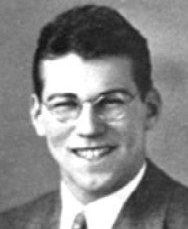
That trajectory shifted abruptly with America’s mobilization for war. Drafted into the U.S. Army in 1940, Salomon entered service not as a medical officer but as an infantry private. This fact, often overlooked, would prove consequential. He distinguished himself in infantry training, qualifying as an expert marksman with both rifle and pistol and demonstrating composure under pressure. His performance marked him not merely as a technical specialist but as a capable soldier.
Only later did the Army commission him into the Dental Corps, assigning him to a category formally designated as noncombatant under the laws and customs of war. By 1943, Captain Salomon, DDS was serving as the regimental dental officer for the 105th Infantry Regiment of the 27th Infantry Division. Officially, his responsibilities centered on dental care and preventive medicine. In practice, the realities of Pacific warfare erased such neat distinctions. Casualties were severe, aid stations exposed, and medical personnel of every specialty pressed into expanded roles. Salomon soon found himself functioning as the battalion surgeon for the 2nd Battalion, operating a forward aid station under constant threat.
It is in that capacity that he found himself in the June 1944 Battle of Saipan. At the tactical level, it was a campaign of unrelenting brutality. Dense jungle, broken volcanic terrain, and a determined enemy produced weeks of close-quarters fighting and heavy losses. The medical unit was constantly receiving wounded. By early July, Japanese forces on the island were cornered, their defeat inevitable, yet their willingness to die undiminished.
In the early hours of July 7, 1944, Japanese commanders launched a final, desperate effort: a massive banzai charge involving several thousand soldiers. It was the largest such assault of the Pacific War. Screaming and firing as they advanced with fixed bayonets, Japanese troops smashed into already depleted American positions. The 2nd Battalion of the 105th Infantry Regiment was particularly hard hit, suffering devastating casualties as the enemy penetrated deep into rear areas. Amid the collapse, Salomon’s aid station became a focal point, crowded with wounded men who could neither fight nor flee.
As the sounds of battle drew closer, Salomon continued treating casualties, moving deliberately from one wounded soldier to the next. Witnesses later recalled his calm demeanor even as Japanese troops approached within yards of the position. When enemy soldiers finally burst into the aid station, the situation shifted instantaneously from medical crisis to mortal threat.
Salomon reacted without hesitation. Seizing a rifle and pistol, he fired at point-blank range, killing attackers who were attempting to bayonet wounded Americans lying helpless on the ground. In the confined chaos of the aid station, he engaged in hand-to-hand combat, striking down enemies who threatened his patients. His actions were not offensive in purpose but defensive in intent, driven by an uncompromising resolve to protect those entrusted to his care.
Repeatedly, Salomon was urged to withdraw. He had opportunities to escape and was under no obligation to remain. Each time, he refused. Instead, he ordered medical personnel and ambulatory wounded to fall back while he stayed behind to delay the enemy advance. In doing so, he knowingly accepted near-certain death, subordinating both personal survival and doctrinal protection to the lives of others.
When the aid station could no longer be held on July 7, 1941, Salomon made his final decision. Moving to a nearby .30-caliber machine gun, he took control of the weapon and began firing directly into the massed enemy advancing across open ground. Alone, exposed, and without relief, he delivered sustained fire that halted multiple assaults and bought critical time for American forces to withdraw and reorganize. He continued firing until he was mortally wounded.
When U.S. troops later retook the position, they found Salomon dead beside the machine gun, his body riddled with 76 bullet wounds and numerous bayonet stabs. In front of the gun lay the bodies of approximately ninety-eight Japanese soldiers, stark evidence of the ferocity and effectiveness of Saloman’s final stand. There was no doubt that he had fought until the last moment, nor that his actions had saved the lives of wounded soldiers who would otherwise have been killed.
Delay and Recognition
Despite the clarity of his heroism, Salomon’s Medal of Honor was not immediately awarded. It took four attempts over decades to be successful. Army officials wrestled with the implications of recognizing lethal force employed by a medical officer. For decades, his recognition was halted by legal interpretations and institutional caution.
In 1944, the recommendation for the Medal of Honor was returned by Maj. Gen. George W. Griner, the commanding general of the 27th Division. Officially, Griner declined to approve the award because Salomon was “in the medical service and wore a Red Cross brassard upon his arm. Under the rules of the Geneva Convention, to which the United States subscribes, no medical officer can bear arms against the enemy.” The then guidelines for awarding the Medal of Honor to medical non-combatants states that one may not receive the Medal of Honor for actions in an offensive. More recent interpretations of the convention, as well as the US Laws of Land Warfare, allow use of personal weapons (i.e., rifles and pistols) in self-defense or in defense of patients and staff, as long as the medical soldier does not wear the Red Cross. Part of the problem in Salomon’s citation was that a machine gun is considered a “crew-served” weapon, not a personal weapon.
In 1951, the MOH package was resubmitted through the Office of the Chief of Military History. The recommendation was returned without action with another pro-forma reason: the time limit for submitting World War II awards had passed.
In 1969, another Medal of Honor recommendation was submitted by Lt. Gen. Hal B. Jennings, the Surgeon General of the United States Army. In 1970, Stanley R. Resor, Secretary of the Army, recommended approval and forwarded the recommendation to the Secretary of Defense. The recommendation was returned without action.
In 1998, the recommendation was re-submitted by Dr. Robert West (USC Dental School). A comprehensive Army review concluded that Salomon’s actions were defensive, necessary, and fully consistent with both the law of war and the highest traditions of military service.
He was finally awarded the Medal of Honor in May 2002 by President George HW Bush. The citation reads:
For conspicuous gallantry and intrepidity at the risk of his life above and beyond the call of duty. Captain Ben L. Salomon was serving at Saipan, in the Marianas Islands on July 7, 1944, as the Surgeon for the 2nd Battalion, 105th Infantry Regiment, 27th Infantry Division. The Regiment’s 1st and 2nd Battalions were attacked by an overwhelming force estimated between 3,000 and 5,000 Japanese soldiers. It was one of the largest attacks attempted in the Pacific Theater during World War II. Although both units fought furiously, the enemy soon penetrated the Battalions’ combined perimeter and inflicted overwhelming casualties. In the first minutes of the attack, approximately 30 wounded soldiers walked, crawled, or were carried into Captain Salomon’s aid station, and the small tent soon filled with wounded men. As the perimeter began to be overrun, it became increasingly difficult for Captain Salomon to work on the wounded. He then saw a Japanese soldier bayoneting one of the wounded soldiers lying near the tent. Firing from a squatting position, Captain Salomon quickly killed the enemy soldier. Then, as he turned his attention back to the wounded, two more Japanese soldiers appeared in the front entrance of the tent. As these enemy soldiers were killed, four more crawled under the tent walls. Rushing them, Captain Salomon kicked the knife out of the hand of one, shot another, and bayoneted a third. Captain Salomon butted the fourth enemy soldier in the stomach and a wounded comrade then shot and killed the enemy soldier. Realizing the gravity of the situation, Captain Salomon ordered the wounded to make their way as best they could back to the regimental aid station, while he attempted to hold off the enemy until they were clear. Captain Salomon then grabbed a rifle from one of the wounded and rushed out of the tent. After four men were killed while manning a machine gun, Captain Salomon took control of it. When his body was later found, 98 dead enemy soldiers were piled in front of his position. Captain Salomon’s extraordinary heroism and devotion to duty are in keeping with the highest traditions of military service and reflect great credit upon himself his unit and the United States Army.
Nearly fifty-eight years after his death, Captain Benjamin L. Salomon, DDS was posthumously awarded the Medal of Honor. He remains the only dentist in United States history to receive the nation’s highest military decoration and one of the very few medical officers so honored. A replica of Salomon’s Medal of Honor is displayed at the USC Dental School. His story endures as a testament to moral courage under fire—a reminder that valor is not defined by specialty or designation, but by the willingness to give everything to protect others when the moment demands it.
About James G. Fausone, Esq.
James G. Fausone, Esq. is a partner with Legal Help For Veterans, PLLC, with over twenty years of experience helping veterans apply for service-connected disability benefits and starting their claims, appealing VA decisions, and filing claims for an increased disability rating so veterans can receive a higher level of benefits.
If you were denied service connection or benefits for any service-connected disease, our firm can help. We can also put you and your family in touch with other critical resources to ensure you receive the treatment you deserve.
Give us a call at (800) 693-4800 or visit us online at www.LegalHelpForVeterans.com.
This electronic book is available for free download and printing from www.homeofheroes.com. You may print and distribute in quantity for all non-profit, and educational purposes.
Copyright © 2018 by Legal Help for Veterans, PLLC
ALL RIGHTS RESERVED