
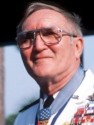
George Everett “Bud” Day
Born: February 24, 1925 at Sioux City, Iowa
Home Town: Sioux City, Iowa
Status: POW
RELATED HEROES STORIES


Medal of Honor
Vietnam War
U.S. Air Force
GB-180, March 22, 1976
The President of the United States of America, in the name of Congress, takes pleasure in presenting the Medal of Honor to Colonel [then Major] George Everett “Bud” Day (AFSN: 0-49555), United States Air Force, for conspicuous gallantry and intrepidity at the risk of his life above and beyond the call of duty a Pilot of Misty Super FAC’s F-100 Squadron, held as a Prisoner of War in North Vietnam. On 26 August 1967, Colonel Day was forced to eject from his aircraft over North Vietnam when it was hit by ground fire. His right arm was broken in three places, and his left knee was badly sprained. He was immediately captured by hostile forces and taken to a prison camp where he was interrogated and severely tortured. After causing the guards to relax their vigilance, Colonel Day escaped into the jungle and began the trek toward South Vietnam. Despite injuries inflicted by fragments of a bomb or rocket, he continued southward surviving only on a few berries and uncooked frogs. He successfully evaded enemy patrols and reached the Ben Hai River, where he encountered U.S. artillery barrages. With the aid of a bamboo log float, Colonel Day swam across the river and entered the demilitarized zone. Due to delirium, he lost his sense of direction and wandered aimlessly for several days. After several unsuccessful attempts to signal U.S. aircraft, he was ambushed and recaptured by the Viet Cong, sustaining gunshot wounds to his left hand and thigh. He was returned to the prison from which he had escaped and later was moved to Hanoi after giving his captors false information to questions put before him. Physically, Colonel Day was totally debilitated and unable to perform even the simplest task for himself. Despite his many injuries, he continued to offer maximum resistance. His personal bravery in the face of deadly enemy pressure was significant in saving the lives of fellow aviators who were still flying against the enemy. Colonel Day’s conspicuous gallantry and intrepidity at the risk of his life above and beyond the call of duty are in keeping with the highest traditions of the U.S. Air Force and reflect great credit upon himself and the United States Armed Forces.
Silver Star
Vietnam War
U.S. Air Force
The President of the United States of America, authorized by Act of Congress July 9, 1918 (amended by an act of July 25, 1963), takes pleasure in presenting the Silver Star to Major George Everett “Bud” Day (AFSN: 0-49555), United States Air Force, for gallantry in connection with military operations against an opposing armed force while serving as a Forward Air Controller of Misty Super FAC’s F-100 Squadron, Phu Cat Air Base, Vietnam, PACIFIC Air Force, while directing fighter strikes near Ben Quang, North Vietnam, on 26 August 1967. On that date, Major Day was flying a visual reconnaissance mission in the vicinity of a heavily camouflaged Surface-to-Air missile site that was a threat to friendly air forces in the area. Due to the low, overcast cloud conditions, fighter aircraft were unable to locate and destroy this SAM site. With complete disregard for his own personal safety, Major Day made repeated passes over heavy and accurate anti-aircraft artillery fire attempting to identify the site for the waiting fighter bombers. On the last pass, his aircraft was hit and severely damaged, forcing him to bail out over hostile territory. By his gallantry and devotion to duty, Major Day has reflected great credit upon himself and the United States Air Force.
Air Force Cross
Vietnam War
U.S. Air Force
Department of the Air Force, Special Orders GB-1152, (October 29, 1974)
The President of the United States of America, authorized by Title 10, Section 8742, United States Code, takes pleasure in presenting the Air Force Cross to Colonel George Everett “Bud” Day (AFSN: 0-49555), United States Air Force, for extraordinary heroism in military operations against an opposing armed force as a Prisoner of War in North Vietnam from 16 July 1969 to 14 October 1969. During this period, Colonel Day was subjected to maximum punishment and torture by Vietnamese guards to obtain a detailed confession of escape plans, policies, and orders of the American senior ranking officer in the camp, and the communications methods used by the Americans interned in the camp. Colonel Day withstood this punishment and gave nothing of value to the Vietnamese, although he sustained many injuries and open wounds to his body. Through his extraordinary heroism and willpower, in the face of the enemy, Colonel Day reflected the highest credit upon himself and the United States Air Force.