
Dave Schreiner
Wisconsin Legend Answers the Call to Serve
James G. Fausone

Before First Lieutenant Dave Schreiner became a respected officer in the United States Marine Corps, he was one of the most celebrated college football players in America. Born and raised in Lancaster, Wisconsin, Schreiner distinguished himself as an exceptional athlete whose determination, discipline, and leadership would ultimately carry him far beyond the football field.
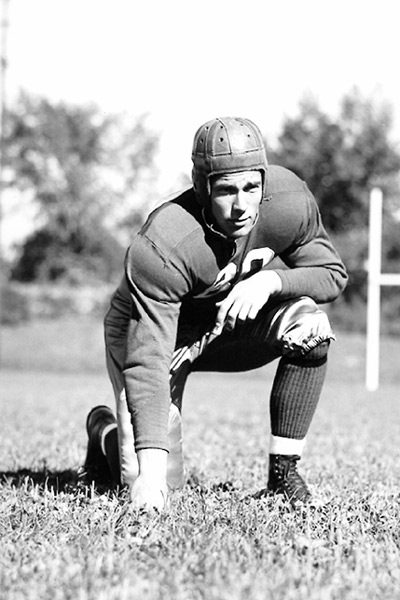
At the University of Wisconsin, Schreiner emerged as a standout end for the Badgers, earning All-American honors twice and recognition as the Big Ten Conference’s Most Valuable Player in 1942. That season, Wisconsin compiled an impressive 8–1–1 record and earned recognition as national champions from the Helms Athletic Foundation. Playing alongside future football legends, Schreiner helped establish one of the most memorable teams in university history.
Yet his athletic achievements came at a time when the United States was engaged in a global war. Following Japan’s attack on Pearl Harbor in December 1941, millions of Americans answered the call to military service. Schreiner was among the young men who set aside promising civilian futures to defend their country.
Rather than pursue the professional football career that awaited him, Schreiner entered the United States Marine Corps, exchanging the roar of packed stadiums for the uncertainty and danger of combat in the Pacific Theater.
From the Gridiron to the Marine Corps
Dave Schreiner eventually served as an officer with Company A, 1st Battalion, 4th Marine Regiment, 6th Marine Division. The division was among the American formations preparing for the final stages of the island-hopping campaign against Imperial Japan.
The U.S. Marine Corps demanded more than physical endurance. Its junior officers were expected to lead from the front, make decisions under fire, maintain discipline, and sustain the fighting spirit of their men through exhausting and often brutal conditions.
For Schreiner, the transition from athlete to combat leader was a natural extension of the qualities that had defined his football career. His fellow Marines remembered an officer who treated enlisted men with respect, understood their hardships, and placed their welfare above personal comfort.
One Marine, Private First Class Ed Liguori, later recalled a period when his unit had gone more than two days with little food or water. Schreiner disappeared from their position, returning approximately an hour later carrying a box of large cans of grapefruit juice. He distributed the precious refreshments among his exhausted Marines, providing a moment of relief during an otherwise miserable stretch of the campaign.
It was a small act, but one that remained with Liguori for decades. Such gestures reflected a fundamental principle of military leadership: the responsibility of an officer extends beyond issuing orders. It includes caring for the Marines entrusted to his command.
The Mosquito Bowl: A Moment of Normalcy Before Battle
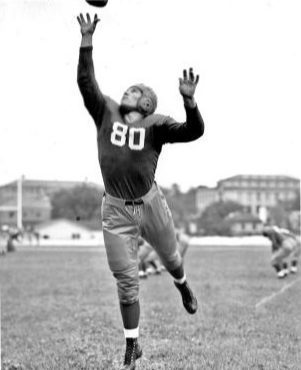
December 1944, while stationed on Guadalcanal, Marines of the 4th and 29th Marine Regiments organized an unusual sporting event that would later become known as the Mosquito Bowl.
The game brought together an extraordinary collection of former college football players serving in the Marine Corps. Many had been nationally recognized athletes before the war, but now wore the same uniform and faced the same uncertain future.
For a brief afternoon, the Marines could escape the demands of military training and the looming prospect of combat. Competition, camaraderie, and familiar rivalries offered a reminder of the lives they had left behind. Yet the significance of the Mosquito Bowl would become tragically apparent in the months that followed.
The Marines participating in the game were preparing for the invasion of Okinawa, one of the largest and deadliest amphibious operations of the Pacific War. For some, the football game would be among their final moments of recreation before entering combat.
Schreiner’s story, along with those of fellow servicemen and former college football standouts, would eventually become the subject of Buzz Bissinger’s book The Mosquito Bowl: A Game of Life and Death in World War II.
The Battle of Okinawa
On April 1, 1945, American forces launched Operation Iceberg, the invasion of Okinawa. The operation was intended to secure a strategic island that could support future operations against the Japanese home islands. The campaign quickly developed into a prolonged and exceptionally costly battle.
Japanese defenders employed an extensive system of fortified caves, tunnels, concealed firing positions, and mutually supporting defensive strongpoints. Rather than contest every beach landing, they concentrated much of their resistance in the island’s rugged interior, forcing American troops to advance against carefully prepared positions.
The terrain presented severe challenges. Rocky ridgelines, steep escarpments, and narrow valleys limited visibility and maneuverability. Japanese troops could remain concealed until American units approached within effective firing range, then unleash rifle, machine-gun, mortar, and artillery fire.
For the Marines of the 6th Marine Division, progress was measured in yards rather than miles.
Dave Schreiner commanded Marines in Company A, 1st Battalion, 4th Marines, enduring the same difficult conditions as the men he led. As the campaign continued, casualties mounted, supplies were strained, and the physical and psychological demands of combat intensified. The war also claimed men Schreiner had known long before entering military service.
Among them was fellow Wisconsin football player and Marine Bob Baumann, who served in the same company and was killed in action earlier in June 1945. The loss underscored the devastating human cost of the campaign. Former teammates who had once shared football practices and Saturday afternoons were now fighting, and dying, thousands of miles from home.
A Final Mission in Southern Okinawa
By mid-June 1945, organized Japanese resistance on Okinawa was approaching collapse. Nevertheless, isolated enemy positions remained dangerous, particularly in the rugged southern portion of the island. Japanese soldiers continued to occupy caves and concealed positions, where even small groups could inflict devastating casualties on advancing American troops.
On June 18, Schreiner wrote a letter home to his parents in Lancaster. In it, he described improved food supplies and opportunities for rest, reassuring his family that his position as a company commander was comparatively safe. It would be his final letter.
On June 20, Schreiner was sent forward with a small patrol to investigate enemy activity in difficult terrain near the remaining Japanese defensive positions. Accounts differ regarding the precise circumstances of the mission, but they consistently place him near the front of the American advance during the final stages of the battle.
According to a contemporary Marine Corps correspondent, Schreiner moved ahead to scout when Japanese gunfire erupted from a concealed position near a cave. Other accounts described a machine-gun ambush or sniper fire. Some Marines later recalled reports that Japanese soldiers had feigned surrender before opening fire. However, that version of events remains disputed and cannot be conclusively established from the surviving accounts. What is certain is that Schreiner suffered devastating wounds to his upper body.
His fellow Marines immediately moved to recover their wounded officer, carrying him back toward friendly positions where Navy medical personnel attempted to stabilize him. Pharmacist’s Mate William Ramey, a Navy corpsman who helped treat Schreiner, later recalled the urgency of administering plasma as the wounded lieutenant struggled to survive.
Despite his injuries, Schreiner reportedly remained conscious for portions of the evacuation, displaying the same determination and toughness that had characterized his leadership. He was transported to a field hospital and underwent emergency surgery. His wounds, however, proved too severe.
On June 21, 1945, First Lieutenant David Nathan Schreiner died of wounds sustained in combat. He was just 24 years old. His death occurred only hours before Marine Lieutenant General Roy S. Geiger’s announcement that organized Japanese resistance on Okinawa had ended. After weeks of grueling combat, the campaign was nearing its conclusion. For Schreiner and thousands of other American servicemen, victory came too late.
Military Decorations and the Silver Star
Schreiner’s wartime service has also been associated with the Silver Star, the United States military’s third-highest decoration for valor in combat.
The Silver Star is awarded for gallantry in action against an enemy of the United States, recognizing extraordinary courage under circumstances that distinguish a servicemember’s conduct from the ordinary demands of combat.
Schreiner has been reported as a recipient of the Silver Star. However, an official citation documenting the specific action for which he was recognized has not been located or independently verified.
Without the original citation or corresponding award orders, the precise circumstances surrounding the reported decoration remain undetermined. It would therefore be inappropriate to attribute the award to his final patrol or any particular engagement without additional documentation.
The absence of a verified citation does not diminish the documented courage, sacrifice, and leadership demonstrated throughout his Marine Corps service. The recollections of the men who served alongside him provide a lasting account of an officer who earned their respect through his actions, compassion, and willingness to share their hardships.
Remembering David Schreiner: The Mosquito Bowl Comes to the Screen
More than eight decades after his death, David Schreiner’s remarkable life is reaching a new generation through the major motion picture The Mosquito Bowl.
Directed by Peter Berg, whose previous work includes Friday Night Lights and Lone Survivor, the film is based on Buzz Bissinger’s nonfiction book and follows four prominent college football players whose lives were transformed by service in the Marine Corps during World War II.
Actor Tom Francis portrays Schreiner, alongside Nicholas Galitzine as John McLaughry, Bill Skarsgård as Bob Bauman, and Ray Nicholson as Tony Butkovich.
Scheduled for theatrical release on October 30, 2026, followed by its Netflix debut on November 25, the film explores the relationships, sacrifices, and experiences of young Americans who exchanged promising athletic careers for military service.
For Schreiner’s hometown of Lancaster, Wisconsin, the film holds particular significance. Local commemorations and screenings provide an opportunity to recognize a native son whose achievements on the football field were ultimately overshadowed by his sacrifice in war.
A Legacy Beyond the Football Field
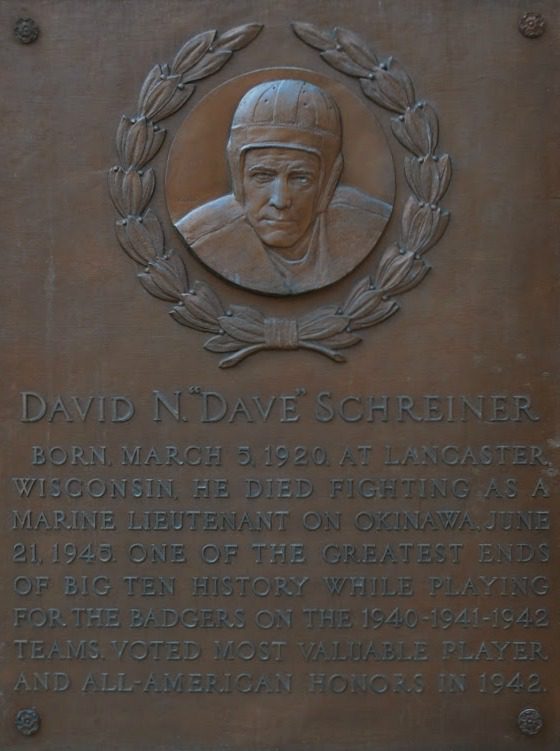
Dave Schreiner’s life embodied the extraordinary sacrifices made by a generation called upon to serve during World War II.
He was a gifted athlete, a respected Marine officer, a devoted son, and a leader whose concern for his men left an impression that endured long after the fighting ended.
His story is not simply one of athletic promise interrupted by war. It is the story of a young American who accepted the responsibilities of military leadership, shared the dangers faced by his Marines, and ultimately gave his life in the service of his country.
The men who survived Okinawa remembered more than Schreiner’s football accomplishments or military rank. They remembered an officer who knew them personally, cared for their welfare, and remained with them through the hardships of combat.
On June 25, 1945, Schreiner’s final letter arrived at his parents’ home in Lancaster, four days after his death. Its reassuring words, written before his final mission, became a heartbreaking reminder of the uncertainty borne by military families during wartime.
Today, through historical accounts, the memories of his fellow Marines, and the renewed attention brought by The Mosquito Bowl, his sacrifice continues to be remembered.
About James G. Fausone, Esq.
James G. Fausone, Esq. is a partner with Legal Help For Veterans, PLLC, with over twenty years of experience helping veterans apply for service-connected disability benefits and starting their claims, appealing VA decisions, and filing claims for an increased disability rating so veterans can receive a higher level of benefits.
If you were denied service connection or benefits for any service-connected disease, our firm can help. We can also put you and your family in touch with other critical resources to ensure you receive the treatment you deserve.
Give us a call at (800) 693-4800 or visit us online at www.LegalHelpForVeterans.com.
This electronic book is available for free download and printing from www.homeofheroes.com. You may print and distribute in quantity for all non-profit, and educational purposes.
Copyright © 2018 by Legal Help for Veterans, PLLC
ALL RIGHTS RESERVED
OUR SPONSORS