
Dwight Hal Johnson
Bravery & Disappointment
James G. Fausone
Dwight Hal Johnson’s life is one of stark contrasts – marked by deprivation and instability in childhood, extraordinary courage in war, and a troubled, ultimately tragic return to the same environment that had shaped him. To understand his story fully, it has to be told not just as the biography of a Medal of Honor recipient, but as the arc of a young man navigating the realities of urban poverty in mid-20th-century Detroit, a system that both produced and failed him.
Early Life in Detroit: Instability and Survival
Dwight Hal Johnson was born on May 7, 1947, in Detroit, Michigan, at a time when the city still carried the legacy of its industrial dominance but was already beginning to show the fractures that would define its later decline. Detroit in the post-World War II era was a city of opportunity for some, but for many Black families, those opportunities were sharply constrained by segregation, economic inequality, and institutional neglect.

Johnson grew up in the City’s core, an area increasingly populated by working-class African American families who had migrated north in search of better lives. By the 1950s and 1960s, however, the promise of steady industrial work was becoming less certain. Automation, suburbanization, and discriminatory hiring practices were narrowing pathways to stability. Neighborhoods like the one Johnson inhabited were characterized by aging housing, underfunded schools, and limited access to economic mobility.
His childhood was not anchored by a stable home. Jon Nordheimer for the New York Times reported in May 1971 that Johnson was born out of wedlock to a teenage mother and was raised on welfare. He also reported Johnson was known as a good boy on his Corktown housing project block, an altar boy, and an Explorer Scout.
These early conditions matter. Developmentally, stability in childhood is closely tied to educational and behavioral outcomes. Johnson’s environment instead required adaptability and toughness. He learned to navigate uncertainty, to rely on himself, and to survive in circumstances where long-term planning often gave way to immediate necessity. His mother, baby brother, and friends in the neighborhood knew him as “Skip”.
Schooling and Adolescence: A Difficult Fit
Johnson attended Northern High School in Detroit, but his experience there was uneven. Schools in his area were overcrowded and under-resourced, reflecting broader patterns of racial and economic segregation. Teachers were often stretched thin, and students facing external pressures – poverty, family instability, neighborhood violence – frequently struggled to engage in traditional academic pathways.
Johnson was one of those students. He had disciplinary issues and difficulty conforming to the structured expectations of school life. This was not unusual for young men in his circumstances; behavioral problems were often less about inherent defiance and more about a mismatch between rigid institutional systems and lives shaped by instability.
There is little evidence that he completed a traditional academic trajectory or developed a clear vocational path during these years. Instead, his adolescence appears to have been marked by increasing contact with the juvenile justice system. Time spent in detention or correctional settings further disrupted any chance of educational continuity and reinforced a cycle that many young men in similar situations found difficult to escape.
By the mid-1960s, Johnson stood at a crossroads familiar to many of his peers: limited education, few job prospects, and a social environment offering more barriers than opportunities. The industrial jobs that had once provided a foothold for working-class Detroiters were no longer as accessible, especially for young Black men without credentials or connections.
Detroit was still the center of the American automotive world. In the mid-1960s, layoffs were less frequent than in previous decades, and union contracts had secured generous pensions and health insurance for many workers. However, Black unemployment was approximately 8% citywide, reaching 11% or more in the neighborhoods where the riots began. For Black residents aged 18–24, the unemployment rate was a staggering 25% to 30%. In late 1967, city officials estimated that 16% of Detroit’s total population lived below the poverty line. For the Black community, that figure was 19% and homeownership was as low as 17% in some neighborhoods.
In 1967, metro Detroit was a region of stark economic contradictions – city vs. suburbs. While the area remained a global industrial powerhouse, the “Motor City” was struggling with deep-seated systemic issues that ultimately boiled over in the civil unrest in July 1967.
The anti-Vietnam War movement was heating up in that same late 1960s period. While the colleges remained the movement’s intellectual hub, the year saw a dramatic surge in draft resistance and protests against corporations linked to the war effort. By 1967, opposition to the Vietnam War shifted from legal protests toward open civil disobedience.
The Draft: A Forced Turning Point
It is in this climate that, in 1967, Johnson was drafted into the United States Army. For many young men of his background, the draft functioned as an abrupt intervention – removing them from their communities and placing them into a highly structured environment with clear expectations and consequences.
For Johnson, the Army represented something new: consistency, regular meals and a steady paycheck. Basic training and military life-imposed discipline, routine, and a defined hierarchy. For individuals who had grown up in unstable environments, this structure could be both challenging and transformative. It offered a sense of purpose and belonging that had been largely absent in civilian life.
Upon completion of basic, he was assigned to Company B, 1st Battalion, 14th Infantry Regiment, part of the 25th Infantry Division, and deployed to Vietnam. There, the abstract concept of discipline took on immediate, life-or-death significance. In his Vietnam unit, he was known as easy going and took racial jokes in stride.
Vietnam: Combat and Transformation
Johnson arrived in Vietnam during one of the most intense phases of the conflict. The nature of the war – characterized by guerrilla tactics, unclear front lines, and constant threat – placed enormous psychological and physical demands on soldiers.
On January 15, 1968, near Cu Chi, Johnson’s unit was engaged in a firefight that would define his legacy. The platoon of four M-48 tanks was racing down a road to Dakto, near the Cambodian border and the Ho Chi Minh Trail. The company came under sudden and heavy attack from a well-entrenched enemy force. The lead tank he generally rode in was hit by a rocket and caught on fire. He rushed to save that crew, pulling one man out, but the others perished being burned alive. That pushed Johnson over the edge and he went into kill-or-be-killed mode.
Johnson himself was wounded early in the engagement. In most cases, a wounded soldier would seek cover or evacuation. Johnson did the opposite. He moved forward into the open, directly into the line of fire. Acting on instinct or resolve – or both – he began engaging enemy positions at close range. Armed initially with his own rifle and grenades, he assaulted fortified positions alone, killing multiple enemy combatants and disrupting their coordinated attack.
At some point, he lost or exhausted his primary weapon. Rather than retreat, he picked up enemy weapons and continued fighting. When he ran out of bullets he bludgeoned a soldier with the stock of his rifle. At one point a Communist soldier, at point blank range, pulled the trigger to kill Johnson but the rifle misfired. Johnson is credited with killing 5 to 20 enemy soldiers. The cumulative effect of his actions was decisive. By disrupting enemy positions and buying time, he allowed his unit to regroup and avoid being overrun. In small-unit combat, such moments can determine whether a unit survives or is annihilated.
With flooding adrenaline, he could not calm down after the 30-minute firefight, and it is reported he needed three men and three shots of morphine to stop his raving. He ended up in a hospital and was watched for psychological effects, his time in Vietnam was over.
For these actions, Dwight Hal Johnson was awarded the Medal of Honor, the nation’s highest military decoration for valor. The citation emphasized his “conspicuous gallantry and intrepidity at the risk of his life above and beyond the call of duty.” It was a formal recognition of what, in practical terms, had been an extraordinary display of individual initiative and courage under fire.
Return to Detroit: Hero Meets Reality
Johnson returned to Detroit in the spring 1968 and was discharged with $600 in his pocket. He fell into the routine with his cousins and friends from the projects. He did not talk about Dakto and outwardly looked fine. His emotional damage was ignored or not addressed. He had a stack of photos of dead Vietnamese which friends thought odd.
Skip’s friends thought things seemed off. He married Katrina May and started looking for work in a lackluster way. By the fall of that year, Johnson’s life would be upended again, and his trauma was bubbling under the surface.
He was briefly celebrated as a national hero. He visited the White House and met President Lyndon B. Johnson and was presented the Medal of Honor on November 19, 1968. The story told was one of redemption – a young man from a troubled background who had performed acts of remarkable bravery.
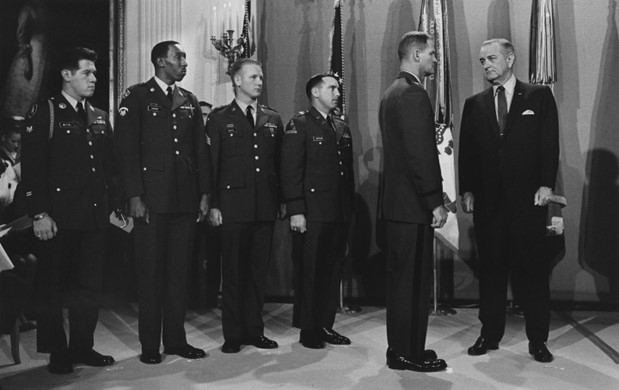
His citation reads:
For conspicuous gallantry and intrepidity at the risk of his life above and beyond the call of duty. Specialist 5 Johnson, a tank driver with Company B, was a member of a reaction force moving to aid other elements of his platoon, which was in heavy contact with a battalion-sized North Vietnamese force. Specialist Johnson’s tank, upon reaching the point of contact, threw a track and became immobilized. Realizing that he could do no more as a driver, he climbed out of the vehicle, armed only with a .45 caliber pistol. Despite intense hostile fire, Specialist Johnson killed several enemy soldiers before he had expended his ammunition. Returning to his tank through a heavy volume of anti-tank rockets, small arms, and automatic weapons fire, he obtained a submachine gun with which to continue his fight against the advancing enemy. Armed with this weapon, Specialist Johnson again braved deadly enemy fire to return to the center of the ambush site, where he courageously eliminated more of the determined foe. Engaged in extremely close combat when the last of his ammunition was expended, he killed an enemy soldier with the stock end of his submachine gun. Now weaponless, Specialist Johnson ignored the enemy fire around him, climbed into his platoon sergeant’s tank, extricated a wounded crewmember, and carried him to an armored personnel carrier. He then returned to the same tank and assisted in firing the main gun until it jammed. In a magnificent display of courage, Specialist Johnson exited the tank and, again armed only with a .45 caliber pistol, he engaged several North Vietnamese troops in close proximity to the vehicle. Fighting his way through devastating fire and remounting his own immobilized tank, he remained fully exposed to the enemy as he bravely and skillfully engaged them with the tank’s externally-mounted .50 caliber machine gun, where he remained until the situation was brought under control. Specialist Johnson’s profound concern for his fellow soldiers, at the risk of his life above and beyond the call of duty are in keeping with the highest traditions of the military service and reflects great credit upon himself and the United States Army.
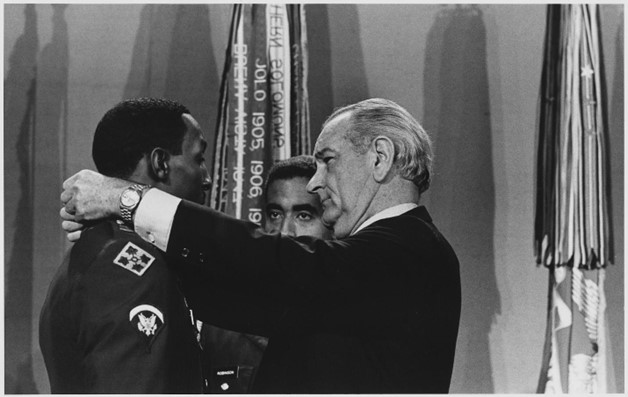
Johnson was a hot property in early 1969, attending Nixon’s inauguration and large testimonial dinners at Detroit’s Cobo Hall. But the recognition was fleeting, and it did not translate into lasting support, help, or stability.
He briefly returned to the active-duty Army after receiving the Medal of Honor and worked as a recruiter and public representative. However, he began missing scheduled appearances, prompting medical concerns. Medical reports documented symptoms including nightmares, emotional distress, and persistent guilt related to his combat experience, particularly his actions during the battle near Dakto. Today, it would be called post-traumatic stress disorder (PTSD).
Johnson went AWOL for 21 days in January 1971. The Army also sent him to Selfridge Air Base for medical treatment for a stomach problem. Then he was transferred to Valley Forge Army Hospital in Pennsylvania, where he was under the care of Army psychiatrists. The “preliminary analysis: Depression caused by post-Vietnam adjustment problem.” Johnson progressed and was given convalescent leave and headed back to Detroit, his wife, and a known life. Upon return, the doctors wrote: “The subject is bright…in general, there is evidence the subject learned to live up to the expectations of others, while there was a build-up of continually suppressed feelings. Skip felt he was exploited by the Army and that business offers to help never materialized.
He finally started talking in therapy about deeper anxieties like bad dreams, survivor’s guilt, and wondering if he was sane. When given a pass-out, he went back home and struggled with money and self-worth. Normal problems like mortgage payments, car payments, brake repairs, and hospital costs pressed down heavily on Johnson, who was really just a kid, notwithstanding the medal fame.
Death: A Tragic End
On April 30, 1971, just days before his 24th birthday, Dwight Hal Johnson’s life came to an abrupt and violent end. He caught a ride with a cousin and aunt to the local market at 11 p.m. Johnson entered the market armed with a revolver and demanded money. The store owner, who was also armed, exchanged gunfire with Johnson. The owner emptied his weapon into Johnson. This Army Medal of Honor recipient was killed during that failed store robbery. The autopsy revealed that Johnson was stone-cold sober.
The circumstances of his death underscore the environment in which he was living. Urban poverty, limited economic opportunity, and systemic neglect created conditions in which crime was both prevalent and, for some, a perceived means of survival.
Johnson died not on a battlefield, but in the same city where he had been born into hardship and to which he had returned after being hailed as a hero. Nordieimer reported that his mother said, “Sometimes I wonder if Skip was tired of this life and needed someone else to pull the trigger.”
Legacy: A Life in Full Context
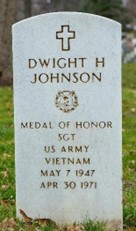
Dwight Hal Johnson is buried at Arlington National Cemetery, a place reserved for those who have served the nation with distinction. His Medal of Honor stands as a testament to his actions in Vietnam, to a moment when he rose above fear and injury to save others. But his legacy is more complex than that.
He demonstrated extraordinary bravery when placed in a context that demanded it and provided the framework to act. Yet outside that context, he faced systems that were ill-equipped to support him.
Johnson’s life does not fit neatly into a narrative of heroism or tragedy alone. It is both. It is the story of a young man shaped by urban poverty, transformed by war, and ultimately failed by the structures meant to reintegrate him.
In that sense, Dwight H. Johnson’s legacy extends beyond his Medal of Honor. It serves as a case study in the broader social and institutional dynamics that define not only individual lives, but entire generations.
About James G. Fausone, Esq.
James G. Fausone, Esq. is a partner with Legal Help For Veterans, PLLC, with over twenty years of experience helping veterans apply for service-connected disability benefits and starting their claims, appealing VA decisions, and filing claims for an increased disability rating so veterans can receive a higher level of benefits.
If you were denied service connection or benefits for any service-connected disease, our firm can help. We can also put you and your family in touch with other critical resources to ensure you receive the treatment you deserve.
Give us a call at (800) 693-4800 or visit us online at www.LegalHelpForVeterans.com.
This electronic book is available for free download and printing from www.homeofheroes.com. You may print and distribute in quantity for all non-profit, and educational purposes.
Copyright © 2018 by Legal Help for Veterans, PLLC
ALL RIGHTS RESERVED
RELATED AWARD CITATIONS
OUR SPONSORS