
Gregory “Pappy” Boyington
Native American Heritage of Marine Fighter Ace
James G. Fausone
Few American fighter pilots achieved the fame of Colonel Gregory “Pappy” Boyington, the hard-fighting Marine Corps aviator whose exploits over the Pacific during World War II made him a national hero. As commander of the legendary Black Sheep Squadron, Boyington became one of America’s most celebrated fighter aces, earning the Medal of Honor and Navy Cross for his extraordinary courage against Japanese forces. His remarkable military career eventually inspired a bestselling autobiography and a popular television series.
Yet one aspect of Boyington’s background has received considerably less attention: his Native American ancestry, commonly identified as Brulé Sioux, a branch of the Lakota people. This connection places Boyington within the broader history of Native American military service, a tradition extending from the nineteenth-century frontier through the world wars and into the modern American armed forces.
Although Boyington’s combat achievements are well documented, the details of his Indigenous ancestry remain less well established. Historical accounts identify him as being of Brulé Sioux descent, while a 2019 article in the Coeur d’Alene Press described him as a Brulé Sioux tribal member. The available published sources, however, do not establish his precise family lineage or provide independent documentation of tribal enrollment. That distinction is important when examining the heritage of one of America’s most colorful military heroes.
Growing Up in Idaho
Gregory Boyington was born on December 4, 1912, in northern Idaho. Although official military biographies identify Coeur d’Alene as his birthplace, some historical accounts list St. Maries, the nearby logging community where he spent much of his childhood. His early life unfolded in a region shaped by timber, mining, agriculture, and the longstanding presence of Native American communities.
Boyington’s family circumstances were complicated. His mother remarried when he was young, and he grew up believing that his stepfather, Gregory Hallenbeck, was his biological father. For much of his youth, he used the Hallenbeck surname. Only when he applied for Marine Corps aviation training in 1935 did he discover, through his birth records, that his biological father was Charles Boyington.
This revelation was consequential for his personal identity and military career. It also illustrates how incomplete knowledge of family history could complicate the reconstruction of ancestry. Although later biographical accounts identify Boyington’s Brulé Sioux heritage, the available sources do not clearly establish which branch of his family carried that ancestry or how prominently it figured in his upbringing.
The Brulé, also known as the Sicangu Lakota, are one of the major divisions of the Lakota people, whose historical homelands extend across the northern Great Plains. Their history includes generations of resistance to American westward expansion, treaty disputes, forced relocation, and efforts to preserve tribal sovereignty and cultural traditions.
Boyington’s reported Lakota ancestry is particularly noteworthy because he grew up in Idaho, far from the principal Brulé communities of the northern Plains. His family background reflected the geographical movement and complicated family histories that characterized many American households during the early twentieth century. However, there is insufficient evidence to conclude that he was raised within a Lakota cultural community or that traditional Lakota customs played a significant role in his childhood.
From Idaho to Marine Corps Aviation
As a youngster, Boyington developed a fascination with aviation. An early airplane ride with celebrated aviator Clyde Pangborn helped spark an enthusiasm that would eventually shape his life. His family later relocated to Washington, where he attended Lincoln High School in Tacoma before enrolling at the University of Washington.
At the university, Boyington distinguished himself as an athlete, participating in wrestling and swimming while studying aeronautical engineering. He also joined the Reserve Officers’ Training Corps, gaining his first substantial exposure to military discipline and leadership.
Graduating in 1934, Boyington briefly worked as an engineer for Boeing before pursuing his ambition of becoming a military pilot. He entered Marine Corps aviation training in 1936 and earned his naval aviator wings in March 1937.
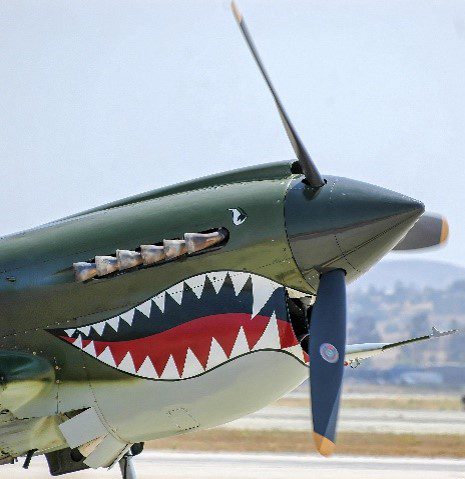
His early Marine career was marked by exceptional flying ability but also personal difficulties. Financial problems, drinking, and disputes with military authorities complicated his professional advancement. Nevertheless, his confidence in the cockpit and aggressive flying style would eventually prove invaluable in combat.
In 1941, Boyington resigned his Marine commission to join the American Volunteer Group, better known as the Flying Tigers. Operating in China and Burma under Claire Lee Chennault, these American volunteer pilots fought Japanese forces before and during the opening months of America’s involvement in World War II.
The Black Sheep Squadron
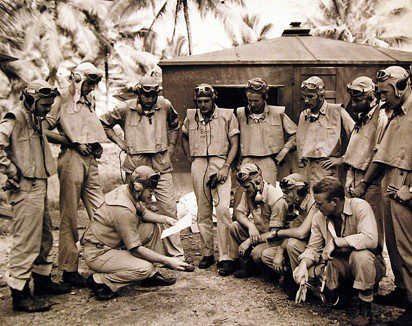
Boyington returned to the Marine Corps in 1942 and eventually found his defining assignment in the South Pacific. In September 1943, he assumed command of Marine Fighting Squadron 214, an organization assembled from replacement pilots and aviators awaiting permanent assignments.
The squadron became famous as the Black Sheep, while its commander acquired the nickname “Pappy” because, at approximately 30 years old, he was considerably older than most of his pilots.
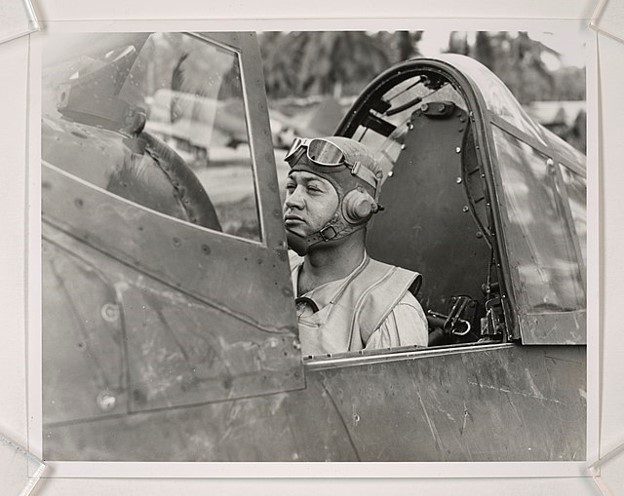
Flying powerful Vought F4U Corsair fighters, Boyington’s squadron engaged Japanese aircraft throughout the Solomon Islands campaign. His aggressive leadership, willingness to challenge numerically superior formations, and extraordinary aerial combat skills quickly established him as one of the Pacific War’s outstanding fighter commanders.
On October 17, 1943, Boyington led a formation of 24 American fighters over the Japanese airfield at Kahili on Bougainville. Rather than immediately attacking, the Americans challenged the Japanese pilots to take off and fight. The resulting aerial battle produced devastating losses for the Japanese without the loss of an American aircraft.
By January 1944, Boyington had become one of America’s leading fighter aces. His officially credited total is generally recorded as 26 aerial victories, although wartime accounts and subsequent historical assessments have differed concerning individual claims.
On January 3, 1944, Boyington was shot down during an aerial engagement near Rabaul. Initially reported missing and presumed dead, he had actually been captured by Japanese forces. He endured approximately 20 months as a prisoner of war before liberation in August 1945.
Native American Service in World War II
Boyington’s reported Brulé Sioux ancestry connects his story to the extraordinary contributions of Native Americans during World War II.
Approximately 44,500 Native Americans served in the American armed forces during the conflict, an exceptionally high participation rate relative to the Indigenous population at the time. Their service included infantry combat, aviation, naval operations, military intelligence, and communications.
Among the most celebrated were the Navajo Code Talkers, whose use of the Navajo language helped secure American military communications in the Pacific. Native Americans also distinguished themselves in European combat operations and throughout the Pacific campaigns.
For many Indigenous service members, military duty existed alongside a complicated relationship with the United States government. Their communities had experienced generations of treaty violations, land dispossession, and federal assimilation policies. Nevertheless, thousands volunteered to defend the country, their families, and their homelands.
Boyington’s achievements belong within this larger history, even though his own statements about his Native ancestry are not prominently documented in the principal military biographies. It would be speculative to attribute his courage, combat aggressiveness, or leadership style to Lakota cultural traditions without direct evidence of such an influence. His heritage deserves recognition on its own terms rather than through assumptions about Indigenous identity.
A Medal of Honor and a Lasting Legacy
While Boyington remained missing, President Franklin D. Roosevelt approved the Medal of Honor in recognition of his extraordinary combat leadership. Following his liberation, President Harry S. Truman personally presented the decoration at the White House on October 5, 1945.
Boyington also received the Navy Cross for his actions on the day he was shot down. He retired from the Marine Corps in 1947, having been advanced to the rank of colonel.
His postwar life included public appearances, writing, and the continuing challenges of adjusting to civilian life. His 1958 autobiography, Baa Baa Black Sheep, helped cement his reputation as a larger-than-life Marine aviator. During the 1970s, the television series based loosely on his experiences introduced his story to a new generation of Americans.
Boyington died on January 11, 1988, at age 75. He was buried with military honors at Arlington National Cemetery.
Today, Gregory “Pappy” Boyington is remembered primarily for his remarkable flying skills, his leadership of the Black Sheep Squadron, and his Medal of Honor. His reported Brulé Sioux heritage adds another dimension to that legacy, connecting one of America’s best-known combat aviators to the much larger, frequently overlooked history of Native American military service.
His story demonstrates that American military history is composed of many overlapping identities and traditions. Boyington was an Idaho native, a university-educated engineer, a Marine officer, a fighter ace, and a prisoner of war. He was also identified in historical accounts as a man of Lakota ancestry.
Recognizing that heritage does not diminish his individual accomplishments. Rather, it broadens our understanding of the Americans who fought and sacrificed during World War II, including those whose Indigenous family histories have too often remained outside the traditional narrative of military heroism.
Historical sources and editorial note
The article draws principally upon the Naval History and Heritage Command’s official biography, the Department of Defense’s Medal of Honor history, HistoryLink’s detailed biographical account, and reporting on Boyington’s Brulé Sioux ancestry.
The most important remaining research question concerns documentary verification of Boyington’s specific Brulé Sioux lineage and tribal citizenship. The Coeur d’Alene Press describes him as a tribal member, while other accounts describe him as being partly of Brulé Sioux descent. Those descriptions should not be treated as interchangeable without genealogical or tribal documentation.
About James G. Fausone, Esq.
James G. Fausone, Esq. is a partner with Legal Help For Veterans, PLLC, with over twenty years of experience helping veterans apply for service-connected disability benefits and starting their claims, appealing VA decisions, and filing claims for an increased disability rating so veterans can receive a higher level of benefits.
If you were denied service connection or benefits for any service-connected disease, our firm can help. We can also put you and your family in touch with other critical resources to ensure you receive the treatment you deserve.
Give us a call at (800) 693-4800 or visit us online at www.LegalHelpForVeterans.com.
This electronic book is available for free download and printing from www.homeofheroes.com. You may print and distribute in quantity for all non-profit, and educational purposes.
Copyright © 2018 by Legal Help for Veterans, PLLC
ALL RIGHTS RESERVED