
Terry P. Richardson
A Long Overdue Medal of Honor
James G. Fausone
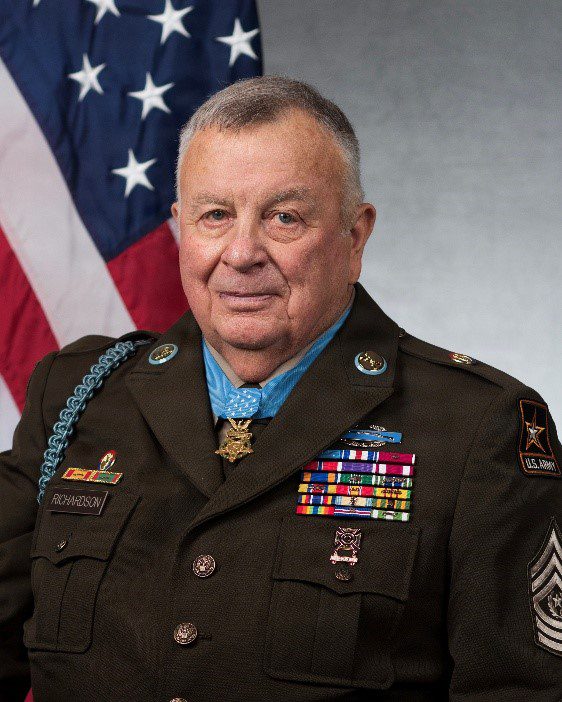
(Source: William Pratt, Public Domain, via Wikimedia Commons)
For nearly six decades, the story of Terry P. Richardson’s extraordinary courage in Vietnam remained largely unknown outside a small circle of family and fellow soldiers. On March 2, 2026, that changed when President Donald J. Trump presented retired Command Sergeant Major Terry Patrick Richardson with the Medal of Honor at the White House. The award recognized actions Richardson performed as a 20-year-old Staff Sergeant on September 14, 1968, near Loc Ninh, Vietnam—actions that ultimately saved the lives of 85 American soldiers.
He recounts his upbringing and service in an interview with Veterans Radio. A copy of that transcript follows. However, Medal of Honor recipients are not asked about the worst battle of their life on Veterans Radio. Therefore, below is a description of that battle and its larger context.
Vietnam placed Richardson in command responsibilities unusual for a young soldier. He became squad leader for 1st Platoon. During an operation along Highway 13, his platoon’s radio-telephone operator was killed. Richardson moved into the communications role while continuing to lead his men. It was a preview of the adaptability and personal courage he would demonstrate at Hill 222.
The Battle for Hill 222
On September 14, 1968, Richardson’s company was conducting a reconnaissance and movement-to-contact operation in the vicinity of Loc Ninh, not far from the Cambodian border. The mission involved securing Hill 222, a strategically important piece of high ground covered by rubber trees.
Richardson’s Lima Platoon was assigned to the point. He placed one of his squads forward. Almost immediately, the Americans encountered devastating enemy fire. The North Vietnamese force was far larger and better positioned than the Americans initially realized. Richardson’s platoon became separated from the remainder of the company and was pinned down by intense automatic-weapons and small-arms fire. Three soldiers were quickly severely wounded and trapped between enemy machine-gun positions.
Richardson repeatedly exposed himself to enemy fire to reach the wounded men. He moved through the danger zone three separate times and succeeded in getting the wounded soldiers back toward safety. At the same time, he organized his men and directed suppressive fire against the enemy.
The situation, however, was deteriorating rapidly. Richardson realized that the force confronting his company was much larger than originally believed. His soldiers were in danger of being surrounded and overrun. He made a decision that would define his military legacy.
Richardson moved alone toward Hill 222, using a shallow irrigation ditch and the rubber trees as cover. From his exposed position, he established contact with tactical aircraft and began directing airstrikes against the North Vietnamese positions.
The danger was immense. Richardson was operating forward of his own troops, effectively directing aircraft against an enemy force that was attempting to destroy his unit. Approximately an hour into the airstrike mission, a North Vietnamese sniper shot him in the right leg. Richardson refused to leave. Instead, he continued directing the aircraft.
For approximately seven more hours, despite his wound and the continuing danger around him, Richardson coordinated roughly 32 tactical airstrikes. The strikes devastated the enemy’s positions and ultimately forced the North Vietnamese force to withdraw. His actions allowed Alpha Company to secure Hill 222 without facing the full force of the enemy’s defensive position. According to the official Medal of Honor citation, Richardson’s actions directly resulted in 85 American lives being spared.
The official citation describes his conduct as “conspicuous gallantry, extraordinary heroism, and intrepidity” at the risk of his life, above and beyond the call of duty.
Richardson’s heroism was recognized with several military decorations, including the Bronze Star Medal, Purple Heart, Air Medal and Combat Infantryman Badge. Yet the Medal of Honor would not come for almost 58 years.
Recognition at Last
For years, Richardson did not publicly tell the full story of Hill 222. At his Michigan National Guard retirement ceremony, one of his former unit colleagues spoke about the events of September 14, 1968. Richardson later acknowledged that he had struggled with the experience and had rarely discussed it.
The long-delayed recognition culminated on March 2, 2026, when President Trump presented Richardson with the Medal of Honor at the White House. The following day, Richardson was inducted into the Pentagon’s Hall of Heroes.
The timing made the ceremony particularly significant. Richardson was the living recipient among three soldiers honored that day. Master Sergeant Roderick W. Edmonds was recognized posthumously for his World War II heroism, while Staff Sergeant Michael H. Ollis was recognized posthumously for his actions in Afghanistan. Together, their stories represented American valor across three generations of warfare.
For Michigan, however, Richardson’s recognition carries additional significance. The farm boy from Cass City who entered the Army as a 19-year-old draftee became an infantry leader in one of the Vietnam War’s most dangerous environments. He survived combat, returned home, built a civilian career, and then voluntarily returned to military service. He ultimately became one of Michigan’s most senior enlisted National Guard leaders.
The Battle of Hill 222 deserves considerably more attention because Richardson’s Medal of Honor action was not an isolated firefight. It occurred at the culmination of a major U.S. effort to locate and destroy elements of the North Vietnamese Army’s 7th Division in the Loc Ninh area during the third phase of the 1968 Communist offensive. The battle also illustrates the kind of large-unit, combined-arms fighting that characterized the Vietnam War after the Tet Offensive.
The Battle of Hill 222 in the Larger Vietnam Campaign
By September 1968, the Vietnam War had entered a complicated new phase. The North Vietnamese and Viet Cong had suffered enormous losses during the Tet Offensive of January–February 1968, but they had not been defeated. Instead, Communist forces continued attempting to keep American and South Vietnamese forces dispersed, inflict casualties, disrupt pacification efforts and demonstrate that they retained the ability to launch major attacks.
The fighting around Loc Ninh was part of what the U.S. Army historian Erik Villard describes as the third general offensive of 1968. By late summer, North Vietnamese forces were again increasing their activity in the provinces surrounding Saigon. In Binh Long Province, the North Vietnamese 7th Division was operating around the Loc Ninh area, using the jungle, rubber plantations and elaborate bunker complexes to conceal its forces.
Loc Ninh was strategically important. It lay along Highway 13, north of Saigon and close to the Cambodian border. The area was an important avenue for Communist forces moving men and supplies from sanctuaries in Cambodia into South Vietnam. For the 1st Infantry Division, locating and engaging those forces was therefore part of the broader effort to prevent the North Vietnamese from reconstituting themselves after Tet and from using the border region as a sanctuary.
The 1st Infantry Division, commanded by Major General Keith L. Ware, was consequently conducting operations designed to find the enemy rather than simply defend fixed positions. In August and September, American units repeatedly encountered North Vietnamese formations in the rubber plantations surrounding Loc Ninh.
The Road to Hill 222
The immediate battle began on September 11, when North Vietnamese forces attacked the Loc Ninh area. The 320th Regiment shelled American and Special Forces positions. The 1st Battalion, 2nd Infantry, went out to locate the enemy and encountered North Vietnamese fortifications east of Loc Ninh.
The following day, General Ware committed the 1st Battalion, 28th Infantry Regiment, Richardson’s battalion, to the operation.
The 28th Infantry was ordered to move north toward Hill 222, approximately six kilometers from Loc Ninh. Three companies advanced along separate routes through the rubber plantations. The dispersion was intended to increase the area covered and prevent the enemy from simply slipping away. Instead, the Americans encountered a substantial North Vietnamese force. The situation quickly became a major battle.
The American companies became separated and encountered elements of several North Vietnamese regiments, including the 141st, 165th and 320th Regiments. The fighting was sufficiently intense that at least one American company came close to being overrun. American artillery, tactical air support and the arrival of Troop E, 2nd Squadron, 11th Armored Cavalry Regiment, helped stabilize the situation.
This is important in understanding Richardson’s subsequent heroism. He was not operating in a small patrol that unexpectedly stumbled upon a handful of guerrillas. He was a platoon leader in a large-scale operation against well-organized North Vietnamese regulars.
September 13: A Disaster for the 1st Infantry Division
The following day, September 13, brought one of the most tragic events in the division’s history.
General Keith Ware flew toward the battlefield to observe the operation from the air. His command helicopter was struck by enemy fire approximately five kilometers south of Loc Ninh. The helicopter crashed, killing Ware, three members of his staff and four crewmen. All eight men aboard died. Brigadier General Orwin C. Talbott immediately assumed command of the division. Yet the operation continued.
The 1st Battalion, 28th Infantry attempted to assault Hill 222. The first attack was stopped by intense North Vietnamese fire. American commanders pulled the infantry back and brought in additional artillery and air strikes. A second attempt also encountered heavy resistance. The enemy had turned Hill 222 into a formidable defensive position.
Historical research by the U.S. Army Center of Military History indicates that the position contained an extensive bunker system. When American troops finally occupied the hill, they discovered at least 80 fighting positions, interconnected by communications wire and tied into a central command position on the reverse slope.
Other accounts from veterans describe the larger complex around Hill 222 as considerably more extensive. The terrain, rubber trees and concealed bunker positions gave the North Vietnamese substantial advantages.
September 14: Richardson’s Day
It was into this continuing battle that Staff Sergeant Terry Richardson led Lima Platoon of Alpha Company.
Richardson’s platoon was assigned to the point as American forces again moved against Hill 222. Richardson placed one of his squads at the front. Almost immediately, the platoon came under intense machine-gun and rifle fire. Three American soldiers were wounded and exposed. Richardson personally went forward to rescue them. This is where Richardson’s action connects directly to the distinctive American way of fighting in Vietnam.
The United States possessed overwhelming advantages in artillery, helicopters and tactical airpower. But those weapons were useful only when soldiers on the ground could locate the enemy and communicate his positions accurately. Richardson became the critical link between an isolated infantry platoon and the American airpower overhead.
His willingness to expose himself allowed American aircraft to attack the North Vietnamese positions that were pinning down his men.
Why Hill 222 Mattered
Hill 222 itself was not comparable to a strategic city or major military base. Its importance was operational.
The hill overlooked terrain north of Loc Ninh and was incorporated into a sophisticated North Vietnamese defensive system. Taking it helped the Americans disrupt the North Vietnamese forces operating in the area and contributed to the conclusion of the Communist third offensive in Binh Long Province. The U.S. Army’s official history specifically identifies the fall of Hill 222 as marking the end of that offensive in the province. That makes Richardson’s actions more significant than a single act of individual bravery.
His platoon was part of a larger American effort to prevent the North Vietnamese 7th Division from maintaining its freedom of movement in one of the most important border regions of South Vietnam. The battle demonstrated the continuing ability of North Vietnamese regular units to mount powerful conventional attacks despite the losses they had suffered earlier in 1968. It also demonstrated the price of fighting those forces.
In the broader history of Vietnam, Hill 222 represents something important: the war after Tet was becoming increasingly conventional in many areas, even while the United States continued to describe the conflict largely in terms of counterinsurgency. American infantrymen were confronting North Vietnamese regular formations equipped with machine guns, mortars, sophisticated field fortifications and coordinated defensive positions.
Richardson’s battlefield therefore combined the defining elements of Vietnam warfare: jungle terrain, concealed enemy positions, close infantry combat, helicopter mobility, artillery and overwhelming tactical airpower. And at the center of that complex battlefield was a 20-year-old Michigan soldier who repeatedly exposed himself to enemy fire to save his men.
Nearly 58 years later, when Richardson finally received the Medal of Honor, the award recognized not merely what he did during a few minutes on September 14, 1968, but his role in one of the most consequential battles fought by the 1st Infantry Division during the turbulent months following the Tet Offensive.
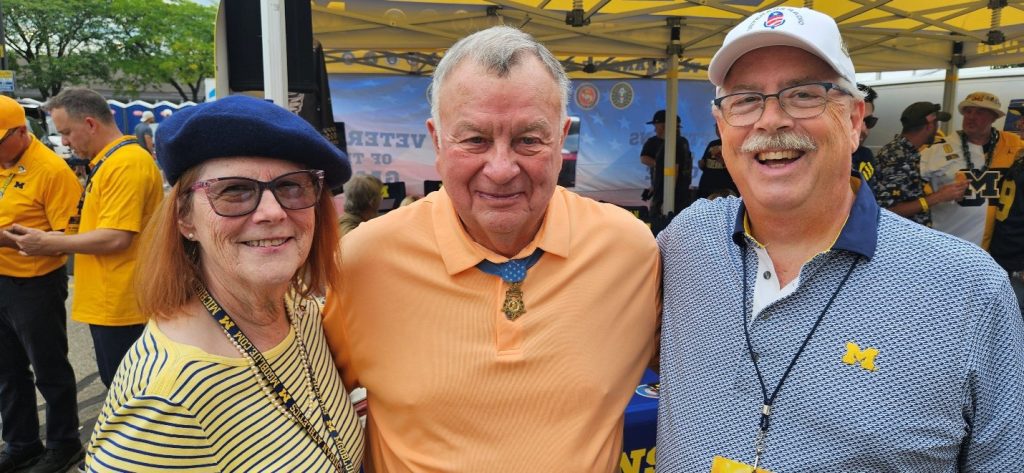
LISTEN TO VETERANS RADIO’S INTERVIEW WITH TERRY P. RICHARDSON
About James G. Fausone, Esq.
James G. Fausone, Esq. is a partner with Legal Help For Veterans, PLLC, with over twenty years of experience helping veterans apply for service-connected disability benefits and starting their claims, appealing VA decisions, and filing claims for an increased disability rating so veterans can receive a higher level of benefits.
If you were denied service connection or benefits for any service-connected disease, our firm can help. We can also put you and your family in touch with other critical resources to ensure you receive the treatment you deserve.
Give us a call at (800) 693-4800 or visit us online at www.LegalHelpForVeterans.com.
This electronic book is available for free download and printing from www.homeofheroes.com. You may print and distribute in quantity for all non-profit, and educational purposes.
Copyright © 2018 by Legal Help for Veterans, PLLC
ALL RIGHTS RESERVED
RELATED AWARD CITATIONS
OUR SPONSORS