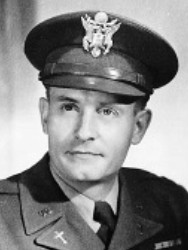
Emil Joseph Kapaun
Born: April 20, 1916 at Pilsen, Kansas
Home Town: Marion, Kansas
Status: MIA
Medal of Honor
U.S. Army
Korean War
Headquarters, Eighth U.S. Army, Korea: General Orders No. 625 (August 18, 1951)
The President of the United States of America, in the name of Congress, takes pride in presenting the Medal of Honor (Posthumously) to Captain (Chaplain) Emil Joseph Kapaun, United States Army, for conspicuous gallantry and intrepidity in action above and beyond the call of duty. Chaplain Kapaun distinguished himself by acts of gallantry and intrepidity above and beyond the call of duty while serving with the 3d Battalion, 8th Cavalry Regiment, 1st Cavalry Division during combat operations against an armed enemy at Unsan, Korea, from 1 – 2 November 1950. On 1 November, as Chinese Communist Forces viciously attacked friendly elements, Chaplain Kapaun calmly walked through withering enemy fire in order to provide comfort and medical aid to his comrades and rescue friendly wounded from no-man’s land. Though the Americans successfully repelled the assault, they found themselves surrounded by the enemy. Facing annihilation, the able-bodied men were ordered to evacuate. However, Chaplain Kapaun, fully aware of his certain capture, elected to stay behind with the wounded. After the enemy succeeded in breaking through the defense in the early morning hours of 2 November, Chaplain Kapaun continually made rounds, as hand-to-hand combat ensued. As Chinese Communist Forces approached the American position, Chaplain Kapaun noticed an injured Chinese officer amongst the wounded and convinced him to negotiate the safe surrender of the American Forces. Shortly after his capture, Chaplain Kapaun, with complete disregard for his personal safety and unwavering resolve, bravely pushed aside an enemy soldier preparing to execute Sergeant First Class Herbert A. Miller. Not only did Chaplain Kapaun’s gallantry save the life of Sergeant Miller, but also his unparalleled courage and leadership inspired all those present, including those who might have otherwise fled in panic, to remain and fight the enemy until captured. Chaplain Kapaun’s extraordinary heroism and selflessness, above and beyond the call of duty, are in keeping with the highest traditions of military service and reflect great credit upon himself, the 3d Battalion, 8th Cavalry Regiment, the 1st Cavalry Division, and the United States Army.
Distinguished Service Cross
U.S. Army
Korean War
Headquarters, Eighth U.S. Army, Korea: General Orders No. 625 (August 18, 1951) | General Orders No. 625 (August 18, 1951)
The President of the United States takes pride in presenting the Distinguished Service Cross (Posthumously) to Emil Joseph Kapaun (0-558217), Captain (Chaplain), U.S. Army, for extraordinary heroism in connection with military operations against an armed enemy of the United Nations while serving as Chaplain with Headquarters Company, 8th Cavalry Regiment (Infantry), 1st Cavalry Division. Captain (Chaplain) Kapaun distinguished himself by extraordinary heroism in action against enemy aggressor forces in the vicinity of Unsan, Korea, on 1 and 2 November 1950. On the afternoon of 1 November 1950, and continuing through the following 36 hours, the regiment was subjected to a relentless, fanatical attack by hostile troops attempting to break through the perimeter defense. In the early morning hours, the enemy succeeded in breaking through the defenses, and hand-to-hand combat ensued in the immediate vicinity of the command post where the aid station had been set up. Chaplain Kapaun, with complete disregard for his personal safety, calmly moved among the wounded men, giving them medical aid and easing their fears. His courageous manner inspired all those present and many men who might otherwise have fled in panic were encouraged by his presence and remained to fight the enemy. As the battle progressed, the number of wounded increased greatly and it became apparent that many of the men would not be able to escape the enemy encirclement. Finally, at dusk on 2 November 1950, the remaining able-bodied men were ordered to attempt to break through the surrounding enemy. At this time, although fully aware of the great danger, Chaplain Kapaun voluntarily remained behind, and when last seen was administering medical treatment and rendering religious rites wherever needed.
Headquarters, Eighth U.S. Army, Korea: General Orders No. 625 (August 18, 1951)
