
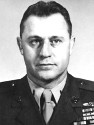
John William Frederick, Jr.
Home Town: Manito, Illinois
Status: POW


Navy Cross
Vietnam War
U.S. Marine Corps
Authority: Navy Department Board of Decorations and Medals
The President of the United States takes pride in presenting the Navy Cross (Posthumously) to John William Frederick, Jr. (333240838), Chief Warrant Officer, U.S. Marine Corps, for extraordinary heroism while interned as a Prisoner of War in Southeast Asia from June 1967 to August 1968. During this period, Chief Warrant Officer Frederick distinguished himself by his relentless rejection of any attempts to gain his cooperation or assistance. His steadfast resistance in the face of grave personal danger was an inspiration to other Prisoners of War who observed him. As a result of his dogged resistance, in spite of the fury and relentless cruelty of his captors, fellow prisoners were able to emulate his highly professional example and to find additional personal strength by which to resist interrogation and indoctrination. As a hard-core resister, and with full knowledge of the serious personal hazards to his life, Chief Warrant Officer Frederick personified leadership, bravery, and resistance far beyond that which could reasonably be expected. By his loyalty, perseverance, and courageous actions, Chief Warrant Officer Frederick upheld the highest traditions of the United States Marine Corps and the United States Naval Service.
Silver Star
Vietnam War
U.S. Marine Corps
The President of the United States takes pride in presenting the Silver Star Medal (Posthumously) to John William Frederick, Jr. (0-82847/397561), Chief Warrant Officer, U.S. Marine Corps, for conspicuous gallantry and intrepidity while interned as a Prisoner of War in Southeast Asia from May 1966 to April 1967. Despite severe injuries which resulted from maltreatment and severe cruelties, Chief Warrant Officer Frederick steadfastly refused to cooperate with his captors in their attempt to gain tactical information. Although long periods of solitary confinement for such offenses as refusing to bow or provide biographical information weakened his physical condition, he was not detracted from his dogged resistance. Refusing at all times to give in to the enemy, he provided a personal example and source of strength to his fellow prisoners. With full knowledge that his tenacious resistance could only arouse worse treatment, he showed extraordinary courage and determination, adhering to a Code of Conduct to an extent far beyond that which could reasonably be expected. By his resourcefulness and leadership in the face of great adversity, Chief Warrant Officer Frederick reflected great credit upon himself and upheld the highest traditions of the Marine Corps and the United States Naval Service.