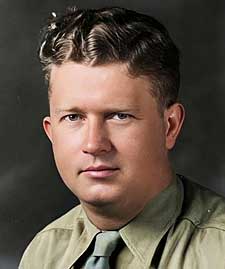
Roderick Waring Edmonds
Born: August 20, 1919 at Knoxville, Tennessee
Home Town: Fort Oglethorpe, Georgia
Master Sergeant Roderick W. Edmonds distinguished himself by acts of gallantry and intrepidity above and beyond the call of duty from January 27, 1945, to March 30, 1945, as a prisoner of war in Germany, while assigned to Headquarters and Headquarters Company, 422d Infantry Regiment, 106th Infantry Division. Upon arrival at Stalag IXA in Ziegenhain, Germany, he was soon put to the test as Senior Non-Commissioned Officer. On the evening of January 26, 1945, the Germans announced that only Jewish-American prisoners would fall out for roll call the following morning, at the threat of execution. Master Sergeant Edmonds quickly understood that segregating more than 200 Jewish-American prisoners of war would likely result in their persecution and possible death, so he directed his senior leaders to have all 1,200 American prisoners present themselves for roll call. The following morning, the Nazi Commandant became incredulous after realizing that so many Americans were standing in formation. Master Sergeant Edmonds bravely resisted his fury, while also recounting the rights afforded to all prisoners under the Geneva Convention. Still enraged, the Commandant removed his pistol, pressed it hard against Master Sergeant Edmonds’ forehead between his eyes and demanded that he order all Jewish-American prisoners to step forward, or he would be shot. With unwavering courage at the risk of his life, above and beyond the call of duty, Master Sergeant Edmonds fearlessly held his ground, refusing to concede and verbally warned the Commandant that if he executed him, he would be prosecuted for war crimes once the war was over. Finally, the Commandant, who was visibly reddened with anger, lowered his weapon and returned to his office without further attempts to segregate the Jewish-American prisoners. Master Sergeant Edmonds’ actions inspired his fellow prisoners of war. Several weeks later, in March 1945, as Allied forces were rapidly advancing toward the area, the Germans ordered all prisoners to assemble outside the barracks for evacuation farther east to another camp. Fully intending to undermine his enemy captors, Master Sergeant Edmonds ordered all American prisoners to form in front of the barracks, and when the enemy transports arrived, they would break ranks and rush back to their barracks. Without regard for his own life Master Sergeant Edmonds gallantly led these prisoners in a relentless pursuit of opposition and resistance, forcing the Germans to abandon the camp leaving the 1,200 American prisoners behind. The full extent of his bravery, unbending will, and courageous leadership would be realized when soldiers from 3d U.S. Army liberated the camp on March 30, 1945. Master Sergeant Edmonds’ conspicuous gallantry and intrepidity at the risk of his life, above and beyond the call of duty, are in keeping with the highest traditions of military service and reflect great credit upon himself, his unit, and the United States Army.
