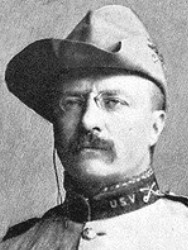
Theodore Roosevelt
Born: October 27, 1858 at New York, New York
Home Town: New York, New York
Medal of Honor
U.S. Army
Spanish-American War
Date of Issue: January 16, 1901
The President of the United States of America, in the name of Congress, takes pride in presenting the Medal of Honor (Posthumously) to Lieutenant Colonel Theodore Roosevelt, United States Army, for extraordinary heroism while serving with 1st U.S. Volunteer Cavalry (Rough Riders), in action at Santiago, Cuba. Lieutenant Colonel Theodore Roosevelt distinguished himself by acts of bravery on 1 July, 1898, near Santiago de Cuba, Republic of Cuba, while leading a daring charge up San Juan Hill. Lieutenant Colonel Roosevelt, in total disregard for his personal safety, and accompanied by only four or five men, led a desperate and gallant charge up San Juan Hill, encouraging his troops to continue the assault through withering enemy fire over open countryside. Facing the enemy’s heavy fire, he displayed extraordinary bravery throughout the charge, and was the first to reach the enemy trenches, where he quickly killed one of the enemy with his pistol, allowing his men to continue the assault. His leadership and valor turned the tide in the Battle for San Juan Hill. Lieutenant Colonel Roosevelt’s extraordinary heroism and devotion to duty are in keeping with the highest traditions of military service and reflect great credit upon himself, his unit, and the United States Army.
Silver Star
U.S. Army
World War I
The President of the United States of America, authorized by Act of Congress July 9, 1918, takes pleasure in presenting a Bronze Oak Leaf Cluster in lieu of a Second Award of the Silver Star to Major Theodore Roosevelt, Jr. (ASN: 0-139726), United States Army, for gallantry in action during the operations against Mouzon and Sedan in 1918.
Silver Star
U.S. Army
World War I
The President of the United States of America, authorized by Act of Congress July 9, 1918, takes pleasure in presenting a Third Bronze Oak Leaf Cluster in lieu of a Fourth Award of the Silver Star to Brigadier General Theodore Roosevelt, Jr. (ASN: 0-139726), United States Army, for gallantry in action while serving with the 1st Infantry Division at El Guettar, Tunisia, 23 March 1943. During the Division’s initial assault operations General Roosevelt, displaying exceptional tactical judgment, planned and led the attack of a reinforced combat team. Although constantly harassed by heavy enemy machine gun and small arms fire, General Roosevelt preceded his team’s assault waves into battle. This example of unflinching courage was a source of great confidence to his men in his leadership and enabled them to quickly attain their objective.
Silver Star
U.S. Army
World War I
The President of the United States of America, authorized by Act of Congress July 9, 1918, takes pleasure in presenting the Silver Star to Major Theodore Roosevelt, Jr. (ASN: 0-139726), United States Army, for gallantry in action while serving with the 26th Infantry, 1st Division, American Expeditionary Forces, in action during the operations connected with the capture and defense of Cantigny, France, 27 to 31 May 1918. Major Roosevelt during an enemy raid, displayed high qualities of courage and leadership in going forward to supervise in person the action of one of the companies of his battalion which had been attacked; on the day of our attack upon Cantigny, although gassed in the lungs and gassed in the eyes to blindness, Major Roosevelt refused to be evacuated and retained command of his battalion, under heavy bombardment, throughout the engagement.
Silver Star
U.S. Army
World War I
The President of the United States of America, authorized by Act of Congress, July 9, 1918, takes pleasure in presenting a Second Bronze Oak Leaf Cluster in lieu of a Third Award of the Silver Star to Brigadier General Theodore Roosevelt, Jr. (ASN: 0-139726), United States Army, for gallantry in action while serving with the 1st Infantry Division at El Guettar, Tunisia, 22 March 1943. When enemy forces began a savage counterattack on our positions, General Roosevelt proceeded immediately to a forward observation post subjected to particularly intense enemy artillery fire, strafing, and furious dive-bombing, returning to the Division Command Post only when the enemy threat had been dispelled. His personal observations were of great value to this command, and his cheerful zeal, aggressive energy and great personal Courage exemplified the highest traditions of the Service.
