
Benjamin D. Pritchard
Cabinetmaker, Lawyer, and Michigan Statesman
James G. Fausone
Few figures from Michigan’s richard military and civic history occupy as unique a place in the American narrative as Brevet Brigadier General Benjamin Dudley Pritchard. Best remembered as the Union cavalry officer who led the final pursuit and apprehension of Confederate President Jefferson Davis, Pritchard’s life extended far beyond a single historic morning in Georgia. He was an educator, a pioneering attorney, a dedicated community builder, a banking executive, and a two-term Treasurer of the State of Michigan.
Early Life and Education
Benjamin Dudley Pritchard was born on January 29, 1835, in rural Nelson, Portage County, Ohio, to parents Lambert and Zulpha (Adams) Pritchard. Growing up in a hardworking nineteenth-century household, Pritchard initially learned the trade of carpentry and cabinet-making. Possessing a fierce drive for self-improvement and higher education, he saved every dollar he earned from his manual labor until he had accumulated enough funds to enroll at Hiram College.
At Hiram, Pritchard studied under notable educators, including James A. Garfield, who would later serve as the twentieth President of the United States. Pritchard also honed his penmanship under the renowned Spencer brothers, developers of the famous Spencerian script.
Garfield served as the twentieth president of the United States from March 4, 1881, until his death on September 19 of that year. Shot on July 2, he died after a prolonged illness. His brief presidency included a confrontation with Senator Roscoe Conkling over patronage appointments, affirming presidential authority over federal appointments. Garfield’s assassination intensified demands for civil-service reform, helping pave the way for the Pendleton Civil Service Reform Act, signed by President Chester A. Arthur in 1883. Garfield also championed African American civil rights and educational opportunity. His connection to Pritchard offers a glimpse of the educational and political currents that shaped the era.
Garfield’s example may have reinforced Pritchard’s commitment to education and public service. Seeking new opportunities, Pritchard moved to Allegan, Michigan, in 1856. To support himself while pursuing his professional ambitions, he accepted a position teaching for the Allegan Public Schools at a modest annual salary of $240. Simultaneously, he read law under the tutelage of Judge W. B. Williams. Seeking formal legal grounding, he entered the University of Michigan Law School in 1858, graduating and gaining admission to the Michigan bar in 1860. Returning to Allegan, he formed a partnership with his former mentor, Judge Williams, establishing a thriving local law practice.
Civil War Service and 4th Michigan Cavalry
When the American Civil War tore the nation apart, Pritchard answered President Abraham Lincoln’s call to preserve the union. In August 1862, both Pritchard and his law partner, Judge Williams, closed their office doors to enlist in the Union Army, joining the 4th Michigan Volunteer Cavalry.
Pritchard was initially commissioned as a Captain and placed in command of Company L. The 4th Michigan Cavalry quickly earned a stellar reputation for discipline, tactical mobility, and tenacity in the Western Theater. During the American Civil War, the Western Theater was broadly defined as the region situated west of the Appalachian Mountains and east of the Mississippi River.
The regiment participated in numerous grueling campaigns and major engagements, including the Tullahoma Campaign, the Battle of Chickamauga, the Atlanta Campaign, and the pursuit of Confederate forces across Tennessee and Georgia.
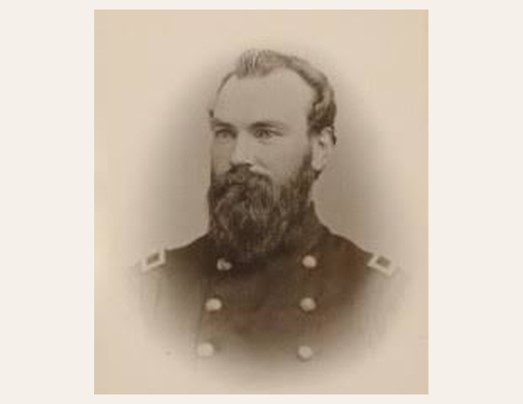
Through exemplary leadership under fire, steady administrative capability, and tactical competence, Pritchard steadily rose through the ranks. Following the rigorous combat actions of late 1863, he was promoted to Lieutenant Colonel, placing him second-in-command of the entire regiment.
The Capture of President Jefferson Davis
Pritchard’s place in history was sealed in May 1865. Following the collapse of the Confederacy and the surrender of General Robert E. Lee’s army, fugitive Confederate President Jefferson Davis fled south from Richmond, Virginia, attempting to reach the Trans-Mississippi Department or escape overseas.
Federal authorities assigned Union cavalry units across Georgia to scour the countryside and intercept the fleeing Confederate leader. By early May, Lieutenant Colonel Pritchard and a detachment of approximately 439 men from the 4th Michigan Cavalry were actively scouting the banks of the Ocmulgee River.
On May 7, 1865, intelligence reached Pritchard indicating that Davis and his remaining small party were moving through the pine barrens twoard Irwinville, Georgia. Demonstrating the aggressive initiative that defined his military career, Pritchard led his men on a punishing, fast-paced night ride of roughly 30 miles down narrow rural roads, arriving in the vicinity of Irwinville late in the night.
Upon arrival, Pritchard split his forces to converge on the suspected campsite from multiple directions to prevent escape. In the early morning hours of May 10, 1865, elements of the 4th Michigan Cavalry surrounded the encampment. Corporate George Munger, an Allegan native serving under Pritchard, noticed figures attempting to slip past the picket lines wrapped in heavy cloaks and shawls. Challenging the individuals, Munger and his comrades discovered that the fleeing figures were Jefferson Davis and his wife. Though sensationalized in Northern newspapers and political cartoons of the era regarding Davis’s attire during the hurried moment of apprehension, the capture effectively ended the organized political leadership of the Confederacy.
For his role in executing the successful operation, Lieutenant Colonel Pritchard was awarded the brevet rank of brigadier general of volunteers and received a substantial share of the reward money offered by the federal government. Throughout his later life, Pritchard remained a modest and respected veteran, always careful to share the credit with the brave officers and enlisted men of the 4th Michigan Cavalry who shared the saddle with him that night.
Post-War Career and Civic Leadership in Allegan
Mustering out of the military, General Pritchard returned to his adopted hometown of Allegan, Michigan, resuming his civilian life with the same vigor he brought to the battlefield. On September 1, 1864 – during a brief respite from the war – he married Mary Bently Kent, with whom he later raised two children, Bertha Edna and Harry.
Pritchard practiced law in Allegan until 1868, after which he transitioned into banking and public administration. Recognizing the economic needs of a growing post-war western Michigan, he founded the First National Bank of Allegan in 1870, serving as its president for 35 years until 1905. Later, he established the First State Bank, pioneering local financial innovations such as safety deposit boxes and higher interest yields for everyday savers.
Deeply committed to civic duty, Pritchard spent decades shaping local education. He served extensively as the Director of the Allegan School Board, during which time he oversaw the construction of three new elementary schools and founded Allegan’s very first high school, which graduates its inaugural senior class in 1876.
Stepping onto the broader political stage, Pritchard was elected to two terms as the Treasurer of the State of Michigan, serving from 1880 to 1884 with a reputation for fiscal integrity. His political standing was such that he was strongly urged to run for Governor of Michigan and the United States Congress in 1884; however, Pritchard declined both opportunities, preferring to remain close to his family, community, and local responsibilities.
Legacy and Death
General Benjamin D. Pritchard remained an active, prominent figure of the Allegan community well into his later years. He worshipped at the Allegan First Congregational Church and remained closely tied to fellow veterans through the Grand Army of the Republic.
In November 1907, Pritchard began experiencing failing health. He died at his home on November 26, 1907, at the age of 72. His passing was mourned statewide, and more than 600 mourners – including civic leaders, judicial peers, and aging Union veterans – attended his funeral services. He was laid to rest with full military honors in Allegan’s Oakwood Cemetery.
Today, Benjamin D. Pritchard is remembered as the embodiment of the nineteenth-century American citizen-soldier: a self-made man who traded his legal briefs and carpenter’s tools for a cavalry saber, played a decisive role in closing the chapter of the American Civil War, and returned home to quietly build the institutions of law, education, and finance that shaped modern Michigan.
About James G. Fausone, Esq.
James G. Fausone, Esq. is a partner with Legal Help For Veterans, PLLC, with over twenty years of experience helping veterans apply for service-connected disability benefits and starting their claims, appealing VA decisions, and filing claims for an increased disability rating so veterans can receive a higher level of benefits.
If you were denied service connection or benefits for any service-connected disease, our firm can help. We can also put you and your family in touch with other critical resources to ensure you receive the treatment you deserve.
Give us a call at (800) 693-4800 or visit us online at www.LegalHelpForVeterans.com.
This electronic book is available for free download and printing from www.homeofheroes.com. You may print and distribute in quantity for all non-profit, and educational purposes.
Copyright © 2018 by Legal Help for Veterans, PLLC
ALL RIGHTS RESERVED
OUR SPONSORS