
Duane Edgar Dewey
A Body of Steel, A Life of Service
James G. Fausone
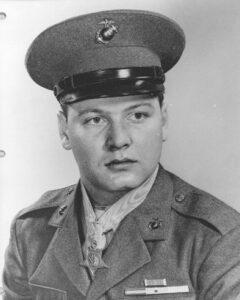
(Photo Courtesy: Wikipedia)
Among the thousands of Americans who fought in the Korean War, few embodied the Marine Corps ideals of courage, sacrifice, and fidelity to comrades more completely than Corporal Duane Edgar Dewey. His Medal of Honor action on April 16, 1952, lasted only a matter of seconds, yet it secured his place in military history forever. Faced with an enemy grenade while already wounded and unable to escape, he consciously chose to use his own body as a shield to save a Navy corpsman and fellow Marines.
The act was extraordinary. The life that followed was equally remarkable.
For nearly seventy years after Korea, Dewey demonstrated that heroism is not merely found in dramatic moments of combat but in the steady fulfillment of responsibilities as a husband, father, businessman, veteran advocate, and citizen. While Americans celebrated him as a Medal of Honor recipient, those who knew him best remembered him as a devoted family man whose greatest pride was not the medal he wore around his neck but the family he helped build and the quiet life he forged after surviving a war that nearly killed him.
Depression-Era Beginnings
Duane Edgar Dewey entered the world on November 16, 1931, in Grand Rapids, Michigan, during the darkest years of the Great Depression. America was struggling through economic collapse, unemployment, and uncertainty. Millions of families found themselves living from one paycheck to the next, and the Dewey family was no exception.
His earliest years were spent on a farm near Kalkaska in northern Michigan. Life on a Michigan farm during the Depression was demanding. He described his family as “very poor” as they lived in a 100-year-old house owned by the State of Michigan and leased to the family. Children learned responsibility early because life often depended on the labor of every family member.
Secure, consistent employment during those difficult years was unavailable. Eventually, the family relocated to Muskegon, where his father found work in a foundry. Although the move provided greater economic stability, life remained modest. The Deweys were a working-class family accustomed to sacrifice and perseverance.
These early experiences shaped Duane’s character. Friends later observed that he possessed an unusual humility, maybe from his poor upbringing and lack of education. That humility was rooted in his upbringing. He never forgot where he came from.
Like many young Americans of his generation, economic realities often outweighed personal or educational ambitions. At sixteen, Dewey left school. He wanted to join the Air Force and his dad agreed to sign for him,
but his mother would not allow it. She worked at the local post office where the recruiting station was located, and upon hearing about Duane’s plans, she stopped him from joining the Army. He joked that his dad agreed so that he had one less mouth to feed.
Duane then moved to South Haven, Michigan, where he lived with relatives. There he worked on local farms and later in foundry jobs. The work was physically demanding. Within a few years, world events would alter the course of his life forever.
A Young Husband
While living and working in South Haven, Dewey met a young woman named Bertha Bierhalter. Their relationship developed during the years immediately preceding his military service in 1951, and the two eventually married. The marriage would become one of the defining relationships of his life. His first child, a daughter, would be born when he was injured and recovering in service.
Unlike many Medal of Honor recipients whose stories focus exclusively on battlefield heroics, Dewey’s story is also a love story. Bertha would stand beside him through devastating injuries, years of recovery, public recognition, and decades of veteran service.
The couple married shortly before Dewey entered military service, beginning a partnership that would endure for sixty-eight years. Years later, when asked about the most important parts of his life, Dewey frequently spoke more readily about Bertha and his family than about the Medal of Honor.
Answering the Call to Serve
In June 1950, North Korean forces crossed the 38th Parallel and invaded South Korea. The invasion triggered a major international response led by the United States and the United Nations.
In March 1951, nineteen-year-old Duane Dewey was with a cousin who told him to jump in his car as they were going to drive to Kalamazoo. The cousin told him he was going to enlist in the United States Marine Corps. Duane told him he was not going to join the Marines, and three hours later he enlisted in the Marine Corps.
He attended recruit training at Parris Island, South Carolina, where drill instructors transformed civilians into Marines through relentless discipline and physical conditioning. Following recruit training, he attended advanced combat instruction at Camp Pendleton, California.
In September 1951, he deployed to Korea as a member of Company E, 2nd Battalion, 5th Marines, 1st Marine Division. What awaited him was a war unlike any American had anticipated.
Korea’s Trench War
There is a reason it is called the Forgotten War, sandwiched between World War II and Vietnam War. For those who fought, died, or were injured, it was never forgotten. An estimated 5.7 to 6.8 million American service members served during the Korean War, with total troop numbers for all participating nations (including South Korea, China, North Korea, and other UN allies) exceeding 13 million. There were approximately 36,515 to 54,200 deaths, based on the Department of Defense or Veterans Affairs estimates, which include all in-service deaths globally during the hostilities. Of these, roughly 33,700 were classified as battle deaths. More than 103,000 Americans were wounded in action. About 7,200 Americans were captured or went missing, with over 2,700 dying while held as prisoners of war. By the time Dewey arrived, the Korean War had entered a new phase.
The dramatic offensives and retreats of 1950 and early 1951 had largely ended. Instead, the war became a grinding struggle over ridgelines, observation posts, and fortified positions. The front lines stabilized near the 38th Parallel, and combat increasingly resembled the trench warfare of World War I.
Marines lived in bunkers, fought from trenches, and endured constant artillery fire. Nighttime attacks became common. Chinese Communist forces frequently launched assaults under cover of darkness, seeking to overrun United Nations positions through surprise and overwhelming numbers. For Marines defending the line, every night could become a fight for survival.
One such night would define Duane Dewey’s legacy.
April 16, 1952
On April 16, 1952, Dewey was serving near Panmunjom as a machine-gun squad leader. The strategic importance of machine guns cannot be overstated. Machine-gun crews formed the backbone of infantry defenses. Their ability to deliver sustained fire could stop enemy attacks and prevent defensive lines from collapsing. After darkness fell, large numbers of Chinese soldiers launched a determined assault against Marine positions.
Years later, Dewey recalled that approximately eighty Marines faced several hundred enemy troops—possibly as many as six hundred or seven hundred. The odds were daunting. Mortars exploded throughout the defensive perimeter. Small-arms fire crackled through the darkness. One challenge in a sustained firefight was running out of ammunition. When that happened, Dewey sprinted under fire back to the command position to obtain more ammunition. However, supplies were limited, both bullets and grenades. Both sides started hurling grenades as the lines were that close in the fight. Grenades burst among the trenches. The Marines fought fiercely. Dewey’s machine-gun squad helped blunt repeated enemy attacks.
The odds of disaster were mounting. An enemy grenade exploded behind him. Fragments tore through his left leg, inflicting serious wounds and knocking him to the ground. Unable to stand or move to cover, Dewey remained exposed while a Navy corpsman rushed forward to provide medical treatment.
The corpsman was young and, according to Dewey’s recollections, experiencing his first night in combat. While being attended to for the first grenade attack, another enemy grenade landed nearby. The grenade would detonate almost immediately. Dewey later explained that his first instinct was to throw it away, but he recognized there was no time. He was lying on his back badly wounded. Pulling the corpsman toward him, Dewey shouted a warning to nearby Marines. Then he rolled directly onto the grenade.
According to Marine Corps accounts, he yelled: “Doc, I got it in my hip pocket!” A moment later the grenade exploded beneath him. The blast lifted both men off the ground. Dewey absorbed the explosion with his own body. It was an act of deliberate self-sacrifice. He fully expected to die.
Thoughts of Bertha
One of the most poignant aspects of Dewey’s story emerged decades later during interviews conducted by the Congressional Medal of Honor Society and the Veterans History Project.
As he lay wounded following the explosion, he believed death was imminent. His thoughts immediately turned to Bertha. She was pregnant when he deployed overseas. While he was serving in Korea, she gave birth to their daughter. He had never seen the child. Lying on the battlefield, he prayed not for his own survival but for the future of his family. He later recalled praying that Bertha would someday find a good husband if he died and that his daughter would have a good father. The statement reveals the depth of his character.
Even while facing death, his concern centered on others. The same instinct that caused him to shield fellow Marines from the grenade also caused him to think first of his wife and child.
Surviving the Impossible
The explosion inflicted catastrophic injuries. Many believed survival was unlikely. Dewey later joked about his wounds, but the reality was grim. The blast tore into his body and compounded the severe injuries already inflicted by enemy fragments. Following evacuation from the battlefield, he received treatment in Korea before being transferred to hospitals in Japan and eventually the United States.
Recovery required months of hospitalization. Doctors fought infections, repaired damaged tissue, and worked to restore mobility. Few expected him to recover as completely as he eventually did. Yet the same determination that had carried him through the depression and combat carried him through rehabilitation. Against all odds, he survived.
Eisenhower and the Medal of Honor
On March 12, 1953, Duane Dewey entered the White House. President Dwight D. Eisenhower personally presented him the Medal of Honor. The ceremony marked a significant milestone in American military history because Dewey became the first Medal of Honor recipient to receive the decoration from WWII Supreme Commander, General Eisenhower, after he assumed the presidency.
After reading the citation and observing the extent of Dewey’s recovery, Eisenhower reportedly exclaimed: “You must have a body of steel.” The phrase became forever associated with Dewey. Yet he never embraced celebrity. Throughout his life, he insisted that many Marines had displayed equal courage. The only difference, he often suggested, was that he happened to survive.
Duane Edgar Dewey’s Medal of Honor citation reads:
For conspicuous gallantry and intrepidity at the risk of his life above and beyond the call of duty while serving as a gunner in a machine-gun platoon of Company E, in action against enemy aggressor forces. When an enemy grenade landed close to his position while he and his assistant gunner were receiving medical attention for their wounds during a fierce night attack by numerically superior hostile forces, Cpl. Dewey, although suffering intense pain, immediately pulled the corpsman to the ground and, shouting a warning to the other Marines around him, bravely smothered the deadly missile with his body, personally absorbing the full force of the explosion to save his comrades from possible injury or death. His indomitable courage, outstanding initiative, and valiant efforts on behalf of others in the face of almost certain death reflect the highest credit upon Cpl. Dewey and enhance the finest traditions of the U.S. Naval Service.
Coming Home
When Dewey returned to South Haven, he was welcomed as a hero. The local community organized an extraordinary gesture of appreciation. Citizens raised funds and furnished a home for the young Marine and his growing family. The gift provided stability at a critical moment.
Dewey was recovering from severe injuries, adjusting to civilian life, and beginning the responsibilities of fatherhood. The support of the community helped ease that transition. Yet despite national recognition, Dewey sought neither fame nor political influence. Instead, he focused on building a life.
Building a Career
Like many veterans, Dewey understood that medals alone could not provide for a family. He needed a profession. One of his earliest civilian jobs was with the Everett Piano Company in South Haven. The position provided valuable employment while he adjusted to postwar life.
Recognizing the need for specialized skills, he later attended the Michigan Veterans Vocational School at Pine Lake. There he studied office-machine repair. The training proved transformative.
Armed with new technical skills, Dewey established his own business, South Haven Office Machines. The company repaired typewriters, calculators, adding machines, and other office equipment. For younger generations accustomed to computers and smartphones, it is difficult to appreciate how important such equipment was during the 1950s and 1960s. Businesses depended on these machines.
Dewey built a respected reputation through reliability, honesty, and craftsmanship. Customers frequently encountered not a Medal of Honor recipient, but a hardworking repairman dedicated to solving their problems. His business thrived for years.
In addition to operating his company, Dewey drove school buses for South Haven Public Schools. The image is striking. One of America’s most decorated veterans spent part of his civilian career transporting children safely to school. It perfectly reflected his character. No task was beneath him. Service remained service.
A Devoted Family Man
As the years passed, Duane and Bertha built a close-knit family. Their daughter, Arline, grew up hearing stories not of heroism but of responsibility, integrity, and perseverance. Their son, Dwight—nicknamed “Ike” after President Eisenhower—carried a living reminder of the historic relationship between his father and the President who awarded the Medal of Honor.
Family members later recalled that Dewey rarely spoke about himself. Instead, he focused on his children, grandchildren, and community. The marriage between Duane and Bertha became one of remarkable endurance. For sixty-eight years they navigated the challenges of family life, business ownership, retirement, and public obligations associated with the Medal of Honor. Theirs was a partnership built on mutual support and deep affection.
Retirement and New Adventures
In 1973, Dewey retired from active business operations. Rather than settling permanently in one location, he and Bertha embraced a lifestyle that balanced northern and southern living. They sold their South Haven residence and moved to a hunting cabin in Irons, Michigan. The move reflected Dewey’s lifelong love of the outdoors. Hunting, fishing, and spending time in nature became central features of retirement.
The couple eventually adopted a seasonal migration pattern, spending summers in Michigan and winters in Gainesville, Florida. Their travels allowed them to remain close to children and grandchildren while enjoying the best of both states. Retirement also provided more opportunities for veteran activities.
Ambassador for Veterans
As the years passed, Dewey increasingly became an ambassador for the Marine Corps, Korean War veterans, and Medal of Honor recipients. He attended reunions, spoke to young Marines, participated in patriotic ceremonies, and represented the Congressional Medal of Honor Society.
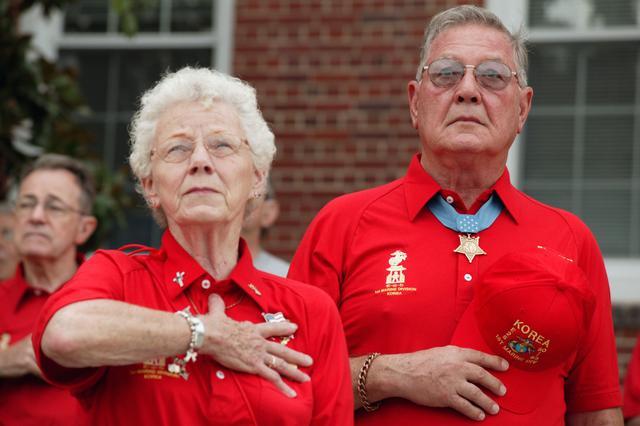
Unlike some public figures, he never viewed these appearances as opportunities for self-promotion. Instead, he used them to honor fallen comrades. Again and again, he reminded audiences that countless Marines had performed heroic acts in Korea without receiving recognition. He considered himself a representative of all those who served. Young Marines found his humility especially powerful.
Here was a man who had literally thrown himself on a grenade, yet he spoke modestly and often redirected praise toward others. His example became a lesson in leadership.
Loss and Final Years
In 2020, Dewey suffered one of the greatest personal losses of his life when Bertha passed away after nearly seven decades of marriage. The loss deeply affected him. The woman who had stood beside him through recovery, parenthood, business ownership, retirement, and public service was gone. Yet he continued participating in veterans’ activities and remained connected to family and friends. On October 11, 2021, Duane Edgar Dewey died at age eighty-nine (89). He left behind two children, grandchildren, great-grandchildren, fellow veterans, and countless Americans inspired by his example.
Legacy of a Marine
Military history often remembers Duane Dewey for a few seconds on a Korean battlefield. Those seconds unquestionably earned him a place among America’s greatest heroes. Yet limiting his story to that moment misses the larger truth.
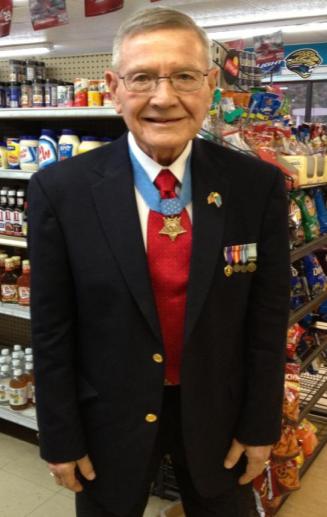
The grenade incident revealed the character that had been developing since childhood. The courage displayed in combat reflected values learned on Michigan farms, reinforced in foundries, strengthened through marriage, and sustained through decades of family life and community service.
His heroism did not end in Korea. It continued through sixty-eight years of marriage. It continued through raising children. It continued through building a business. It continued through mentoring younger veterans. It continued through representing the Medal of Honor with dignity and humility.
President Eisenhower famously said that Duane Dewey possessed a body of steel. Those who knew him best understood something even more important. He possessed a heart of steel as well—one forged by hardship, strengthened by love, and dedicated always to the service of others.
That is the complete measure of Duane Edgar Dewey’s legacy: not merely a Marine who survived impossible wounds, but a husband, father, businessman, mentor, and citizen whose entire life reflected the values that made him worthy of the Medal of Honor.
About James G. Fausone, Esq.
James G. Fausone, Esq. is a partner with Legal Help For Veterans, PLLC, with over twenty years of experience helping veterans apply for service-connected disability benefits and starting their claims, appealing VA decisions, and filing claims for an increased disability rating so veterans can receive a higher level of benefits.
If you were denied service connection or benefits for any service-connected disease, our firm can help. We can also put you and your family in touch with other critical resources to ensure you receive the treatment you deserve.
Give us a call at (800) 693-4800 or visit us online at www.LegalHelpForVeterans.com.
This electronic book is available for free download and printing from www.homeofheroes.com. You may print and distribute in quantity for all non-profit, and educational purposes.
Copyright © 2018 by Legal Help for Veterans, PLLC
ALL RIGHTS RESERVED