
Francis Charles Flaherty
Medal of Honor
James G. Fausone
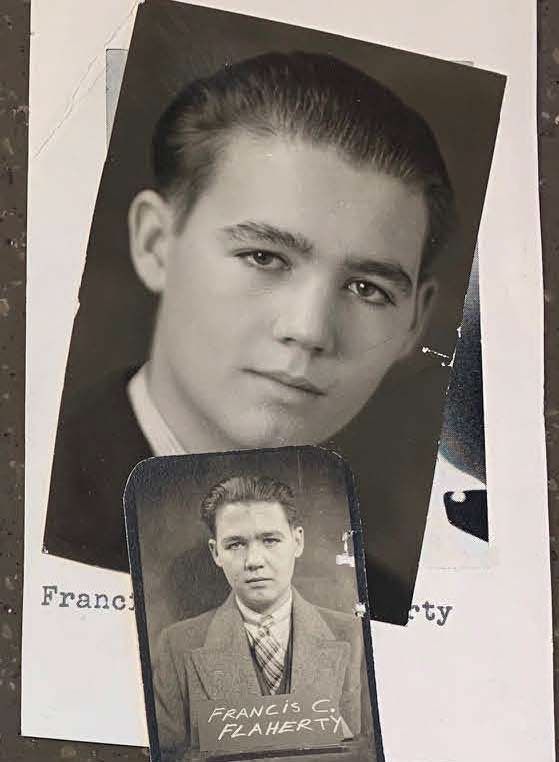
(Photos Courtesy of Bentley Historical Library)
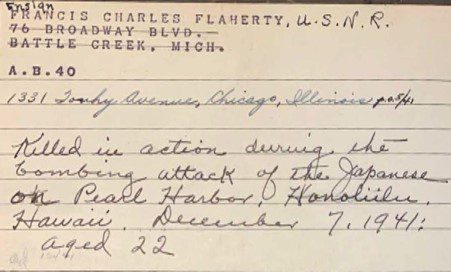
Francis Charles Flaherty stands among Michigan’s most unknown World War II heroes. A native of Charlotte, Michigan, and a graduate of the University of Michigan, he received the Medal of Honor posthumously for an act of self-sacrifice aboard the battleship USS Oklahoma during the Japanese attack on Pearl Harbor on December 7, 1941.
At only twenty-two years old, Ensign Flaherty chose to remain behind in a darkened gun turret, illuminating the escape route for his fellow sailors as the ship rolled over and sank. He knowingly gave his life so others might live. His story reflects the highest traditions of naval service and remains one of the most inspiring examples of courage during the opening hours of America’s entry into World War II.
Early Life in Michigan
Charlotte, Michigan, was a small Midwestern community of 5,300 people where family, faith, and hard work shaped the lives of young people during the years between the First and Second World Wars. It was here that Francis Charles Flaherty was born on March 15, 1919. He grew up during a period of tremendous change in American society. The First World War had recently ended, and the automobile industry was transforming Michigan. Charlotte was focused on furniture manufacturing and agriculture. However, the nation would soon plunge into the hardships of the Great Depression.
The Flaherty family was deeply rooted in the Charlotte community. He was the son of Francis “Frank” F. Flaherty and Gertrude Ursula (Messner) Flaherty. In the early decades of the 20th century, Frank Flaherty was a prominent citizen in Charlotte’s early development. Francis attended St. Mary’s Catholic Church and developed a reputation as a serious, dependable young man. The family lived in a two-story, cross-gabled frame house at 212 E. Harris Avenue. However, tragedy struck. In 1932, when young Francis was just 13 years old, both of his parents passed away. This sudden loss left Francis and his siblings to navigate the remainder of the 1930s and the Great Depression under the care of extended family or older siblings.
Before their parents’ passing, the Flaherty home on Harris Avenue was a bustling household. Census records from 1920 and 1930 reveal the family dynamics. The 1930 Census captures the family just a couple of years before the parents passed away. By this time, older siblings were beginning to enter the local workforce or head households.
Following the loss of their parents in 1932, the older siblings stepped up to keep the family grounded. By the late 1930s, family members began relocating to nearby hubs for work. For instance, by the 1940 Census—just before Francis enlisted in the U.S. Naval Reserve—he was living in nearby Battle Creek, Michigan, working as a waiter and residing in the household of his sister and brother-in-law.
Despite the hardships of losing his parents during the Great Depression, Francis went on to graduate from Charlotte High School in 1936 and attended the University of Michigan.
University of Michigan Years
The University of Michigan during the late 1930s was one of the nation’s leading institutions of higher learning. Students were keenly aware of the growing international tensions in Europe and Asia. While the United States officially remained neutral, events overseas increasingly suggested that another world war was approaching.
Flaherty enrolled at Michigan shortly after high school and completed his studies during a period when military preparedness was becoming a national concern. Across college campuses, Reserve Officer Training Corps programs and military reserve opportunities attracted students interested in service. Many young Americans believed they had a duty to prepare themselves should their country eventually be called into war.
Between 1936 and 1940, as tensions escalated in Europe and Asia, the University of Michigan (UM) carefully balanced its traditional academic identity with a rising imperative for national defense. Rather than undergoing an immediate, disruptive overhaul, the university progressively integrated military preparedness into its curriculum through specialized programs, expanding officer training, and targeted civil-military aviation courses.
At Michigan, the Civil Aeronautics Authority was introduced in 1939 and the Civilian Pilot Training Program was one of the most direct precursors to wartime curricular integration at UM.
While the Army ROTC program had maintained a continuous presence on the Ann Arbor campus since World War I, the late 1930s saw a substantial pivot toward technical and specialized military preparedness within the student body.
Academic coursework increasingly overlapped with military needs. Departments like Mechanical Engineering evolved their curricula to heavily emphasize steam power, internal combustion, and automotive engineering—skills that directly translated to motorized military divisions.
Recognizing the critical need for naval officers, Secretary of the Navy James Forrestal officially authorized the establishment of a Naval ROTC (NROTC) unit at the University of Michigan in the summer of 1940. This immediately introduced naval science, naval tactics, and maritime navigation courses into the university’s formal course catalog.
As the nation began mobilizing through the Selective Training and Service Act of 1940, UM President Alexander Grant Ruthven advocated for a policy of “educational preparedness.” He urged students to stay in school to increase their specialized value to the country before being called to serve. To facilitate this, the university administration and faculty began laying the groundwork for specialized curriculum adjustments:
Francis graduated from UM in June 1940 from the College of Literature, Science and Arts with a degree in Zoology. His college education distinguished him from many naval recruits of the era and made him a strong candidate for an officer’s commission. Yet beyond the practical advantages, his education reinforced values of leadership, responsibility, and service that would later be tested under the most extreme circumstances.
Why He Joined the Navy
Although no personal diary or interview survives explaining his exact motivations, the timing of Flaherty’s enlistment offers important clues. In July 1940, just weeks after graduating from college, he joined the United States Naval Reserve. Europe was already engulfed in war. Nazi Germany had conquered much of Western Europe, and Britain stood virtually alone against Adolf Hitler. Meanwhile, Imperial Japan continued its aggressive expansion throughout Asia and the Pacific.
Many educated young Americans recognized that the United States would eventually be drawn into the conflict. The Navy in particular was expanding rapidly as President Franklin Roosevelt sought to strengthen American defenses. For college graduates such as Flaherty, naval service offered an opportunity to lead, see the world, serve the nation, and prepare for whatever challenges lay ahead.
After entering the Naval Reserve in July 1940, Flaherty underwent officer training and was commissioned an Ensign by December 1940. Less than one year later, he would find himself at the center of one of the most significant events in American history.
Assignment to the USS Oklahoma
Following his commissioning, Ensign Flaherty was assigned to the battleship USS Oklahoma. This had to be a dream assignment for Flaherty with warm ocean breezes and beautiful landscapes far from the flat Midwest he knew.
The Oklahoma was one of the United States Navy’s Nevada-class battleships and had entered service in 1916. During World War I, she served with the Atlantic Fleet assigned primarily to escort troop and supply ships across the Atlantic, protecting them from U-boats. In the 1930s, she was retrofitted with new guns and armor plating, ironically never put to the test.
By 1940, it was assigned to the Pacific Fleet and stationed at Pearl Harbor in the Territory of Hawaii. Although older than some newer battleships, she remained a powerful warship armed with ten 14-inch guns and protected by heavy armor. Her crew numbered well over 1,200 officers and enlisted men. She tied up and berthed on December 5, 1941, for the last time.
Life aboard Oklahoma reflected the routines of the peacetime Navy. Sailors drilled regularly, maintained equipment, and participated in exercises throughout the Pacific. Liberty on Pearl Harbor would have been the envy of every sailor in the Navy. Few aboard expected that their ship would become one of the principal targets of a surprise attack that would propel America into global war.
The USS Oklahoma at Pearl Harbor
On the morning of December 7, 1941, Oklahoma was moored along Battleship Row at Pearl Harbor. Nearby lay several other American battleships, including the USS Arizona, which would also soon suffer catastrophic destruction.
At approximately 7:55 a.m., Japanese aircraft launched a surprise attack against the Pacific Fleet. Torpedo bombers descended upon the anchored battleships. Oklahoma was among the first vessels struck. Within minutes, she absorbed up to eight aerial torpedoes along her port side. Water rushed into the hull, and the ship began listing dramatically.
As additional torpedoes struck, the battleship’s fate became clear. Officers ordered the crew to abandon ship. Sailors scrambled through passageways and compartments seeking escape routes as the vessel rolled increasingly onto her side.
Chaos reigned. Lights failed. Compartments filled with smoke and darkness. The alarms, noise, and screaming were deafening. Men were trapped below decks while others struggled to find exits as the ship continued to capsize. In many areas, flashlights became the only source of illumination.
Flaherty’s Final Moments
Ensign Flaherty was stationed in one of Oklahoma’s gun turrets when disaster struck. As the order to abandon ship spread through the vessel, sailors attempted to escape from the darkened compartment. At that moment, Flaherty made a decision that would define his legacy.
Rather than save himself, he remained behind holding a flashlight so that the other members of the turret crew could find their way to safety. He understood the danger. Oklahoma was already rolling over, and every passing second reduced his own chances of escape. Yet he continued illuminating the route for his fellow sailors.
One by one, crew members escaped from the turret. Flaherty stayed at his post. As Oklahoma finally capsized and settled into the harbor, he became trapped inside the overturned battleship. He never emerged. At twenty-two years old, he gave his life so that others could live.
His actions mirrored those of Seaman First Class James Richard Ward, who performed a similar act elsewhere aboard Oklahoma. Both men knowingly sacrificed themselves while assisting shipmates attempting to escape. Ward would also receive a Medal of Honor.
The Human Cost
The sinking of Oklahoma was one of the deadliest episodes of the Pearl Harbor attack. The battleship capsized rapidly, trapping hundreds of sailors inside. A total of 429 officers and men lost their lives aboard the ship. Some survived for hours within air pockets as rescue teams desperately attempted to reach them through the steel hull.
Flaherty was listed among the missing and dead. For decades, many Oklahoma casualties remained unidentified due to the nature of the disaster. Like many Pearl Harbor families, the Flahertys endured years without complete closure regarding the fate of their son.
Award of the Medal of Honor
The United States Navy carefully investigated acts of heroism during the Pearl Harbor attack. Witness testimony established that Flaherty had voluntarily remained behind to aid others despite having the opportunity to escape. His conduct met the extraordinarily high standard required for the Medal of Honor, the nation’s highest military decoration for valor.
The award was approved posthumously. According to the Congressional Medal of Honor Society, the Medal of Honor was formally presented on March 6, 1946. The decoration was received by Flaherty’s brother on behalf of the family.
Unlike many Medal of Honor presentations conducted personally by the President at the White House, Flaherty’s posthumous award was presented several years after his death and after the conclusion of World War II. Available historical records confirm that the medal was presented to his brother, but do not indicate that the ceremony occurred at the White House or that President Harry Truman personally made the presentation. The surviving official records simply note the March 6, 1946 presentation to his brother.
Medal of Honor Citation
Francis Charles Flaherty’s Medal of Honor citation reads:
For conspicuous devotion to duty and extraordinary courage and complete disregard of his own life, above and beyond the call of duty, during the attack on the Fleet in Pearl Harbor, by Japanese forces on 7 December 1941. When it was seen that the U.S.S. Oklahoma was going to capsize and the order was given to abandon ship, Ens. Flaherty remained in a turret, holding a flashlight so the remainder of the turret crew could see to escape, thereby sacrificing his own life.
The citation is remarkably concise. In just a few sentences it captures the essence of military heroism: devotion to duty, courage under impossible circumstances, and the willingness to place the lives of others ahead of one’s own.
A Final Homecoming
Following the December 7, 1941 attack, the USS Oklahoma was salvaged in 1943. Navy personnel recovered the remains of the deceased crew members entombed inside, including Ensign Flaherty. However, due to the severe nature of the damage and the technology available at the time, individual identification of most crew members was impossible.
In 1949, after a military board classified the remaining unidentified crew members as non-recoverable, Flaherty and his shipmates were buried as “Unknowns” in mass graves at the National Memorial Cemetery of the Pacific (the Punchbowl) in Honolulu, Hawaii.
Between June and November 2015, the Defense POW/MIA Accounting Agency (DPAA) exhumed the USS Oklahoma Unknowns to perform advanced forensic testing. On September 30, 2019, the DPAA officially identified Flaherty’s remains using dental, anthropological, and Y-chromosome DNA analysis.
Nearly 80 years after making the ultimate sacrifice—remaining in a capsizing turret with a flashlight so his crewmates could escape—Ensign Flaherty was finally returned to his hometown of Charlotte, Michigan. He was laid to rest with full military honors at Maple Hill Cemetery on August 21, 2021.
Legacy
Flaherty’s sacrifice was not forgotten. During the war, the Navy honored him by naming the destroyer escort USS Flaherty after him. Commissioned in 1943, the vessel carried his name and memory into combat operations during World War II.
USS Flaherty (DE-135) was an Edsall-class destroyer escort commissioned in June 1943. She played a key role in sinking U-515, capturing the famous U-505, and rescuing survivors from U-546. Built by Consolidated Steel Corp. in Orange, Texas, the USS Flaherty was designed for anti-submarine warfare and convoy protection. She fought in the Battle of the Atlantic in 1944 and chased U-boats in 1945. She ultimately earned four battle stars and a Presidential Unit Citation. Following the end of World War II, USS Flaherty was decommissioned in June 1946 and placed in the Atlantic Reserve Fleet in Florida. She was stricken from the Naval Vessel Register in 1965 and subsequently sold for scrap in 1966.
The symbolism is not lost that Ensign Flaherty died on a vessel that protected against U-boats in World War I, and the USS Flaherty was very successful chasing and sinking U-boats in World War II.
Ensign Flaherty’s hometown of Charlotte likewise preserved his legacy. Veterans organizations, civic groups, and local historians have continued to tell his story for generations. In Charlotte, he remains one of the community’s most distinguished sons and one of Michigan’s earliest World War II Medal of Honor recipients.
Conclusion
Francis Charles Flaherty’s life was brief, but his example has endured for generations. Raised in small-town Michigan, educated at the University of Michigan, and commissioned as a young naval officer during a time of global uncertainty, he embodied the ideal of citizen-service. When confronted with a life-or-death decision aboard the USS Oklahoma on December 7, 1941, he chose duty over survival.
His act required no weapon, no attack upon the enemy, and no expectation of recognition. Armed only with a flashlight, he stayed behind in a sinking battleship so that others might escape. In that simple act of selflessness, he demonstrated the very qualities the Medal of Honor was created to recognize.
Today, Francis Charles Flaherty stands not merely as a Pearl Harbor hero, but as one of Michigan’s most distinguished sons—a young officer whose final decision illuminated a path to safety for others and secured his place in American history forever. His Medal of Honor resides at the Michigan Heroes Museum in Frankenmuth, Michigan.
About James G. Fausone, Esq.
James G. Fausone, Esq. is a partner with Legal Help For Veterans, PLLC, with over twenty years of experience helping veterans apply for service-connected disability benefits and starting their claims, appealing VA decisions, and filing claims for an increased disability rating so veterans can receive a higher level of benefits.
If you were denied service connection or benefits for any service-connected disease, our firm can help. We can also put you and your family in touch with other critical resources to ensure you receive the treatment you deserve.
Give us a call at (800) 693-4800 or visit us online at www.LegalHelpForVeterans.com.
This electronic book is available for free download and printing from www.homeofheroes.com. You may print and distribute in quantity for all non-profit, and educational purposes.
Copyright © 2018 by Legal Help for Veterans, PLLC
ALL RIGHTS RESERVED