
Frederick C. Sherman
Triple Navy Cross Recipient
James G. Fausone
Frederick C. Sherman was one of the outstanding American naval commanders of the Second World War—a sailor whose career stretched from the submarines of World War I to the great aircraft-carrier battles of the Pacific. Born and raised in Port Huron, Michigan, Sherman became a submariner, naval aviator, carrier captain, task-force commander, and ultimately, a vice admiral and commander of the U.S. Fifth Fleet.
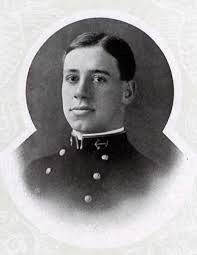
His career is particularly remarkable because he received the Navy Cross three times, making him one of the relatively small number of Americans to earn the nation’s second-highest award for valor three times. His three Navy Cross awards came in very different circumstances: first as a submarine commander in World War I, second as captain of the aircraft carrier Lexington in the opening months of World War II, and third as a carrier task-group commander in 1944.
Sherman’s story is also an important part of Michigan’s military history. He was born in Port Huron on May 27, 1888, to Frederick Ward and Charlotte Sherman. He attended Port Huron High School before receiving an appointment to the United States Naval Academy in 1906.
Growing Up in Port Huron
Sherman was born into a prominent Port Huron family. His grandfather, Loren Sherman, was the longtime editor and publisher of The Daily Times in Port Huron. His father, Frederick, was also involved in newspaper publishing and eventually moved to California, where he became associated with The Daily Independent in Santa Barbara.
Port Huron at the end of the nineteenth century was a natural place for a young man to develop an interest in ships and the Navy. Situated on the St. Clair River at the entrance to Lake Huron, the community had a strong maritime identity. For Sherman, however, the attraction of the sea would eventually lead far beyond the Great Lakes.
At Annapolis, Sherman, as a young midshipman, was not simply an academic cadet preparing for a naval career. He was heavily involved in athletics and competitive activities. He won his “N” in lacrosse, was runner-up for the boxing championship in 1908-1909, and won the Thompson Trophy for sailing. Those activities provide an early indication of the qualities that would later characterize his command style: physical toughness, competitive determination, familiarity with the sea, and an ability to remain composed under pressure.
Sherman graduated from the Naval Academy on June 2, 1910. His graduating class entered the Navy at a time when American naval power was undergoing enormous technological change. Battleships still represented the principal measure of naval strength, but submarines and eventually aircraft would transform naval warfare during Sherman’s lifetime.
From Battleships to Submarines
After graduation, Sherman served aboard the battleships Montana, Ohio, and Maryland. At the time, newly graduated naval officers were required to complete sea duty before receiving their commissions. Sherman was commissioned as an ensign, to rank from March 7, 1912. His career soon took an unusual direction.
In 1914, he was assigned to submarine duty aboard sub tender USS Cheyenne. He subsequently served aboard H-3 Garfish and then assumed command of H-2 Nautilus. These H-class subs were for coastal defense. Submarine warfare was still a relatively new and dangerous specialty, and the submarines of the period were primitive compared with the nuclear submarines that would emerge after World War II.
In December 1917, Sherman was assigned to Quincy, Massachusetts, to help fit out the submarine USS O-7. He became her commanding officer when she was commissioned on July 4, 1918.
America had entered World War I, and German U-boats posed a serious threat to Allied shipping. Sherman and O-7 conducted patrol operations in the Atlantic, performing the hazardous work of searching for and countering enemy submarines while protecting convoys carrying troops and supplies.
For his service as commanding officer of O-7, Sherman received his first Navy Cross. The official citation praised him for “distinguished and heroic action” while commanding O-7 on hazardous patrols in waters threatened by enemy submarines, destroyers and mines. His submarine protected important troop and supply convoys while conducting offensive and defensive operations against enemy naval activity.
That first Navy Cross established a pattern that would recur throughout his career. Sherman was not merely being recognized for personal courage. His awards repeatedly emphasized leadership, tactical judgment and the performance of the men and ships under his command.
Between the Wars: Becoming a Naval Aviator
After World War I, Sherman continued to move through increasingly important naval assignments. He served aboard Minnesota, worked in the Navy Department’s Bureau of Engineering, commanded Submarine Division 9, and attended the Naval War College.
He later served as a gunnery officer aboard West Virginia and held assignments in the Bureau of Navigation and the Office of the Chief of Naval Operations. He commanded Detroit and destroyer divisions before serving as an aide to the Commandant of the Eleventh Naval District in San Diego.
Then came another major transition. In 1935, Sherman reported for flight training at Naval Air Station Pensacola. He was designated a Naval Aviator on March 9, 1936. The transformation was significant. The submariner of World War I was now becoming an expert in the aircraft-carrier warfare that would dominate the next global conflict.
Sherman served as executive officer of Saratoga and later commanded Patrol Wing Three. In 1940, after completing the senior course at the Naval War College, he assumed command of the aircraft carrier USS Lexington (CV-2).
Captain of Lexington
Sherman’s command of Lexington placed him at the center of the opening months of the Pacific War. When Japan attacked Pearl Harbor on December 7, 1941, Lexington and Enterprise were at sea near Midway. The carriers searched for the Japanese force responsible for the attack, but the enemy escaped under cover of a weather front.
In February 1942, Lexington moved into the South Pacific. On February 20, a formation of 18 Japanese bombers attacked the carrier. Sherman’s response became the basis for his second Navy Cross, awarded as a Gold Star in lieu of a second award.
The Japanese formation was met by the carrier’s fighters and antiaircraft defenses. Sixteen of the 18 Japanese bombers were destroyed, while Lexington escaped damage. The Navy credited Sherman with coordinating the combat air patrols, timing their employment and relief, and personally handling the carrier with expert seamanship.
This second Navy Cross is particularly important because it demonstrated how dramatically Sherman’s career had evolved. His first Navy Cross had come from commanding a small submarine against the submarine threat of World War I. His second came while commanding one of America’s great aircraft carriers against a massed Japanese air attack.
The Battle of the Coral Sea
Only a few months later, Sherman would face one of the most consequential battles of the Pacific War. Lexington participated in the Battle of the Coral Sea, May 4-8, 1942. The battle represented a revolutionary moment in naval warfare. American and Japanese surface ships did not directly exchange gunfire; the opposing fleets fought primarily through their aircraft.
Sherman’s carrier was heavily engaged. Lexington‘s aircraft helped attack Japanese naval forces, including the carrier Shoho. Japanese aircraft subsequently attacked Lexington. The carrier suffered catastrophic damage and eventually had to be abandoned. Sherman remained aboard until the ship could no longer be saved. The Naval History and Heritage Command records that he was the last man to leave Lexington, being rescued from the water by another ship. More than 2,700 survivors were ultimately rescued.
Sherman’s conduct during Coral Sea earned him the Legion of Merit with Combat “V,” rather than another Navy Cross. The citation praised his direction of Lexington‘s air squadrons, the successful attacks against Japanese carriers, and his handling of the ship under intense attack. It also specifically recognized his orderly conduct during the evacuation of the carrier. The loss of Lexington did not end Sherman’s combat career. Instead, it marked the beginning of his rise into senior carrier-force command.
His Third Navy Cross
Sherman returned to combat command in the Pacific and became increasingly important in the fast-carrier offensive that carried American forces across the Pacific.
By 1943, he was commanding carrier forces involved in attacks against Japanese bases. His units participated in operations against places such as Buka-Bonis, Rabaul, Kavieng, Nauru and the Marshall Islands. According to the Naval History and Heritage Command, Sherman’s forces destroyed or damaged dozens of ships and hundreds of aircraft during this period.
His third Navy Cross came from action on February 21, 1944. Sherman was serving as Officer in Tactical Command of a carrier task group when the group’s position in the Mariana Islands was reported to the Japanese. Enemy torpedo and bombing aircraft attacked repeatedly during the night and into the following morning.
The situation was dangerous. Sherman’s ships were operating within range of Japanese air forces, and the task group was being actively targeted. The Navy’s citation for his third Navy Cross emphasized his tactical handling of the force. Sherman maneuvered his task group so that it presented the most difficult possible target to the attackers. American shipboard guns and combat air patrols destroyed Japanese aircraft. Despite the attacks, Sherman continued toward the launch point.
His carriers then launched strikes against Japanese shipping, aircraft and shore installations around Tinian and Guam. The attacks inflicted heavy damage, while valuable reconnaissance photographs were obtained. Most importantly, the task group completed its mission and withdrew without suffering damage from the enemy.
The award was formally a Second Gold Star in lieu of a Third Award of the Navy Cross. Thus, Sherman’s three Navy Crosses represent three separate periods of combat achievement: World War I submarine warfare, the opening carrier battles of World War II, and the great American carrier offensive of 1944.
A Commander of the Fast Carrier Forces
Sherman’s significance went beyond his personal decorations. He became one of the commanders responsible for employing the fast carrier forces that would systematically dismantle Japanese air and naval power.
His commands participated in attacks across the Pacific, including operations connected with the Philippines, Formosa, the Marianas, and other Japanese-held positions. The Naval History and Heritage Command biography describes him as leading naval air forces in numerous initial or major strikes against enemy strongholds.
The U.S. Naval Academy’s Nimitz Library also preserves action reports documenting Sherman’s command of carrier groups during the Palau, Visayas, Leyte and Manila operations. One collection identifies him as commander of Task Group 38.3 aboard Essex during the September 1944 Palau strikes and subsequent operations.
Sherman’s style of leadership was particularly suited to carrier warfare. A carrier task group required coordination among pilots, aircraft handlers, ship captains, radar operators, antiaircraft crews and thousands of sailors. The commander had to make decisions quickly while operating hundreds of miles from friendly bases. Sherman had experience at almost every level of that system: submarine command, surface warfare, gunnery, aviation, carrier operations and fleet command.
Vice Admiral and Commander of the Fifth Fleet
Sherman’s promotions reflected his increasing responsibilities. He became a rear admiral in 1942 and was promoted to vice admiral on July 13, 1945, when he assumed command of the First Carrier Task Force of the U.S. Pacific Fleet. After the Japanese surrender, Sherman became Commander, Fifth Fleet, serving from January 18 until September 3, 1946. He was subsequently relieved of active duty pending retirement.
When he was placed on the Navy’s retired list on March 1, 1947, he held the rank of full Admiral. His final decorations included the Navy Cross with two Gold Stars, the Navy Distinguished Service Medal with two Gold Stars, the Legion of Merit with Combat “V,” the Navy Commendation Medal, and numerous campaign and service medals. He also received the British Order of the British Empire.
Life After the Navy
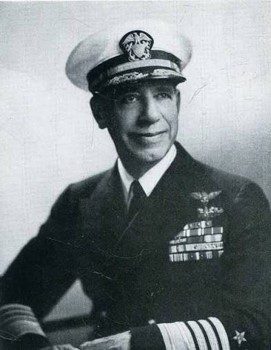
Retirement did not end Sherman’s connection to naval history. He wrote Combat Command, published in 1950, an account of the Pacific war based upon his own experiences. The book offered readers an insider’s perspective on carrier warfare and the commanders and sailors who fought it.
Sherman also retained a sense of humor and perspective about his remarkable career. In 1950, he appeared on Groucho Marx’s radio program You Bet Your Life. When asked about the greatest thrill of his life, Sherman reportedly identified the experience of standing on the bridge of the USS Missouri in Tokyo Bay and watching the Japanese surrender ceremony at the end of World War II.
There was also a lighter side to the admiral’s life. His wife wrote Admiral Wags, a book about the family’s dog and its life aboard ship. The Navy’s biography notes that the dog accompanied Sherman during his Lexington command.
Sherman died in San Diego on July 27, 1957, following a heart attack. He was 69 years old. He is buried at the Fort Rosecrans National Cemetery in San Diego, California, with his wife, Fanny Jessop Sherman. He was survived by his son, John J. Sherman, who then passed away in 2002.
A Port Huron Legacy
Frederick C. Sherman represents a remarkable chapter in Port Huron’s military history.
He left Michigan for Annapolis in 1906 and graduated from the Naval Academy in 1910. Over the next 37 years, he experienced virtually every major transformation in twentieth-century naval warfare. He began his career aboard battleships, became a submarine commander during World War I, learned to fly in middle age, commanded destroyers and patrol aircraft, took command of one of America’s most famous aircraft carriers, survived the loss of Lexington, directed fast-carrier strikes throughout the Pacific, became a fleet commander and ultimately retired as an admiral. Most remarkable of all, he earned the Navy Cross three times.
His story began in Port Huron and ended with the rank of admiral—a remarkable journey that carried one Michigan sailor from the submarines of World War I to the aircraft carriers that helped win the Pacific War.
He was inducted into the Michigan Military and Veterans Hall of Honor in 2026.
About James G. Fausone, Esq.
James G. Fausone, Esq. is a partner with Legal Help For Veterans, PLLC, with over twenty years of experience helping veterans apply for service-connected disability benefits and starting their claims, appealing VA decisions, and filing claims for an increased disability rating so veterans can receive a higher level of benefits.
If you were denied service connection or benefits for any service-connected disease, our firm can help. We can also put you and your family in touch with other critical resources to ensure you receive the treatment you deserve.
Give us a call at (800) 693-4800 or visit us online at www.LegalHelpForVeterans.com.
This electronic book is available for free download and printing from www.homeofheroes.com. You may print and distribute in quantity for all non-profit, and educational purposes.
Copyright © 2018 by Legal Help for Veterans, PLLC
ALL RIGHTS RESERVED