
Matt Urban
The Ghost - Not Forgotten
James G. Fausone
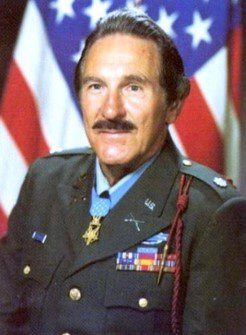
(United States Department of Defense, Public Domain, via Wikimedia Commons)
Among the thousands of Americans who fought across Europe during World War II, few demonstrated greater courage than Lieutenant Colonel Matt Urban. By the end of the war, he had been wounded seven times, earned multiple Silver Stars, Bronze Stars, seven Purple Hearts, and numerous foreign decorations. German soldiers nicknamed him “The Ghost” because no matter how many times they believed they had killed him, he returned to lead his men once again. Yet despite extraordinary heroism displayed during the summer of 1944, Urban waited more than thirty-five years before receiving America’s highest military decoration, the Medal of Honor.
For the final decades of his life, Urban lived quietly in Holland, Michigan, where many neighbors knew him as a recreation director, youth sports advocate, and community leader rather than one of the most decorated infantry officers of World War II. His story is one of courage, perseverance, humility, and a commitment to serving others long after the guns of war had fallen silent.
A Working-Class Beginning
Matt Urban was born Matthew Louis Urbanowicz on August 25, 1919, in Buffalo, New York. His parents, Stanley and Helen Urbanowicz, were members of Buffalo’s growing Polish-American community. Stanley had immigrated from Poland and established himself as a plumbing contractor, while Helen, born near Buffalo, devoted herself to raising the family’s children.
The Urbanowicz household emphasized education, discipline, hard work, and patriotism. Matt grew up alongside two brothers, Stanley and Arthur. A younger brother, Eugene, tragically died from appendicitis as a child, a loss that deeply affected the family.
Growing up during the Great Depression meant that luxuries were few. Like many young men of his generation, Matt learned resilience early. Athletic ability soon became one of his defining characteristics. At East High School in Buffalo, he excelled in football, track, and boxing. His competitive spirit, physical toughness, and willingness to lead others became evident long before he ever wore an Army uniform.
Cornell University and ROTC
Urban’s athletic and academic talents earned him admission to Cornell University in 1937. He majored in history and government while participating in Reserve Officers’ Training Corps (ROTC), track, boxing, and fraternity life.
ROTC proved especially significant. Europe was drifting toward war, and military training offered young Americans an opportunity to prepare for uncertain times. Urban embraced leadership responsibilities and developed the tactical knowledge that would later save countless lives on European battlefields.
He graduated in June 1941 with a Bachelor of Arts degree. Only weeks later he received his commission as a second lieutenant in the United States Army and reported to Fort Bragg, North Carolina. Within months, the Japanese attack on Pearl Harbor thrust the United States into World War II, and Urban soon found himself preparing for combat overseas.
Baptism of Fire
Assigned to the 60th Infantry Regiment of the famed 9th Infantry Division, Urban experienced combat almost from the beginning of America’s ground war. He landed in North Africa during Operation Torch in November 1942. The campaign introduced him to the harsh realities of modern warfare but also revealed his exceptional leadership under fire. His courage earned him two Silver Stars during the North African fighting.
Operation Torch (initially called Operation Gymnast) was the large-scale British-American invasion of French North Africa during World War II, launched on November 8, 1942. It marked the first time British and American forces jointly undertook a major offensive operation during the war, and it served as a critical turning point in the European Theater. Soviet leader Joseph Stalin was pressuring the Allies to open a second front in Europe to relieve pressure on the Soviet Red Army. While the U.S. favored a direct invasion of occupied Europe, the British argued that the Allies weren’t yet ready and suggested clearing North Africa first.
The invasion was commanded by American Lieutenant General Dwight D. Eisenhower. The Allies faced a complex political situation: North Africa was controlled by Vichy France, which was officially neutral but collaborative with Nazi Germany. The Allies hoped the French forces would not resist, but when landings occurred at Casablanca, Oran, and Algiers, French forces initially fought back fiercely. After a few days of heavy fighting and intense back-channel negotiations, Allied forces secured a ceasefire.
Operation Torch successfully established a foothold. By May 1943, Axis forces in North Africa were completely surrounded and surrendered in Tunisia, resulting in the capture of over 250,000 German and Italian soldiers. The success directly paved the way for the Allied invasions of Sicily and mainland Italy later in 1943. It provided invaluable combat experience and logistical lessons for the green American troops and their commanders, which would later prove vital for Operation Overlord (D-Day) in 1944.
The division next invaded Sicily in 1943, and Urban spent roughly three to four months in Sicily total, though his time in active combat there was very brief, lasting just over two weeks. He arrived on August 1, 1943, as part of Operation Husky; Urban’s unit (Company F, 60th Infantry Regiment, 9th Infantry Division) landed at Palermo, Sicily. They arrived 22 days after the initial Allied landings to help break a stalemate in the center of the island.
Urban led his men through the rugged, mountainous terrain of central Sicily to flank German forces. His unit, from August 1-17, played a major role in securing the territory overlooking Troina, Cesaro, and Randazzo, helping to breach the last German line of defense on the island. For his valorous actions in Sicily—including helping an anti-aircraft crew shoot down a German plane attacking their ship—he was awarded his second Silver Star.
Following the conclusion of the Sicilian campaign, the 9th Infantry Division remained stationed on the island for a few months to rest, refit, and prepare for their next major assignment. In November 1943, Urban and the rest of the 9th Division relocated to the British Isles, bivouacking near Winchester, England. He spent the next seven months there training and preparing for the D-Day invasion of Normandy, which took place in June 1944.
By this point, Urban had established a reputation as an officer who never asked his men to undertake a mission he would not personally lead. His willingness to expose himself to enemy fire inspired extraordinary confidence among the soldiers under his command.
Normandy: A Summer of Heroism
Urban landed in France on D-Day +5 with the 9th Infantry Division. Beginning on June 14, 1944, he embarked on nearly three months of continuous heroic action that eventually formed the basis for his Medal of Honor citation.
Near Renouf, France, Company F came under devastating fire from German tanks and infantry. Recognizing that his unit faced destruction, Urban grabbed a bazooka and advanced through intense enemy fire. Maneuvering close enough to the German armor, he destroyed two enemy tanks, allowing American infantry to continue its advance.
Later that same day, he suffered a severe leg wound from tank fire. Although ordered to evacuate, he refused. Instead, he continued directing defensive positions throughout the night. The following morning, he again led attacks despite his injuries before finally collapsing from blood loss. Only then was he evacuated to England.
Most officers would have remained hospitalized until fully recovered. Matt Urban had other plans. Learning that his battalion had suffered devastating casualties, he ignored medical advice, left the hospital without authorization, hitchhiked across England, crossed the English Channel, and somehow found his unit in France. When he arrived, the battalion was already moving into battle. Without hesitation, Urban resumed command.
Leadership Under Impossible Conditions
The battles that followed became legendary.
On July 25, 1944, Urban found American forces stalled while supporting tanks remained immobilized after their commanders were killed. Despite his injured leg, he climbed onto a tank under direct enemy fire and personally directed its movement while firing its machine gun. His fearless example inspired nearby infantrymen to renew their assault. The attack succeeded. Days later, Urban suffered another wound from artillery fragments. Again, he refused evacuation.
When his battalion commander was killed on August 6, twenty-four-year-old Urban assumed command of the battalion. He led repeated assaults while enduring wounds that would have removed almost any other officer from combat.
On September 3 near Heer, Belgium, Urban personally reorganized troops pinned down by intense German fire and led them toward the Meuse River crossing. During the assault, a machine-gun bullet struck his neck, tearing away one vocal cord. Even then, he refused immediate evacuation until the objective had been secured. Doctors believed he would die. He survived.
“The Ghost”
Urban’s repeated returns to combat astonished both friend and foe. German soldiers reportedly nicknamed him “The Ghost” because every report of his death proved premature. American soldiers likewise came to expect that somehow Captain Urban would appear wherever the fighting became most desperate.
The cumulative effect of these actions made him one of the most decorated combat officers of World War II. By war’s end he had earned seven Purple Hearts, two Silver Stars, three Bronze Stars, the Legion of Merit, French Croix de Guerre decorations, and numerous campaign awards.
Why the Medal of Honor Was Delayed
Given such extraordinary heroism, many people naturally ask why Urban did not receive the Medal of Honor immediately after the war. The answer lies in bureaucratic tragedy rather than controversy.
In August 1944, Major Max Wolf, Urban’s battalion commander, initiated a Medal of Honor recommendation after witnessing Urban’s remarkable actions. Before the paperwork completed the approval process, Wolf was killed in action.
Staff Sergeant Earl Evans continued the recommendation process, but during the confusion of wartime operations the paperwork disappeared. Following the war, Evans—who had spent months as a German prisoner of war—again attempted to have Urban recognized. Once again, his recommendation failed to move through official channels. For decades Urban himself never campaigned for recognition. Instead, he quietly built a civilian career.
Finally, in the late 1970s, a Disabled American Veterans service representative familiar with Urban’s record requested information from Army files. Investigators discovered copies of the original recommendation that had remained buried in official records.
After reviewing eyewitness accounts and surviving documentation, Army officials concluded that Urban had unquestionably met the Medal of Honor standard. President Jimmy Carter presented him the Medal of Honor on July 19, 1980—more than thirty-five years after the heroic actions occurred. The ceremony also included presentation of additional decorations that administrative errors had prevented him from previously receiving. Many historians consider Urban’s delayed recognition one of the greatest administrative oversights in Medal of Honor history.
His citation reads:
Lt. Col. (then Capt.) Matt Urban, 112-22-2414, United States Army, who distinguished himself by a series of bold, heroic actions, exemplified by singularly outstanding combat leadership, personal bravery, and tenacious devotion to duty, during the period from 14 June to 3 September 1944 while assigned to the 2d Battalion, 60th Infantry Regiment, 9th Infantry Division. On 14 June, Capt. Urban’s company, attacking at Renouf, France, encountered heavy enemy small-arms and tank fire. The enemy tanks were unmercifully raking his unit’s positions and inflicting heavy casualties. Capt. Urban, realizing that his company was in imminent danger of being decimated, armed himself with a bazooka. He worked his way with an ammo carrier through hedgerows, under a continuing barrage of fire, to a point near the tanks. He brazenly exposed himself to the enemy fire and, firing the bazooka, destroyed both tanks. Responding to Capt. Urban’s action, his company moved forward and routed the enemy. Later that same day, still in the attack near Orglandes, Capt. Urban was wounded in the leg by direct fire from a 37-mm tank gun. He refused evacuation and continued to lead his company until they moved into defensive positions for the night. At 0500 hours the next day, still in the attack near Orglandes, Capt. Urban, though badly wounded, directed his company in another attack. One hour later he was again wounded. Suffering from two wounds, one serious, he was evacuated to England. In mid-July, while recovering from his wounds, he learned of his unit’s severe losses in the hedgerows of Normandy. Realizing his unit’s need for battle-tested leaders, he voluntarily left the hospital and hitchhiked his way back to his unit near Saint-Lo, France. Arriving at the 2d Battalion Command Post at 1130 hours on 25 July, he found that his unit had jumped off at 1100 hours in the first attack of “Operation Cobra.” Still limping from his leg wound, Capt. Urban made his way forward to retake command of his company. He found his company held up by strong enemy opposition. Two supporting tanks had been destroyed and another, intact but with no tank commander or gunner, was not moving. He located a lieutenant in charge of the support tanks and directed a plan of attack to eliminate the enemy strongpoint. The lieutenant and a sergeant were immediately killed by the heavy enemy fire when they tried to mount the tank. Capt. Urban, though physically hampered by his leg wound and knowing quick action had to be taken, dashed through the scathing fire and mounted the tank. With enemy bullets ricocheting from the tank, Capt. Urban ordered the tank forward and, completely exposed to the enemy fire, manned the machine gun and placed devastating fire on the enemy. His action, in the face of enemy fire, galvanized the battalion into action and they attacked and destroyed the enemy position. On 2 August, Capt. Urban was wounded in the chest by shell fragments and, disregarding the recommendation of the battalion surgeon, again refused evacuation. On 6 August, Capt. Urban became the commander of the 2d Battalion. On 15 August, he was again wounded but remained with his unit. On 3 September, the 2d Battalion was given the mission of establishing a crossing-point on the Meuse River near Heer, Belgium. The enemy planned to stop the advance of the Allied Army by concentrating heavy forces at the Meuse. The 2d Battalion, attacking toward the crossing-point, encountered fierce enemy artillery, small-arms, and mortar fire which stopped the attack. Capt. Urban quickly moved from his command post to the lead position of the battalion. Reorganizing the attacking elements, he personally led a charge toward the enemy’s strongpoint. As the charge moved across the open terrain, Capt. Urban was seriously wounded in the neck. Although unable to talk above a whisper from the paralyzing neck wound, and in danger of losing his life, he refused to be evacuated until the enemy was routed and his battalion had secured the crossing-point on the Meuse River. Capt. Urban’s personal leadership, limitless bravery, and repeated extraordinary exposure to enemy fire served as an inspiration to his entire battalion. His valorous and intrepid actions reflect the utmost credit upon him and uphold the noble traditions of the United States Army.
Building a New Life
Following medical retirement from the Army in 1946 as a lieutenant colonel, Urban faced enormous physical challenges. His seven combat wounds caused chronic pain. His neck injury permanently damaged his voice. His body carried the scars of years spent on the front lines. Rather than dwell on these hardships, Urban dedicated himself to helping young people.
He became recreation director in Port Huron, Michigan, where he developed sports programs, coached young athletes, and promoted physical fitness. His leadership style remained much the same as it had been in the Army—encouraging discipline, teamwork, and perseverance.
During the 1960s, he married Jennie, and together they raised their daughter, Jennifer. Friends remembered him as modest about his wartime accomplishments. Unless asked directly, he rarely discussed combat. Instead, he focused on serving his family and community.
Holland, Michigan
In 1972, the Urban family moved to Holland, Michigan. There, Matt Urban became deeply involved in community recreation and amateur athletics. He helped coach numerous sports, mentored young competitors, and worked extensively with boxing programs throughout Michigan. His efforts helped produce Golden Gloves champions and Olympic-caliber athletes.
Urban eventually chaired the Michigan Olympic Boxing Committee and remained active in youth development programs. He also volunteered with organizations including the Red Cross, Boy Scouts, Boys Clubs, and camps serving disadvantaged children. Residents of Holland often encountered a soft-spoken man with a raspy voice, unaware that his damaged vocal cord resulted from one of the most courageous battlefield records in American military history.
Final Years
Urban retired from public service in 1989, nine years after receiving the Medal of Honor, but continued volunteering in numerous civic organizations. He also published his autobiography, allowing future generations to learn firsthand about the realities of combat and leadership.
Matt Urban’s autobiography was co-written with Charles F. Conrad and published in limited quantities in 1989. It is titled: The Matt Urban Story: Life and World War II Experiences. It is also frequently found under the expanded 1990 jacket title, The Hero We Nearly Forgot: The Matt Urban Story, referencing the fact that his Medal of Honor recommendation was famously misplaced for 35 years until he finally received it from President Jimmy Carter in 1980.
On March 4, 1995, Matt Urban died in Holland, Michigan, at the age of 75. The cause was complications from a collapsed lung related to his wartime injuries. He had lived 15 years with the Medal of Honor recognition.
He was buried with full military honors at Arlington National Cemetery. His legacy continues through numerous memorials, including the Matt Urban Sports Complex in Holland, the Matt Urban Center in Buffalo, military buildings named in his honor, and exhibits preserving his remarkable story.
Military historians frequently compare Matt Urban with the legendary Audie Murphy because of the extraordinary number of decorations each earned during World War II. Yet Urban’s greatest legacy extends beyond medals.
He embodied servant leadership. Time after time, he placed the welfare of his soldiers ahead of his own safety. He repeatedly rejected evacuation, not out of recklessness, but because he believed his men deserved experienced leadership during the most dangerous moments of battle.
His postwar life reflected those same values. Rather than seek fame, he dedicated himself to young people, athletics, recreation, and community service in Michigan. Holland became the place where one of America’s greatest combat heroes quietly invested in future generations.
The thirty-five-year delay in awarding his Medal of Honor reminds us that bureaucracies sometimes fail, but courage endures. Thanks to the persistence of former comrades, veterans’ advocates, and Army historians, Matt Urban ultimately received the recognition he had earned on the battlefields of France and Belgium.
About James G. Fausone, Esq.
James G. Fausone, Esq. is a partner with Legal Help For Veterans, PLLC, with over twenty years of experience helping veterans apply for service-connected disability benefits and starting their claims, appealing VA decisions, and filing claims for an increased disability rating so veterans can receive a higher level of benefits.
If you were denied service connection or benefits for any service-connected disease, our firm can help. We can also put you and your family in touch with other critical resources to ensure you receive the treatment you deserve.
Give us a call at (800) 693-4800 or visit us online at www.LegalHelpForVeterans.com.
This electronic book is available for free download and printing from www.homeofheroes.com. You may print and distribute in quantity for all non-profit, and educational purposes.
Copyright © 2018 by Legal Help for Veterans, PLLC
ALL RIGHTS RESERVED