
Paul Ronald Lambers
Michigan's Quiet Hero & Medal of Honor Recipient
James G. Fausone
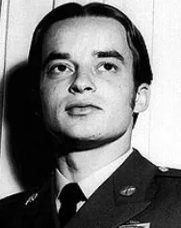
(Photo Courtesy of C. Douglas Sterner)
Among the many Americans who served in the Vietnam War, some unlikely heroes emerged such as Paul Ronald Lambers of Michigan. Lambers embodied the values of duty, humility, faith, and selfless service that characterized so many of the young men who answered their nation’s call during a turbulent era. His extraordinary actions during a desperate battle in Vietnam earned him the Medal of Honor, the United States military’s highest award for valor. Yet those who knew him often remembered him not simply as a war hero, but as a modest, intelligent, and deeply caring individual whose life was cut tragically short at the age of twenty-eight.
Early Life in Holland, Michigan
Paul Ronald Lambers was born on June 25, 1942, in the west Michigan community of Holland. He grew up in a close-knit Dutch-American family during the difficult years between World War II and Vietnam. His parents, Herman Lambers and Jeanette “Janet” Bussies Lambers, instilled in their children strong values of hard work, faith, and service to others. Paul was the youngest of three children, growing up alongside his older brother, Howard, and his sister, Carol.
Holland in the 1940s and 1950s was a community rooted in agriculture, manufacturing, and religious traditions. The city’s Dutch heritage influenced nearly every aspect of daily life, from education to civic engagement. Within this environment, Lambers developed a reputation as a thoughtful and disciplined young man.
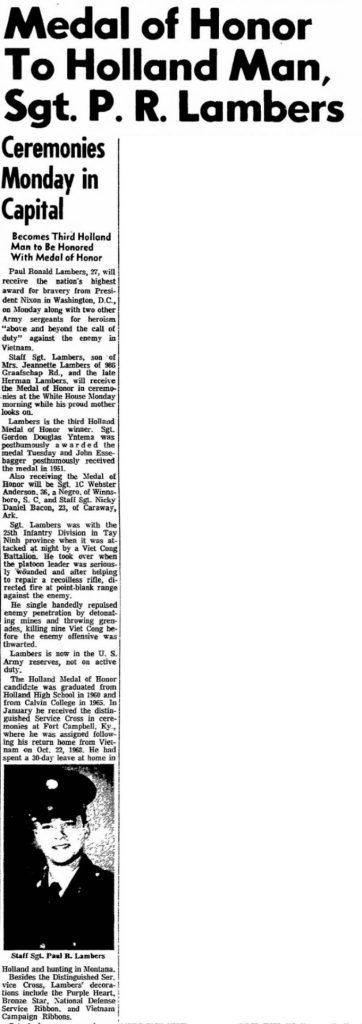
He attended Holland Christian High School, where he excelled academically and demonstrated leadership qualities that would later emerge so dramatically on the battlefield. He graduated in 1960 and continued his education at Calvin College, earning a Bachelors of Arts degree in 1965. Following graduation, he also attended the University of Michigan pursuing a Masters in Social Work before being drafted into military service according to The Holland Museum.
Under the specific rules of the Selective Service System when Lambers first enrolled in graduate school, he was initially eligible for and likely received a temporary graduate school deferment (classified as II-S). However, shifting draft laws during the Vietnam War are precisely why his studies were cut short.
When Congress passed the Military Selective Service Act of 1967, a temporary buffer was put in place via Executive Order 11360. This order granted a one-year-only deferment to male students who were entering their first year of graduate school in the Fall of 1967, provided they were enrolled by October 1, 1967. This protected Lambers through the 1967–1968 academic window. The overarching strategy of the Johnson Administration was to close loopholes that allowed affluent men to completely avoid service by remaining in school indefinitely. On February 16, 1968, the Selective Service announced a major policy shift following recommendations from the National Security Council. Post-graduate draft deferments were completely abolished for the vast majority of fields. Deferments were strictly limited to students pursuing professions in fields deemed critical to the national interest, exclusively defined as medicine, dentistry, veterinary medicine, osteopathy, and optometry.
Because Lambers was in the School of Social Work pursuing a degree in community organization—a field no longer qualifying for an exemption—his II-S draft deferment expired at the end of his academic term. Compounding the problem, the draft system at the time operated on an “oldest men first” basis within the 19-to-25 age pool. As a college graduate in his early 20s whose deferment had just been stripped away, Lambers became a prime target for induction. He was drafted into the U.S. Army later in 1967, ultimately deploying to Vietnam.
Friends and family remembered Lambers as intelligent, personable, and deeply committed to his beliefs. Nothing in his early life suggested that he would one day become one of Michigan’s most decorated combat heroes. Yet the qualities that later distinguished him in battle—calmness under pressure, concern for others, and personal courage—were already evident in his character.
Answering the Call to Serve
By the mid-1960s, the Vietnam War had become the defining military conflict for a generation of Americans. As U.S. involvement expanded, thousands of young men entered military service through enlistment or the draft. Like many educated young Americans of his generation, he faced difficult choices regarding military service. From burning draft cards to going to Canada to avoid the draft, men were considering their options. With his Holland roots, avoiding the draft was likely never a real consideration.
Ultimately, he chose to serve. Lambers entered the United States Army in May 1967, as a draftee with a two-year commitment. After completing his training, he was assigned to Company A, 2nd Battalion, 27th Infantry Regiment, part of the famed 25th Infantry Division. The 27th Infantry Regiment, known as the “Wolfhounds,” had a proud combat heritage dating back to the early twentieth century. In Vietnam, the regiment frequently operated in some of the most dangerous areas of the country, conducting search-and-destroy missions, security operations, and defensive actions against both Viet Cong and North Vietnamese forces.
Lambers quickly earned the respect of his fellow soldiers and superiors. His leadership abilities led to promotion to sergeant, and he became a key noncommissioned officer within his platoon. Those who served with him found him dependable, courageous, and steady in stressful situations. Those qualities would soon be tested.
The Battle at Tay Ninh Province
On the night of August 20, 1968, Lambers’ platoon occupied a defensive position astride a suspected enemy infiltration route in Tay Ninh Province, northwest of Saigon. The area was strategically important because enemy forces frequently used it to move troops and supplies toward major population centers.
The soldiers of Company A established their night defensive perimeter expecting possible enemy activity. What they encountered instead was a massive assault.
Under cover of darkness, an estimated Viet Cong battalion launched a coordinated attack against the American position. The enemy force greatly outnumbered the defenders and sought to overwhelm them through sheer weight of manpower and firepower. Mortars, automatic weapons, rockets, and small-arms fire rained down on the American perimeter.
Within moments, the platoon leader was seriously wounded during the initial assault. In the confusion and violence of the attack, leadership could easily have collapsed. Instead, Sergeant Paul Lambers stepped forward.
Assuming Command Under Fire
Recognizing the critical situation, Lambers immediately assumed command of the platoon. Rather than remaining in cover, he exposed himself to intense enemy fire to secure the platoon radio and establish communication with supporting forces.
Communications are the lifeline of any defensive battle. Without them, a unit cannot coordinate artillery support, request reinforcements, or direct friendly firepower. When his radio was disabled by enemy fire, Lambers again left cover and crossed the bullet-swept battlefield to obtain another radio from a nearby weapons crew.
His actions reflected more than bravery; they demonstrated tactical understanding and leadership. He understood that maintaining communication was essential to the survival of every soldier under his command. Meanwhile, the enemy assault intensified.
Fighting at Point-Blank Range
As waves of Viet Cong fighters pressed toward the perimeter, one of the Americans’ most important defensive weapons—a 90-millimeter recoilless rifle—malfunctioned. The weapon was critical because it could fire devastating canister rounds capable of stopping mass infantry attacks.
Disregarding his own safety, Lambers helped repair the weapon and directed devastating fire against enemy troops who had already breached portions of the defensive wire surrounding the position. The battle became increasingly desperate. Enemy soldiers penetrated the perimeter and began fighting at extremely close range. The recoilless rifle was eventually knocked out by hostile fire, eliminating one of the defenders’ strongest weapons. At that moment, many defensive positions might have collapsed entirely.
Instead, Lambers personally led the counterattack. He detonated Claymore mines directly into advancing enemy formations and hurled grenades into the attackers. Moving through intense fire, he repeatedly engaged enemy soldiers at close range, killing multiple attackers and helping seal breaches in the defensive line. His actions prevented the Viet Cong from overrunning the position. One soldier acting alone cannot normally stop a battalion-sized attack. Yet Lambers’ courage inspired the men around him to continue fighting despite overwhelming odds.
Five Hours of Leadership
The battle lasted approximately five hours. Throughout the engagement, Lambers moved from one fighting position to another, encouraging exhausted soldiers, directing fire, distributing ammunition, and reinforcing areas under the greatest pressure. He consistently placed himself in the most dangerous locations because that was where he was needed most.
Perhaps most remarkable was his management of supporting fires. Lambers personally directed artillery and helicopter gunship attacks onto enemy positions. At times, he called fire missions within five meters of friendly positions—a dangerously close distance requiring exceptional judgment and courage.
Such decisions carried enormous risk. A slight error could have resulted in friendly casualties. Yet Lambers understood that without aggressive use of supporting firepower, the defenders could be overwhelmed. His calculations proved correct. The artillery and helicopter attacks devastated enemy formations while preserving the American defensive line.
Caring for the Wounded
Heroism is often measured by battlefield achievements, but one of the most striking aspects of Lambers’ conduct was his concern for wounded comrades.
Repeatedly exposing himself to enemy fire, he moved across the battlefield to assist injured soldiers. He redistributed ammunition, rendered aid, and carried wounded men to safer positions whenever possible.
This willingness to risk his own life for others reflected the highest ideals of military service. Lambers was not motivated by personal glory. His focus remained on protecting the soldiers under his command and ensuring their survival.
By dawn, the enemy attack had failed. The vastly superior Viet Cong force suffered catastrophic losses. The American defenders had held their position, thwarting what was believed to be part of a larger offensive threat against Tay Ninh City. Military authorities later concluded that Lambers’ leadership and courage were instrumental in saving numerous lives and preventing a potentially significant enemy success.
Awarded the Medal of Honor
The Army recognized that Lambers’ actions far exceeded the requirements of duty. He was initially awarded a Distinguished Service Cross.
His conduct represented the very definition of conspicuous gallantry and intrepidity at the risk of life above and beyond the call of duty. Recommendations moved through military channels, and he was eventually selected to receive the Medal of Honor. On November 24, 1969, President Richard Nixon presented Staff Sergeant Paul Ronald Lambers with the Medal of Honor during a ceremony at the White House.
Paul Ronald Lambers Medal of Honor citation reads:
For conspicuous gallantry and intrepidity in action at the risk of his life above and beyond the call of duty. S/Sgt. (then Sgt.) Lambers distinguished himself in action while serving with the 3d Platoon, Company A. The unit had established a night defensive position astride a suspected enemy infiltration route, when it was attacked by an estimated Viet Cong battalion. During the initial enemy onslaught, the platoon leader fell seriously wounded and S/Sgt. Lambers assumed command of the platoon. Disregarding the intense enemy fire, S/Sgt. Lambers left his covered position, secured the platoon radio, and moved to the command post to direct the defense. When his radio became inoperative due to enemy action, S/Sgt. Lambers crossed the fire-swept position to secure the 90-mm recoilless-rifle crew’s radio in order to re-establish communications. Upon discovering that the 90-mm recoilless rifle was not functioning, S/Sgt. Lambers assisted in the repair of the weapon and directed cannister fire at point-blank range against the attacking enemy who had breached the defensive wire of the position. When the weapon was knocked out by enemy fire, he singlehandedly repulsed a penetration of the position by detonating claymore mines and throwing grenades into the midst of the attackers, killing four more of the Viet Cong with well-aimed hand grenades. S/Sgt. Lambers maintained command of the platoon elements by moving from position to position under the hail of enemy fire, providing assistance where the assault was the heaviest and by his outstanding example inspiring his men to the utmost efforts of courage. He displayed great skill and valor throughout the five-hour battle by personally directing artillery and helicopter fire, placing them at times within five meters of the defensive position. He repeatedly exposed himself to hostile fire at great risk to his own life in order to redistribute ammunition and to care for seriously wounded comrades and to move them to sheltered positions. S/Sgt. Lambers’ superb leadership, professional skill, and magnificent courage saved the lives of his comrades, resulted in the virtual annihilation of a vastly superior enemy force, and were largely instrumental in thwarting an enemy offensive against Tay Ninh City. His gallantry at the risk of his life is in keeping with the highest traditions of the military service and reflects great credit upon himself, his unit, and the U.S. Army.
For the young man from Holland, Michigan, the award represented not only personal recognition but also recognition of the sacrifices made by his fellow soldiers. Like many Medal of Honor recipients, Lambers remained humble about his accomplishments and viewed the award as a tribute to the men with whom he served. The medal placed him among the most distinguished combat veterans in American history.
A Tragic Death
Lambers returned to Holland on a 30-day leave with plans to do some hunting in Montana. On December 1, 1970, less than a year after receiving the Medal of Honor, Lambers was walking along the south breakwater at Holland Harbor on the shore of Lake Michigan. A popular and picturesque vantage point looking into the majesty of Mishigami as named by the Ojibwe, meaning “great water”. The iconic 1907 Holland Harbor Lighthouse is at the end of the breakwater and known as “Big Red”.
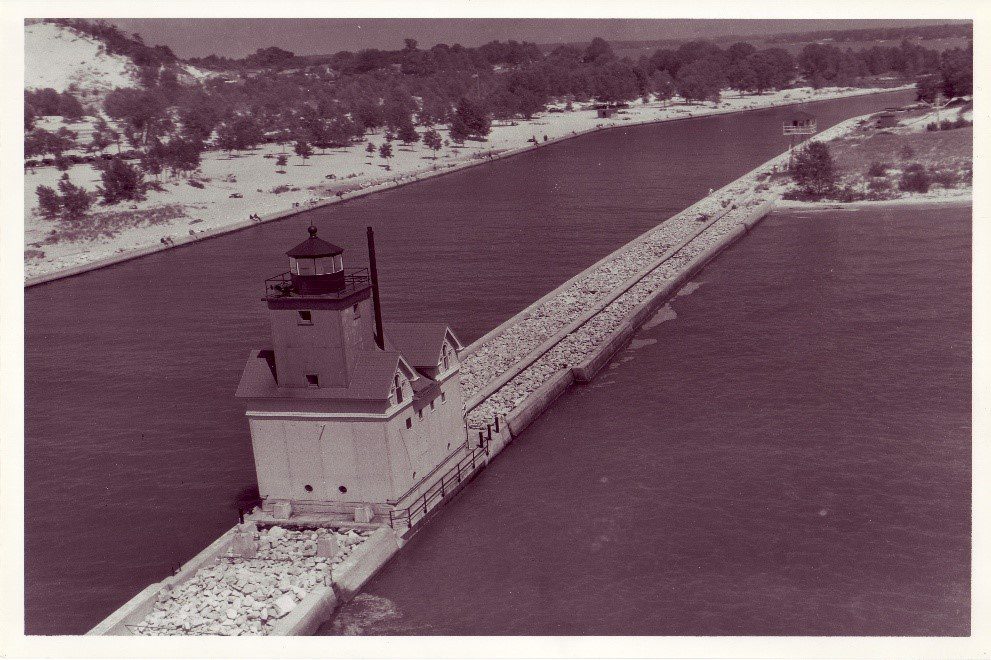
(Public Domain Statement)
It was an unusually warm day, the air temperature in the region surrounding Holland and Grand Rapids, Michigan, reached a high of 62°F (16.7°C). However, near the shore, water temperatures in Lake Michigan were holding in the low to mid 40s.
This unusually warm air mass was part of the same intense, turbulent weather system mentioned in your research, which triggered severe gale-force winds across Lake Michigan and an incredibly rare December tornado outbreak in the Upper Midwest. As the cold front aggressively pushed through later that day, temperatures dropped rapidly.
The powerful storm system generated gale-force winds and enormous waves across Lake Michigan. The weather conditions quickly turned unusually severe, creating dangerous conditions along the shoreline.
As Lambers walked along the breakwater, massive waves crashed over the structure. One of those waves swept him into the frigid waters of Lake Michigan. Despite search efforts, rescuers were unable to recover him. The violent conditions that had claimed his life also prevented recovery of his body. He was only twenty-eight years old.
The irony was heartbreaking. A man who had survived a battalion-sized assault in Vietnam, who had repeatedly exposed himself to enemy fire to save others, and who had received the nation’s highest military honor, was lost to the power of nature on the shores of his hometown. The world lost a man of valor but also compassion. He wanted to be a social worker and help others; a trait demonstrated in the jungle protecting troops and helping wounded battle buddies.
Legacy
Today, Paul Ronald Lambers remains one of Michigan’s most celebrated military heroes. His Medal of Honor is displayed at the Michigan’s Heroes Museum in Frankenmuth, Michigan, where visitors can learn about his extraordinary service and sacrifice.
More than half a century after his heroic actions in Vietnam, Paul Ronald Lambers continues to stand as a symbol of the finest qualities of the American soldier. From the classrooms of Holland Christian High School and Calvin College to the battlefields of Vietnam and the White House ceremony where he received the Medal of Honor, his life was marked by service and courage.
Though his years were few, his legacy endures. Michigan remembers him as a hometown son. The Army remembers him as a warrior and leader. The nation remembers him as a Medal of Honor recipient whose actions under fire saved countless lives and exemplified valor in its purest form.
About James G. Fausone, Esq.
James G. Fausone, Esq. is a partner with Legal Help For Veterans, PLLC, with over twenty years of experience helping veterans apply for service-connected disability benefits and starting their claims, appealing VA decisions, and filing claims for an increased disability rating so veterans can receive a higher level of benefits.
If you were denied service connection or benefits for any service-connected disease, our firm can help. We can also put you and your family in touch with other critical resources to ensure you receive the treatment you deserve.
Give us a call at (800) 693-4800 or visit us online at www.LegalHelpForVeterans.com.
This electronic book is available for free download and printing from www.homeofheroes.com. You may print and distribute in quantity for all non-profit, and educational purposes.
Copyright © 2018 by Legal Help for Veterans, PLLC
ALL RIGHTS RESERVED